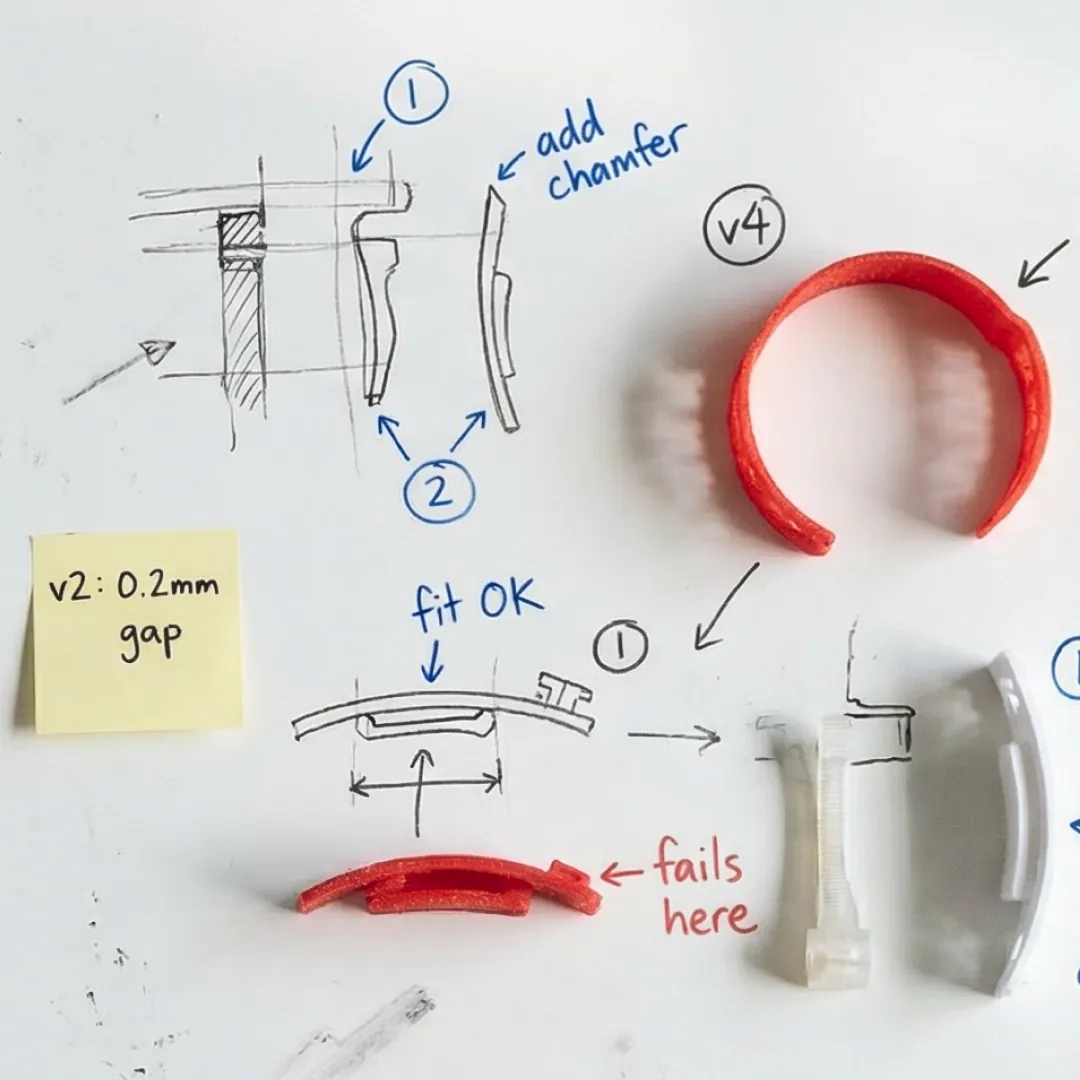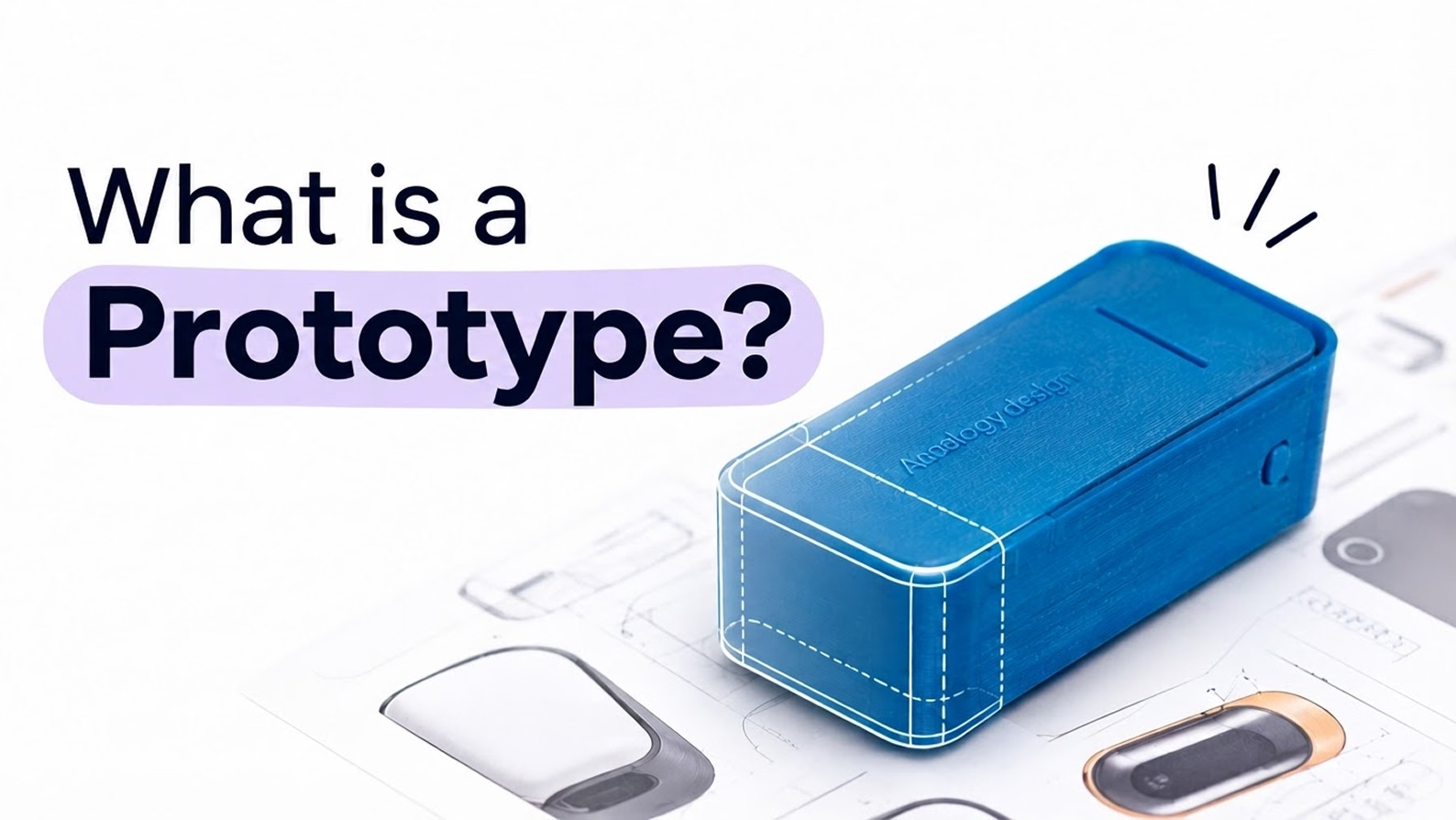
A prototype is anything you build to find out something you don't yet know about your product, before you spend money on tooling. It can be a cardboard box, a breadboard full of wires or a 3D-printed shell with nothing inside. For hardware founders, the right first prototype tests your riskiest assumption at the lowest cost. It is rarely the polished, all-in-one model most people picture.
Imagine a founder in Bengaluru with an idea for a countertop device that tells you when your drinking water is no longer potable. She has the sketches, a slide deck and a friend who knows a vendor in Peenya. Six months and a few lakhs later, she's got a lovely object: a matte white shell with a soft blue ring of light. Then she plugs it in. The sensor reads tap water and mineral water as the same. The shell has no room for the larger sensor that would work. The first three people she gives it to all try to open it from the wrong side.
Nothing about her idea was wrong. What went wrong was the order of the questions. She built an answer to what it would look like before she'd even asked whether it would work or whether people would understand it. That's the most common way first-time hardware founders lose time and money, and it almost always starts with a misunderstanding of one word: prototype.
Key takeaways:
- A prototype is a question you can hold: build it to learn one thing, not to impress.
- Name the question first (role, look and feel, implementation or integration), then build the cheapest prototype that answers it.
- Split looks-like and works-like builds early; combine them only once both are proven.
- Match fidelity to the question. Rough objects get more honest feedback.
- Set pass and fail criteria before you build, not after.
What Is a Prototype? A Question You Can Hold
The textbook definition is that a prototype is an early version of the product, built to test the concept before full production. That's true, but it's not very helpful. It leads you to think of a prototype as a draft of the final product, something you keep refining until it becomes the product.
A better definition: a prototype is a tangible question. It's anything you build, however crude, in order to find out something you don't yet know. A cardboard box with a hole in it can be a prototype. So can a breadboard full of wires, a 3D-printed shell with nothing in it, or a spreadsheet that models battery life.
This isn't a new idea. In 1997, two Apple designers, Stephanie Houde and Charles Hill, published a short chapter, What Do Prototypes Prototype? (Houde and Hill, 1997). They argued that we should stop describing prototypes by what they are (paper or plastic, rough or smooth) and start describing them by what they are trying to find out. That's still the most cogent view today.
It also helps to know what a prototype is not:
- It's not the product. It can be ugly, fragile and very expensive per unit. Its job is to teach you something; it's not there to be sold.
- It's not a sample. A sample is taken off the production line to show what the manufacturing process can produce. A prototype comes before the production line exists.
- It's not an MVP. An MVP goes to real paying users to test the business. A prototype tests the idea. The two overlap late in development, and our product MVP validation framework covers the MVP side.
Hold onto the definition. Every decision from here on comes back to one question: what are we trying to learn with this prototype?
Why Hardware Raises the Stakes
Software founders can ship on Monday, read the complaints on Tuesday and push a fix by Wednesday. Hardware doesn't work like that. Once you cut a steel mould for injection moulding, you can't just change a wall thickness or move a screw boss. That's not a click. That's weeks of rework and a bill that can easily run into the lakhs.
That's why engineers and designers commit to cost long before they spend any money. Decades of research into product cost have produced the same result: some 70–80% of a product's cost is set during the design phase, even though only a tiny proportion of it has been spent at that point (Fuh, Fu and Nee, 2004). Geoffrey Boothroyd and Peter Dewhurst, who laid the foundations of Design for Manufacture and Assembly, spent their careers on that very point (Boothroyd, Dewhurst and Knight, 1991).
Read that number again from a founder's side of the table. By the time you're paying for tooling, most of your product's cost is already set. The material, the number of parts and how they fit together (snap fits, screws) were all decided in the sketches and models that came before.
Prototyping is where you can afford to change your mind. Every question you answer with foam, cardboard or a ₹2,000 (about $20) 3D print is a question you won't have to answer with a ₹10 lakh (about $10,500) mould. That's the real economics of prototyping: spend a little early to save a lot later. It's also why prototyping and Design for Manufacture are two sides of the same coin, which we cover in detail in our guide to design for manufacturing.
The Four Questions a Prototype Can Answer
Houde and Hill's (1997) model is simple enough to draw on a napkin. Every prototype answers at least one of three questions: role, look and feel, or implementation. A fourth kind, integration, brings all three together. For hardware founders, that translates to:
Role: does it matter to anyone?
What does the product actually do in a person's life? Do they want it? A role prototype doesn't need to work or look good. It just needs to let someone imagine themselves using it. A founder designing a pill organiser for elderly parents might give five families a shoebox with labelled compartments and see what they do with it over a week. If no one opens it after three days, no amount of engineering will save the concept.
Look and feel: what is it like to live with?
This is the tangible experience: size, weight, texture, colour, the sound of a button being pressed, how it feels in the hand or on the table. Look-and-feel prototypes are where industrial design does its job. As Houde and Hill (1997) point out, people are naturally drawn to them, because appearance is the easiest thing to form an opinion on.
Implementation: will the technology actually work?
Can the sensor do what it claims? Will the battery last a day? Does the motor overheat? Implementation prototypes are a mess of wires and development boards, and that's the point. Their only job is to prove the physics and the electronics.
Integration: does it all fit together?
The fourth type brings role, look and feel, and implementation into a single object. It's the prototype most founders picture when they hear the word, and the one they most often try to build first. It should usually be the last.
One caveat: Houde and Hill wrote about software and interactive systems. Does the model hold for physical products? An undergraduate thesis at MIT tested it on 10 physical prototypes from a mechanical engineering design course and found that it held, with only a few caveats (Hernley, 2011). For hardware founders, that's reassurance enough. Before you build anything, name which of the four questions it answers. If you can't, you're not ready to build it.
Types of Prototypes: The Hardware Prototype Family
Once you know the question, picking the right type of prototype becomes much easier. The hardware world uses a fairly standard set of terms, and you'll hear them from every engineer, manufacturer and investor you meet.
| Prototype | Question it answers | Typical tools and materials | When |
|---|---|---|---|
| Sketch or block model | Role, rough form | Paper, foam, cardboard, clay | Day one |
| Proof of concept (POC) | Implementation: can the core idea work at all? | Arduino, Raspberry Pi, off-the-shelf modules, breadboards | Early |
| Looks-like | Look and feel | 3D printing, CNC machining, foam, paint and finish | Early to mid |
| Works-like | Implementation, in more depth | Custom PCB, real components, often oversized | Mid |
| Works-like-looks-like (engineering prototype) | Integration | Custom electronics inside a near-final enclosure | Mid to late |
| Validation builds (EVT, DVT, PVT) | Can it be made reliably, at volume? | Production-intent parts, soft and then hard tooling | Late |
Proof of concept: the early, honest one
A proof of concept will almost never work exactly like the final product, and it almost certainly won't look like it. For most electronic products, you'll build it on a development kit such as an Arduino or Raspberry Pi. Its job is narrow and urgent: prove that the most difficult technical claim in your pitch is achievable (Teel, 2019).
Looks-like vs works-like prototypes
This is the single most important idea in early hardware prototyping. Instead of building one object that does it all, you build two: a looks-like prototype focused on form, feel and aesthetics, and a works-like prototype focused on function. The looks-like prototype is usually 3D printed, CNC machined, or made from foam or clay. The works-like prototype will look nothing like the final product (Teel, 2017).
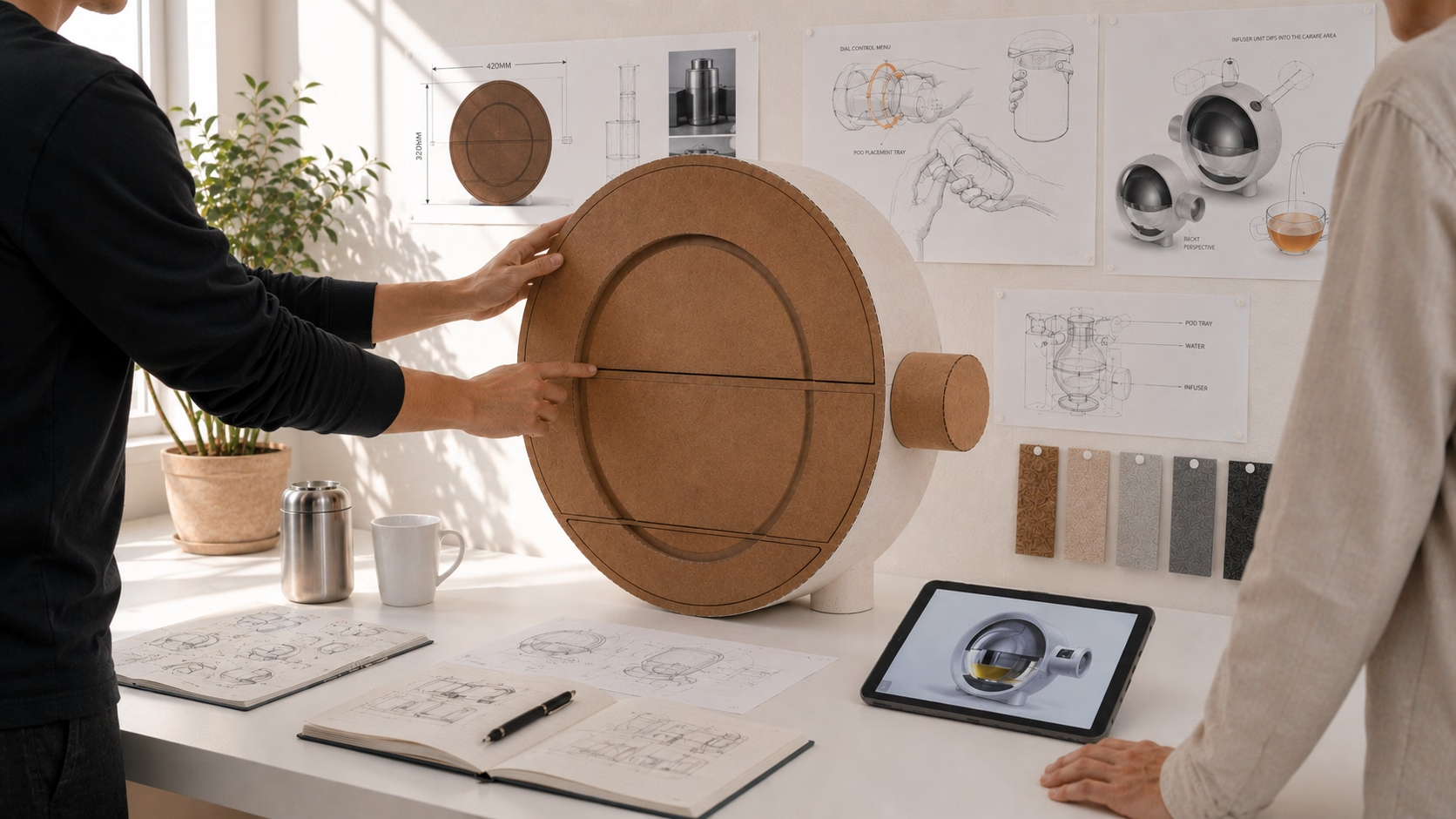
Why split them? Because the two questions move at very different speeds and need very different skills. You can iterate on form in days with a 3D printer. Electronics take weeks, and the move from a development kit to a custom PCB is a big leap in engineering skill. Tie them together too early and each will wait for the other.
Which should come first? John Teel, an electronics engineer who writes widely for hardware startups, has a sensible rule (Teel, 2017). If aesthetics are the big risk, start with a looks-like. If the technology is the big risk, start with a works-like. If neither is, go straight to a combined prototype. In our experience, most first-time founders underestimate how uncertain their technology is.
Engineering prototype: where the two meet
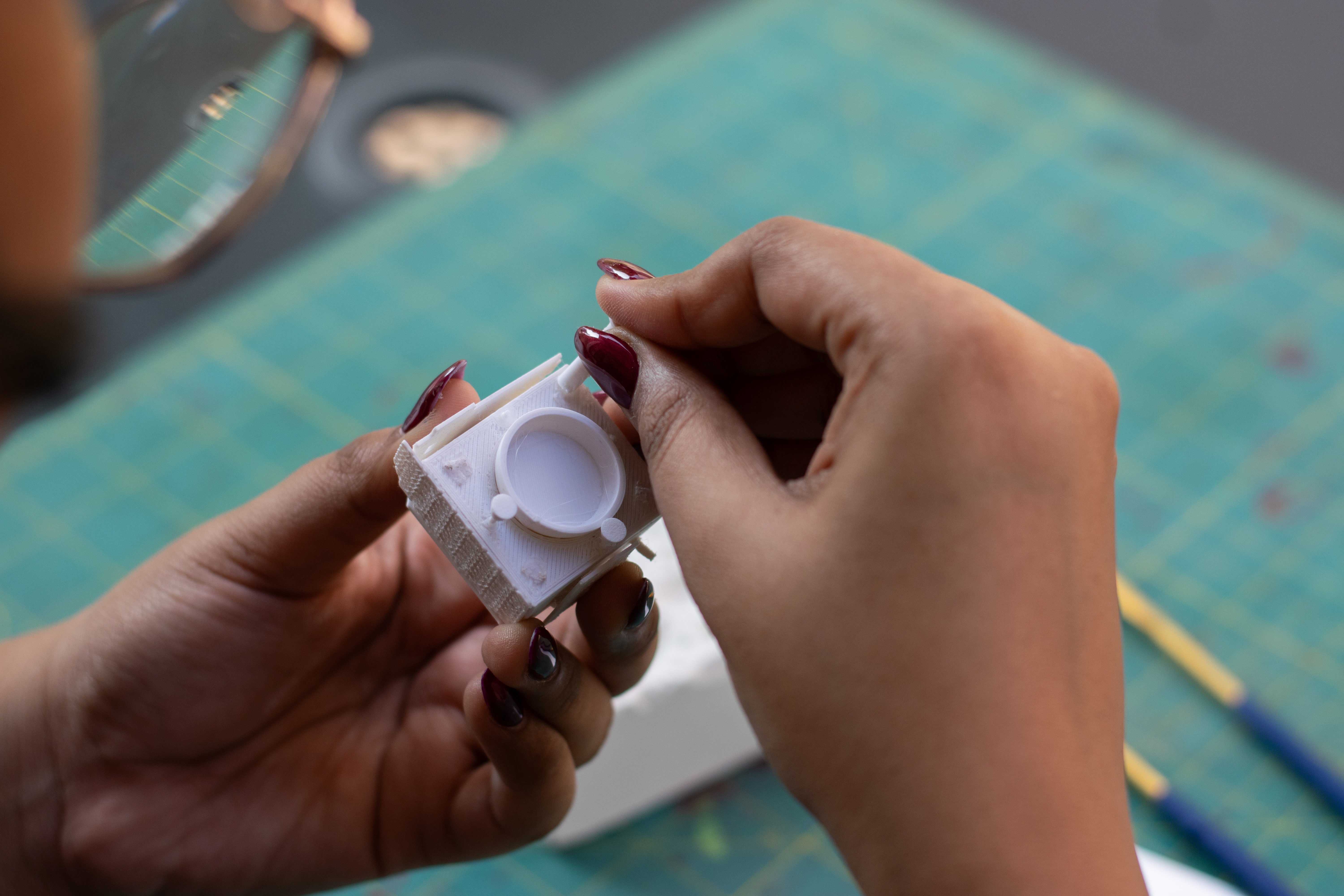
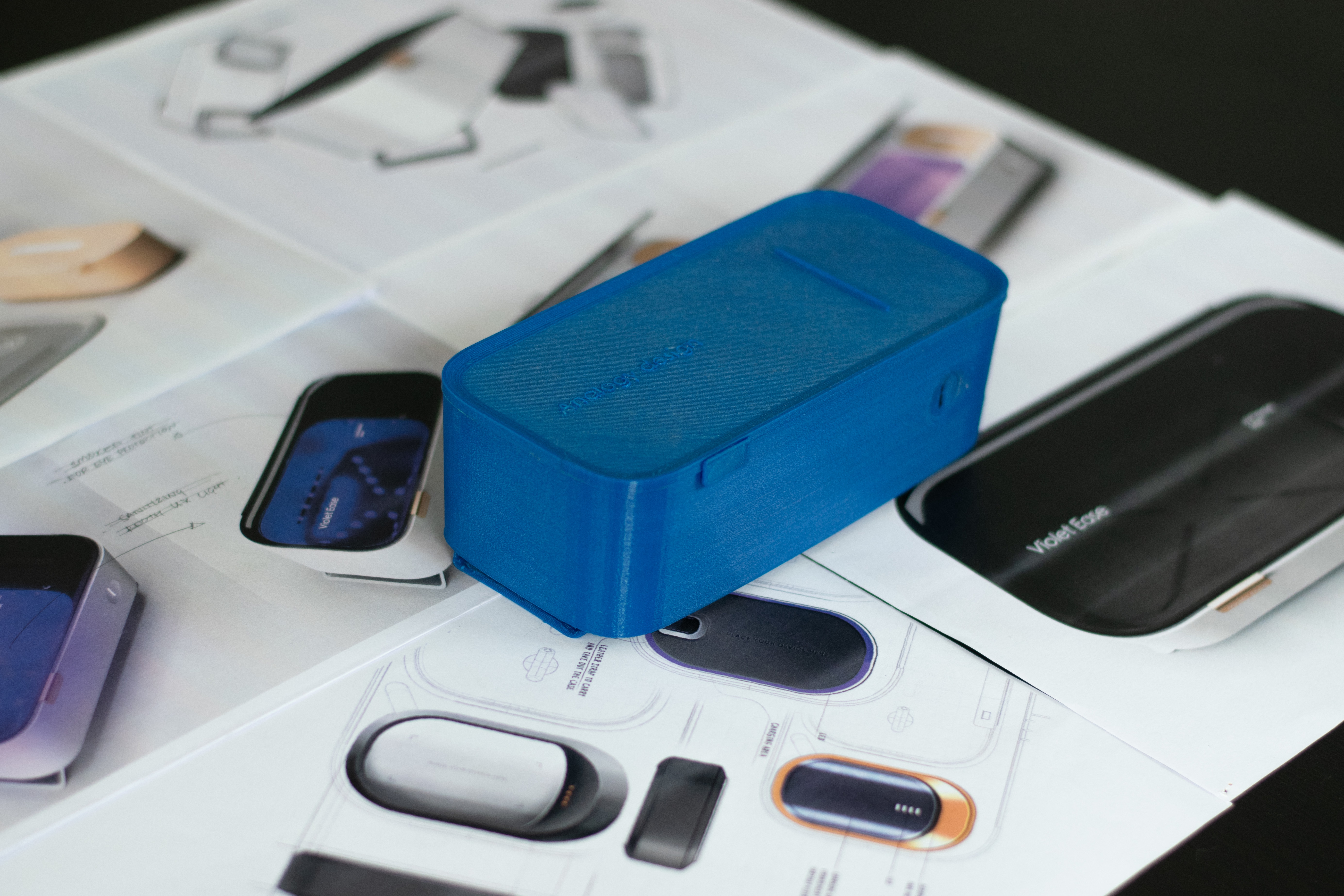
The engineering prototype, or works-like-looks-like, is the first time the product's appearance and function exist in one object (Teel, 2019). It's usually when you discover what you got wrong, as you try to fit bulky works-like electronics into a slim looks-like shell. Far better to find out now than in a steel mould.
Validation builds: EVT, DVT and PVT
Beyond that point, hardware teams go through a sequence of builds with three-letter names: EVT (Engineering Validation Test), DVT (Design Validation Test) and PVT (Production Validation Test). They're less about learning what to build and more about proving you can build it, again and again, to the same standard. Anna-Katrina Shedletsky of Instrumental, a product design engineer herself, has written the clearest guide we've found to these stages (Shedletsky, 2023). Our hardware product development process guide covers the full road from prototype to production.
How Finished Should a Prototype Look?
Fidelity is how closely a prototype resembles the real thing. Low fidelity is foam and tape. High fidelity is a painted, textured shell you could mistake for a retail product. First-time founders almost always go for high fidelity too early, and it's easy to see why: a high-fidelity prototype looks like progress.
But fidelity should match the question, not your ambition. A shoebox will answer "would people use this?" just as well as a ₹50,000 (about $500) model, and often better, because people are more honest about a rough object. Show them a finished product and they'll critique the colour. Show them a rough one and they'll tell you whether they actually need it.
Investors know this too. A hardware investor who has funded products before will see straight through a beautiful shell with nothing inside. A nice-looking prototype with nothing proven underneath worries them more than an ugly one that clearly works (Flynn Product Design, 2026). If you're prototyping to raise money, the "works" question usually matters far more than the "looks" question. Our guide to what investors want from hardware startups covers the rest of that checklist.
There's also a quieter, more personal cost. IDEO has a rule its designers call Boyle's Law: never go to a meeting without a prototype. Yet Tom and David Kelley of IDEO also point out that the more you invest in a prototype, and the closer it gets to the final product, the harder it is to let go of a concept that isn't working (Kelley and Kelley, 2013). A cheap prototype is easy to throw away. An expensive one resists, and starts making decisions for you.
Five Prototyping Mistakes We See Again and Again
- Building one hero prototype. The founder in our opening story made this mistake. One object built to answer every question at once usually answers none of them well, and it's the most expensive thing to change. Several small, focused prototypes almost always teach you more for less.
- Asking the wrong prototype the wrong question. A looks-like model won't tell you anything about battery life. A breadboard won't tell you whether the product feels cheap in the hand. Using one to judge the other leads to false confidence, then rework.
- Polishing before proving. Paint, texture and a perfect logo are the last things to spend money on in a prototype. Pay for finish only once you've proven the role and the implementation.
- Confusing a working prototype with a manufacturable part. A part that comes out perfectly on a 3D printer may be impossible to injection mould. Undercuts, wall thickness and draft don't matter to a 3D printer, but they're critical for moulding. This is where design for manufacturing comes in, and it needs to join the conversation much earlier than most founders expect.
- Building without pass or fail criteria. If you haven't decided in advance which outcome would make you change course, every outcome will look like a success. Write down what success looks like before the prototype exists.
How to Plan Your First Prototype
Before you spend a single rupee, sit down with your co-founder or design team and work through these six steps. It takes an afternoon, and it can save you months.
- List your assumptions. Write down everything that has to be true for your product to work. That people want it. That the sensor works. That it fits in a pocket. That it can be made for less than a target cost.
- Rank them by risk. Which assumption, if wrong, would kill the whole proposition? That's the one your prototype should test.
- Name the question type. Is it role, look and feel, implementation or integration? That tells you what kind of prototype you need.
- Choose the cheapest form that can answer it. Foam before plastic, development kit before custom board, one unit before ten.
- Set pass and fail criteria. Be specific. "Four out of five users open it correctly without help" is a test. "People like it" is not.
- Decide what happens next. Know your next move for each outcome before you see the result. A pass takes you to the next riskiest assumption. A fail sends you back to rethink, and that's a good outcome, because it's a cheap rethink.
Once you know what to build, our step-by-step guide to hardware prototyping covers how to build it.
How Analogy Helps Founders Sequence Prototypes
Go back to our founder and her water monitor. If she'd started with a shoebox and five households, a breadboard, a few water samples and some foam shapes on a kitchen counter, she'd have known in weeks what took her six months to find out. The concept would have been the same. The cost of learning would have been far lower.
That's what a prototype is for. It's not to impress or to finish. It's to find out what matters, when it matters, at the lowest possible cost. You build to answer questions, and the product evolves around the answers.
At Analogy Design, we sequence prototypes so each one buys down a specific risk before you spend the next rupee. In our prototype development work, every round starts with one question (form, fit, function or all three) and ends with a written review of what worked, what failed and what changes next. Most new products need three to five rounds before they're ready for manufacturing.
For Aditya Scientific's rotary evaporator, that approach took the product from concept to a working prototype in nine months. For Agnisumukh's commercial stove, burner and grid prototypes were tested in real kitchens.
If you have an idea and aren't sure what to build first, that's exactly the conversation we like to have. Tell us what you're building.
Frequently Asked Questions About Prototypes
What is the difference between a prototype and an MVP?
A prototype tests whether your idea works: the mechanism, the form, the experience. An MVP is the simplest version you can put in front of paying customers to test whether the business works. In hardware the two overlap late, when a production-intent prototype is good enough to sell in small numbers. Our prototype and MVP service covers both stages.
How much does a prototype cost?
It depends on what the prototype has to prove. Typical ranges are $300–$2,000 for a looks-like model, $2,000–$20,000 for a works-like model and $30,000–$150,000+ for a production-intent build. Connected products add $5,000–$30,000 for the PCB, sensors and firmware. Our prototype cost guide breaks down each stage.
How long does it take to build a prototype?
A proof of concept for a simple mechanical product can take two to four weeks. A single prototype round, from defining the question to testing the build, usually takes a few weeks. A full engineering and prototyping phase, with several rounds, testing and a first bill of materials, usually takes 8–14 weeks. Electronics and custom mechanisms add time.
How many prototypes does a hardware product need?
Most new products go through three to five prototype rounds before they're ready for manufacturing, moving from rough proofs of concept to a production-intent build. The count depends on how many open questions you start with. Giving each round one named question, with pass and fail criteria, usually keeps the number down.
Should I 3D print my first prototype?
Often, yes, if the question is about form and fit. 3D printing is the fastest, cheapest way to test size, shape and feel. It can't tell you whether a part can be injection moulded, so check draft, wall thickness and undercuts before treating a printed part as final. Use CNC machining for precision or metal parts.
Sources
- Boothroyd, G., Dewhurst, P. and Knight, W.A. (1991) Research program on the selection of materials and processes for component parts. International Journal of Advanced Manufacturing Technology, 6(2), pp. 98–111.
- Flynn Product Design (2026) What do investors actually want to see from a hardware startup before funding it? Cambridge Network, 1 July.
- Fuh, J.Y.H., Fu, M.W. and Nee, A.Y.C. (2004) Early cost estimation of injection moulds. In Computer-aided injection mould design and manufacture. Boca Raton, FL: CRC Press.
- Hernley, L.R. (2011) An analysis of early stage prototypes using implementation, look and feel, and role. SB thesis, Massachusetts Institute of Technology.
- Houde, S. and Hill, C. (1997) What do prototypes prototype? In Helander, M.G., Landauer, T.K. and Prabhu, P.V. (eds) Handbook of human-computer interaction. 2nd edn. Amsterdam: Elsevier, pp. 367–381.
- Kelley, T. and Kelley, D. (2013) Creative confidence: unleashing the creative potential within us all. New York: Crown Business.
- Shedletsky, A. (2023) EVT, DVT, PVT stage gate definitions. Instrumental, 4 August.
- Teel, J. (2017) How to prototype your new electronic hardware product. Hackster.io.
- Teel, J. (2019) Overview of the various types of hardware prototypes. Hackster.io.
Ready to build?
Tell us what you're building.
We'll tell you where the real risks sit in your specific product and what it would take to ship it, concept to production.