Manufacturing for production readiness

Design for Manufacturing, cost control and reliable scale without last minute surprises.

Assess your Manufacturability
Close-up of hands assembling a black speaker with visible green circuit board and copper foil inside.
Detailed transparent 3D CAD model of a mechanical cylindrical component showing internal threading and a small brass connector.

DFM Solutions For Founders Who Want to Scale Smart

Scaling an unplanned product multiplies every design mistake.

Design for Manufacturing Services By Analogy Design

The Challenge

Manufacturing doesn’t fail suddenly,
It fails quietly through small design decisions. Tolerances, part counts, materials, and assembly choices made early can multiply costs, delays, and defects at scale.

Don’t Let Small DFM Mistakes Become Expensive Ones

De-risk My Manufacturing Plan

This is most suited for

Founders preparing for Production
Founders onboarding vendors
Companies planning to Scale-up
Startups moving Ideas to Production
Our Design for Manufacture service is perfect for teams who want to launch faster, cut costs & scale smarter without compromising on quality.
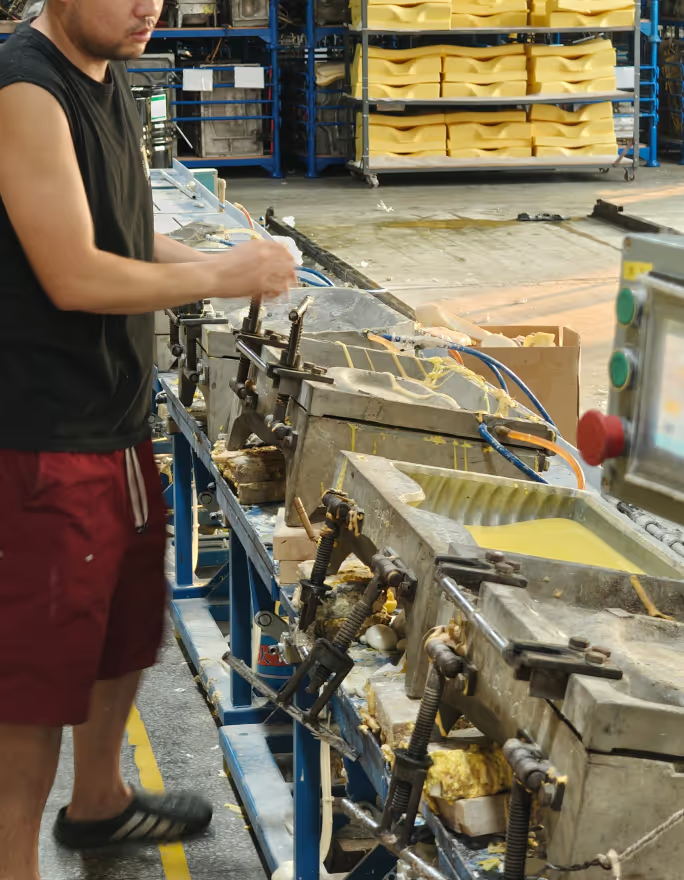
Technical design and 3D renderings of a phone case with labeled dimensions, texture details, and a green strap attached.Factory worker operating machinery with yellow foam mold trays on a production line.Design for Manufacturing Services By Analogy Design
Design for Manufacturing
  • What it delivers: Lower part count, predictable tooling, and cleaner assembly looking at Complete manufacturing drawings, Specifications, Assembly instructions and quality checkpoints.
  • Production tooling recommendations and requirements
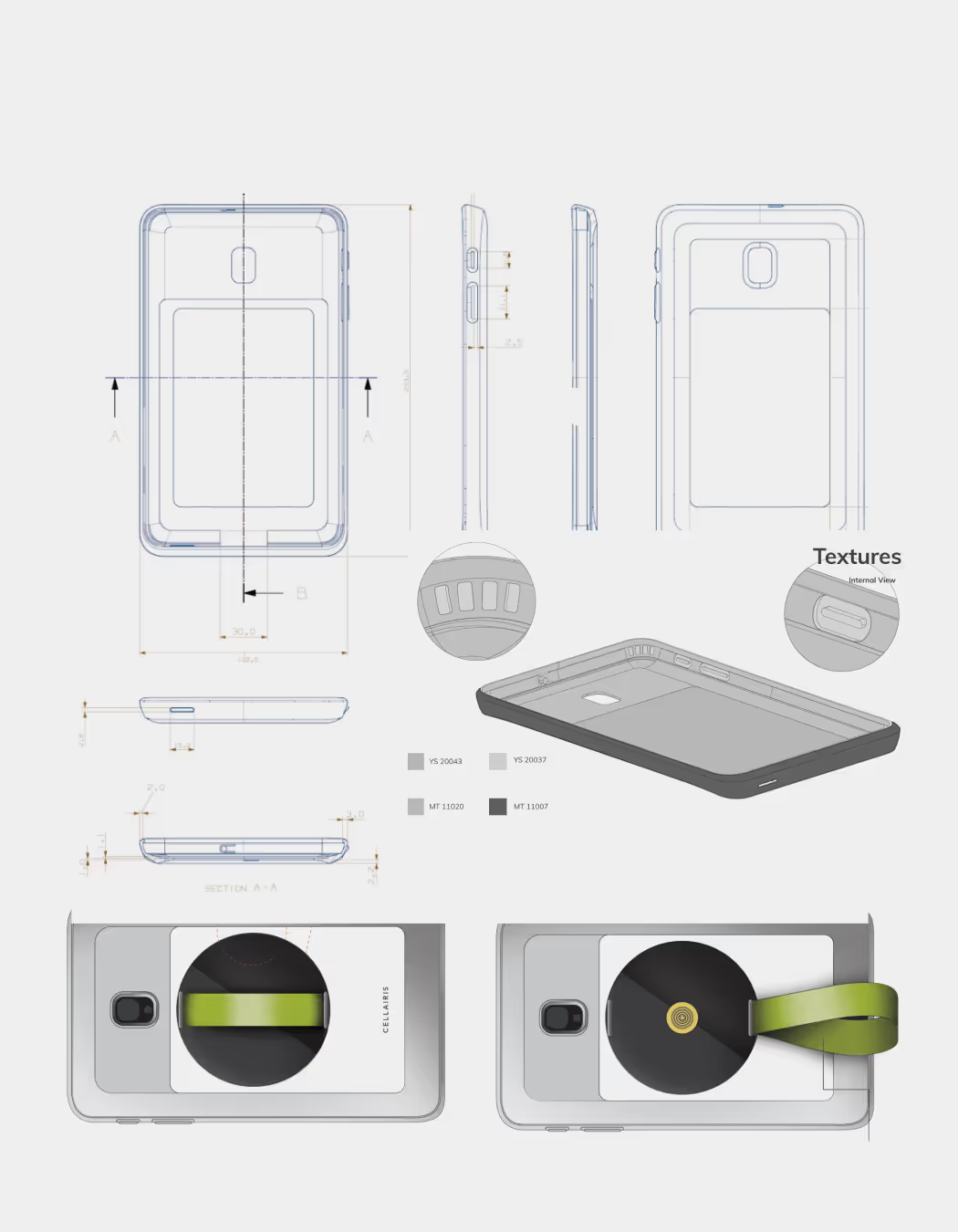
Technical and textured design blueprints and 3D renderings of a rectangular electronic device case with a circular black and green component on the back labeled 'CELLARIS'.
Vendor Identification & Onboarding
  • What it delivers: Fewer vendor iterations and faster onboarding. Material selection for cost-efficiency and performance.
  • Component consolidation to reduce assembly complexity
  • Tolerance analysis to prevent costly production errors
Worker operating molds on an industrial production line with yellow material inside, in a factory setting.
Tooling & Process Validation
  • What it delivers: Reduced rework, scrap, and production delays. This will involve Custom QC protocols tailored to your product
  • Sample batch testing and iteration cycles
  • Production timeline optimization with buffer planning
get mfg roadmap
get mfg roadmap
Design for Manufacturing Services By Analogy Design
Circle Blur

Now for the numbers & risk mitigation

Request a DFM Consultation

Products engineered to survive tooling, scale & real world use

40–60%

Average reduction in part count

Improves manufacturability and assembly efficiency

95%

First pass factory acceptance rate

Indicates production ready design maturity

30%

Average tooling cost optimisation

Direct financial benefit before scale

100+

Vendors evaluated across regions

Demonstrates supply chain depth and flexibility

0

Recalls caused by DFM oversight

Trust built through prevention

IN+CHN

Manufacturing ecosystems leveraged

Geography used as a strategic advantage
Man wearing a white collared shirt with a pen in the pocket against a dark background.
Joseph Brown
Chief Product Officer, Cellairis Global
Get in touch
“Analogy Design helped Cellairis develop new product lines and an interconnected ecosystem for enterprise customers. Their team provided expert guidance on manufacturing requirements, ensuring smooth collaboration and clear communication throughout the project.”
Man wearing a white collared shirt with a pen in the pocket against a dark background.
Pankaj Jamwal
NPD Lead, CG Global
Get in touch
“The experience with Analogy was excellent. I’d rate it 9 out of 10. They have good talent, leadership, and management, and they think deeply about technology and market research. They’re the best consultancy I’ve worked with.”
Man with dark hair and beard wearing a black jacket with crossed arms against a dark background.
Anurag Srivatsava
Product Lead, Panasonic Smart devices
Contact Us
“Analogy brought innovation, passion, and commitment to the table, not only creating a best-in-class Smart Product experience that left our customers are mesmerized with every day, but also designing an experience that is award winning.”
Middle-aged man with glasses and gray hair wearing a blue denim shirt, smiling with arms crossed against a dark background.
Vivek Madappa
Founder, Mobident Dental Solutions LLP
Contact Us
"Meeting Analogy was transformative. Their honesty and acknowledgment of project complexity were refreshing. Their market research and design approach are top-notch, but their real strength lies in translating vision into practical engineering. Under VT's leadership, Analogy's talent is unparalleled. For world-class product design that works, choose Analogy."
Smiling man in a navy blue polo shirt with arms crossed against a dark background.
Sanjay Parekh
Founder, Eume & Avon Lifestyle, Pvt Ltd
Contact Us
“We wanted to create the worlds first massage backpack and we started with Analogy with an idea and they helped us develop the entire brand message, product design with the patented back mechanism as well as the crowdfunding campaign that hit the funding goal is less than 12 hours. We would love to work with them again”

Client Success Powered By Manufacturing Readiness

Learn more about Our Service here

Design For Manufacturing Services By Analogy Design

Our DFM service helps you transition from concept success to manufacturing confidence. With expert DFM engineering, founders eliminate hidden risks early and optimize every detail for cost, durability, and repeatability. When you're ready to go beyond “it works” and move toward “we can build thousands flawlessly,” DFM becomes your competitive advantage. Our DFM service ensures your product is not just manufacturable, but manufacturable intelligently. We evaluate tooling needs, production methods, quality checkpoints, and supplier constraints to design a build process that works from batch one to batch one-thousand. Every decision is rooted in performance, cost optimization, and long-term reliability.

By treating Design for Manufacturing as a strategic step, not an afterthought, you avoid costly redesigns and protect your timeline.

Most founders underestimate how dramatically manufacturing changes the product, and that’s where DFM consulting becomes essential. Materials behave differently in volume, tolerances become tighter, and assembly steps can multiply costs if not planned early. Through rigorous Design for Manufacturing analysis, we refine your product to avoid errors that only appear on the factory floor. The goal is simple: reduce complexity, improve efficiency, and ensure predictable production at scale. With the right DFM engineering strategy, you launch faster, smoother, and with fewer iterations. This is where engineering precision, manufacturing constraints, and real-world feasibility come together to shape a product built for mass production.

If you’re preparing to scale, DFM is the step that turns a proven idea into a production-ready reality.

Scaling Starts With Manufacturing Intelligence

Scaling a hardware product demands more than a functional prototype. It requires DFM solutions engineered for precision, efficiency, and repeatability. Our Design for Manufacturing approach helps founders remove production risks long before they appear on the assembly line. Through structured DFM engineering, we refine every part, material, and tolerance to ensure your product is ready for volume without hidden surprises. This is where smart scaling begins: with decisions grounded in manufacturability, not assumptions. When founders treat DFM as strategy, the path to mass production becomes faster and far more predictable.

Our DFM solutions focuses on simplifying complexity while preserving the intent and performance of your design. We analyze each component to identify cost-saving opportunities, consolidate parts, and minimize assembly steps, all without compromising quality. This Design for Manufacturing process creates clarity for both engineering and suppliers, ensuring seamless communication from design studio to factory floor. For founders, it means fewer redesign cycles, better unit economics, and a smoother transition into production.

Smart scaling happens when every detail has been optimized for how the product will actually be built.

Through our DFM consulting framework, we give founders a clear roadmap for materials, tooling, manufacturing workflows, and quality control. The goal is simple: make your product viable for large-scale production while protecting timelines, budgets, and safety standards. Our DFM solutions are crafted to anticipate real-world manufacturing challenges and eliminate them before they escalate. With over a decade of experience across industries, we guide founders toward decisions that maximize reliability and performance at scale.

If you’re preparing to grow, DFM is the foundation that ensures your product grows with you.

Why Early DFM Precision Prevents Costly Production Failures

DFM mistakes are expensive because they appear when it’s already too late on the production floor, during tooling, or when thousands of units have already been manufactured. That’s why Design for Manufacturing demands precision from the very beginning. By identifying DFM mistakes early, founders protect their timelines, budgets, and product reliability. Our DFM engineering approach ensures that every detail is evaluated through the lens of manufacturability, not just functionality. When precision is prioritized, scaling becomes smoother and far more predictable. Many teams assume a working prototype means they’re ready for production, but manufacturing introduces new constraints that prototypes don’t reveal. Material behaviour changes, tolerances get tighter, and assembly complexity can multiply costs if not properly planned. Through our DFM service, we refine your design to eliminate these hidden inefficiencies before they become costly bottlenecks. This is where strong engineering judgement prevents months of rework.

With the right DFM solutions, you avoid common pitfalls that slow founders down.

Our DFM consulting process is built to safeguard your product from structural, mechanical, and production-related risks. We analyze every connection, interface, and component interaction to ensure your design can withstand real-world manufacturing demands. Precision reduces uncertainty, improves quality, and creates predictable outcomes across every production cycle. When founders optimize for precision, they don’t just prevent DFM mistakes. They build a stronger foundation for scale.

That DFM foundation pays off every single time the product rolls off the line.

Every overlooked tolerance, material choice, or assembly step can turn a smooth launch into costly delays. Our Design for Manufacturing (DFM) experts help you spot and fix these issues before they hit production. With tailored DFM consulting, precise engineering, and actionable DFM solutions, we ensure your product is ready to scale efficiently and reliably.

Don’t wait for errors to slow you down. Take control of your production journey now.

We Provide DFM Services For

DFM engineering solutions are ideal for founders, startups, and inventors. With expert DFM engineering, founders can move from concept validation to market-ready products with confidence. Our Design for Manufacturing approach ensures every component, material choice, and assembly step is optimized for scalability and efficiency. By identifying potential DFM mistakes early, teams can save time, reduce costs, and avoid production delays. This creates a clear, reliable path from prototype to mass production.

DFM for Startups

Our Design for Manufacturing (DFM) service is ideal for startups validating their ideas and preparing to scale efficiently. Early-stage founders often focus on prototypes, but without DFM engineering, small DFM mistakes can become costly roadblocks. By applying precise DFM solutions, we help teams anticipate manufacturing challenges before they arise. Startups gain clarity, reduce risk, and accelerate their journey from concept to production-ready product.

DFM for First Time Founders

For first-time founders, the Design for Manufacturing process can feel complex and overwhelming. DFM consulting provides structured guidance to avoid common pitfalls, from material selection to tolerance analysis. Every design decision is reviewed for manufacturability, helping founders prevent DFM mistakes that could delay production or inflate costs. With our DFM solutions, new founders gain clarity, reduce risk, and build products that are production-ready from day one.

DFM for Product Managers

Product managers often bridge the gap between design and manufacturing, but without proper DFM expertise, small errors can cascade into major production issues. Our DFM service supports product managers by streamlining component design, assembly processes, and quality checkpoints. Design for Manufacturing ensures every product detail is optimized for efficiency, cost, and reliability. With DFM engineering, product managers can confidently oversee projects that scale from prototype to mass production.

DFM for Inventors

DFM consulting helps inventors transform prototypes into products that can be reliably produced without costly mistakes. Inventors bring groundbreaking ideas to life, but innovation alone isn’t enough for large-scale manufacturing. Through tailored DFM solutions and DFM engineering, we evaluate every component, material, and assembly process. This ensures that inventive concepts not only work in theory but succeed in production, saving time, cost, and frustration.

DFM Documentation That Removes Factory Guesswork

Technical documentation is a critical part of the Design for Manufacturing (DFM) process. It transforms your prototype into precise instructions that manufacturers can follow without error. By providing clarity and reducing design mistakes, our DFM service ensures your product is production-ready from the very first batch.

Technical Documentation

Comprehensive technical documentation is the backbone of successful Design for Manufacturing (DFM). By translating prototypes into precise, actionable instructions, our DFM service ensures that design mistakes are identified and corrected before production begins. With robust documentation, founders, startups, and inventors gain clarity on every aspect of their product, from components to assembly processes. Our DFM solutions focus on bridging the gap between concept and scalable manufacturing, reducing risk and accelerating timelines.

Complete Manufacturing Drawings

Our DFM engineering process produces complete manufacturing drawings that leave no detail to chance. Every dimension, tolerance, and component interface is clearly defined, helping manufacturers reproduce your product accurately. This minimizes the risk of design mistakes that could cause costly delays or defects during production. Detailed drawings provide a single source of truth, ensuring consistency and quality across every unit.

DFM Specifications

Specifications are the foundation of reliable manufacturing. Our DFM consulting includes material selection, component standards, and performance criteria tailored to your product and production scale. By clearly documenting specifications, we prevent costly errors and miscommunications that often occur between design teams and manufacturers. These specifications align with real-world production capabilities, ensuring your product performs as intended from batch one to batch ten thousand.

Assembly Instructions and Quality Checkpoints

We provide step-by-step assembly instructions and quality checkpoints to streamline production and maintain high standards. DFM engineering identifies potential failure points and simplifies assembly processes to reduce errors and inefficiencies. By integrating quality control protocols into the documentation, our Design solutions ensure consistent product performance and minimize the risk of defects. This allows teams to produce at scale without compromising on reliability or precision.

Production Tooling Recommendations and Requirements

Our DFM service also includes detailed production tooling recommendations and requirements. We evaluate manufacturing methods, tooling needs, and process optimizations to make production smoother and more cost-effective. With the right tooling guidance, founders can avoid expensive redesigns and delays caused by mismatched equipment or inefficient processes. Proper planning at this stage ensures your product is ready for scalable, repeatable manufacturing.

Optimizing Materials, Parts, And Tolerances For Scale

Optimizing your product for manufacturing is essential to scale efficiently and avoid costly mistakes. Design for Manufacturing (DFM) ensures that every component, material choice, and assembly step is evaluated for cost, performance, and manufacturability. Our DFM solutions focus on reducing complexity, improving quality, and preventing errors that can delay production. By applying proven DFM engineering techniques, founders, startups, and inventors can confidently move from prototype to mass production. With the right optimization, your product becomes easier to manufacture, more reliable, and cost-efficient at scale.

Material Optimization

Selecting the right materials is critical for both performance and cost-efficiency. Our DFM service evaluates material options based on strength, durability, availability, and production feasibility. By choosing materials strategically, we prevent common DFM mistakes that lead to defects or excessive costs. Material optimization ensures your product maintains its intended performance while staying scalable and budget-friendly.

Component Simplification

Reducing the number of components simplifies assembly, minimizes errors, and lowers manufacturing costs. Our DFM engineering approach identifies parts that can be consolidated or redesigned for efficiency. Component simplification not only speeds up production but also improves reliability and reduces the chances of assembly mistakes. These design solutions make your product easier to manufacture without compromising functionality.

Tolerance Optimization

Accurate tolerance analysis is key to preventing costly production errors. Our DFM consulting evaluates every interface and dimension to ensure parts fit and function as intended. By addressing potential tolerance issues early, we reduce the need for rework and keep manufacturing timelines on track. Tolerance optimization is a cornerstone of reliable, scalable, and high-quality product production.

Avoiding Costly Mistakes With DFM

Design for Manufacturing (DFM) focuses on eliminating costly mistakes before production begins, ensuring every unit meets performance and quality standards. Our DFM solutions integrate planning, testing, and quality checkpoints to streamline manufacturing and reduce risks. By combining DFM engineering with tailored strategies, founders and product teams gain confidence in both timelines and outcomes. Effective production planning and quality systems are essential for turning a prototype into a scalable product.

With proper planning, your product is not only manufacturable but optimized for reliability and efficiency.

Custom QC Protocols

Every product has unique requirements, which is why our DFM service develops custom quality control protocols. These protocols ensure every component, assembly, and process step meets predefined standards. By catching potential issues early, we prevent DFM mistakes that could impact performance or production schedules. Custom QC protocols provide founders with peace of mind and consistent product quality at scale.

Sample Batch Testing

Testing sample batches is critical for identifying design flaws and optimizing production methods. Our DFM consulting includes iteration cycles that refine both the product and the manufacturing process. Sample batch testing uncovers hidden issues before full-scale production, reducing rework and cost overruns. By iterating early, teams can implement design solutions that improve efficiency and reliability.

Timeline Optimization

Efficient production requires precise scheduling and buffer planning to handle unexpected delays. DFM engineering approach helps founders map out realistic production timelines while accounting for tooling, assembly, and quality checkpoints. Optimized timelines minimize downtime, reduce rushed processes, and prevent costly DFM mistakes. With clear planning, products move from prototype to market faster and more reliably.

DFM Reduces Risk, Cost, And Time To Market

Investing in Design for Manufacturing (DFM) helps you with risk mitigation and incurring losses. DFM solutions help founders and startups avoid costly DFM mistakes, shorten production timelines, and improve product reliability. By integrating DFM engineering early, teams can significantly reduce overhead costs associated with rework, defective units, and delayed launches. With every product we optimize, the focus is on maximizing return on investment while safeguarding manufacturing schedules. Over the past decade, our DFM service has successfully guided hundreds of products from prototype to production. By applying rigorous DFM consulting, we ensure that material choices, tolerances, assembly processes, and tooling recommendations align with both cost-efficiency and scalability. This structured approach reduces risks that often plague first-time founders, startups, and inventors.

Founders gain confidence knowing that every step is evaluated and optimized for predictable outcomes.

Companies that implement Design for Manufacturing see measurable improvements in cost, production speed, and product quality. DFM solutions help you prevent common mistakes that can derail manufacturing, helping clients scale smarter and faster. By combining expert DFM engineering with actionable insights, founders achieve a balance between innovation, precision, and operational efficiency.

The result is a product that’s not only market-ready but also resilient against production challenges.

Frequently Asked Questions

Here are the answers founders commonly look for. If you can’t find what you’re looking for here, contact us below.

Can a DFM service reduce manufacturing costs?

Yes, a DFM service can significantly reduce manufacturing costs, especially before production begins. At Analogy, we often see cost overruns caused by unnecessary part complexity, overly tight tolerances, or materials that don’t scale well. Design for Manufacturing focuses on making smarter design decisions early, when changes are still affordable. These decisions directly impact tooling costs, cycle times, and long-term unit economics.

Analogy’s DFM engineering process looks beyond CAD models and evaluates how parts are actually made, assembled, and inspected in real factories. This often reveals opportunities to consolidate components, simplify assembly, or choose manufacturing processes that reduce labor and scrap. Even small optimizations can create meaningful savings when multiplied across thousands of units. That’s where DFM becomes a financial advantage, not just an engineering exercise.

A major cost-saving benefit of working with Analogy’s DFM service is avoiding late-stage redesigns. Changes made after tooling or supplier commitments can be extremely expensive and disruptive. By identifying manufacturability issues early, founders avoid rework, missed deadlines, and wasted inventory. This proactive approach protects both budget and launch timelines. For startups and growing product teams, lower manufacturing costs improve margins, pricing flexibility, and investor confidence.

Analogy treats Design for Manufacturing as a strategic lever for scale, not a checkbox before production. When DFM is done right, it often pays for itself many times over.

Cost reduction becomes predictable rather than reactive.

What are common mistakes in the DFM process?

One of the most common DFM mistakes is assuming that a working prototype is ready for mass production. We frequently see prototypes designed for testing, not for repeatable manufacturing. Without a proper Design for Manufacturing review, hidden issues emerge during tooling or early production runs. These late discoveries are often costly and stressful to resolve. Another frequent mistake is over-engineering components with unnecessarily tight tolerances. While precision sounds ideal, excessive tolerances increase manufacturing costs and defect rates. Analogy’s DFM engineering approach helps determine where precision is truly required and where flexibility improves yield. This balance is critical for scalable production.

Material selection is another area where teams often struggle. Materials that work well in low-volume prototypes may be expensive, difficult to source, or inconsistent at scale. Analogy evaluates materials based on long-term availability, manufacturing behavior, and supplier capabilities. Ignoring these factors can lead to delays and quality issues during ramp-up. Finally, many teams overlook assembly and quality considerations during the DFM process. Designs that are hard to assemble increase labor costs and error rates. Without defined quality checkpoints, defects can slip into production.

Analogy’s DFM consulting ensures products are designed not just to function, but to be built efficiently and consistently.

What is a DFM review and why is it critical before production?

A DFM review is a structured evaluation of a product’s readiness for manufacturing at scale. This DFM review examines materials, tolerances, part geometry, assembly flow, and tooling requirements. The goal is to identify manufacturing risks before production investments are made. It serves as a critical checkpoint between prototype validation and mass production. Before tooling is finalized, design changes are relatively fast and affordable. Once production begins, even small modifications can cause major delays and cost overruns. Design for Manufacturing review catches these issues early, when flexibility is highest. This significantly reduces the risk of rework and missed launch timelines.

DFM reviews also ensure alignment between design intent and supplier capabilities. Different manufacturers have different constraints depending on process, region, and equipment. Analogy’s DFM engineering team bridges this gap by designing with real-world factory conditions in mind. This alignment smooths the transition from design to production. For founders and product teams, a DFM review provides clarity and confidence before committing to large manufacturing runs. It replaces assumptions with data-backed decisions.

By addressing manufacturability early, Analogy helps teams enter production with fewer surprises and greater control.

Skipping this step often proves far more expensive than investing in it.

What issues are typically found during a DFM review?

One common issue uncovered during a DFM review is tolerance stack-up, where small dimensional variations cause parts to misalign during assembly. These problems often don’t appear in CAD but become obvious during manufacturing. Analogy’s Design for Manufacturing process identifies and corrects these risks early. This prevents inconsistent builds and high rejection rates. Another frequent finding is part geometry that is difficult or costly to manufacture. Features like deep pockets, sharp corners, or complex undercuts can require expensive tooling or secondary operations. Analogy’s DFM engineering team recommends geometry changes that simplify manufacturing without affecting performance. These adjustments reduce tooling costs and cycle times.

Material behaviour is another area where issues commonly arise. Some materials warp, shrink, or produce inconsistent finishes when manufactured at scale. Analogy evaluates material performance under real production conditions, not just theoretical specs. This helps teams avoid quality problems after launch. Assembly complexity is also a major focus during DFM reviews. Products with too many fasteners or unclear assembly sequences increase labor time and error rates.

Analogy’s DFM consulting often recommends part consolidation or simplified assembly flows. These improvements boost consistency, reduce labor costs, and improve overall reliability.

When should a DFM review be done in the product lifecycle?

A DFM review should ideally take place after prototype validation but before production tooling begins. This is when design intent is clear, yet changes are still manageable. At Analogy, we see the highest impact when Design for Manufacturing reviews are done at this stage. Waiting longer significantly increases cost and risk. For startups preparing for fundraising or large purchase orders, an early DFM review is especially valuable. Investors and manufacturing partners want proof that a product can be built reliably at scale. Analogy’s DFM engineering process demonstrates that manufacturing risks have been addressed. This often strengthens investor confidence and supplier negotiations.

DFM reviews are also valuable during pilot or pre-production runs. Real manufacturing data often reveals issues that simulations miss. Analogy uses these insights to refine designs before full-scale production. This iterative approach improves yield and long-term quality. Design for Manufacturing is not a one-time activity. As volumes grow or suppliers change, designs may need to be re-evaluated. Analogy’s ongoing DFM consulting ensures products continue to scale efficiently over time.

The earlier and more consistently DFM is applied, the smoother the manufacturing journey becomes.

What are the best design for manufacturing tools for startups?

For startups, the best design for manufacturing tools are those that helps identify risk early without slowing down innovation. While no single tool replaces experience, the right combination can significantly improve manufacturing readiness.

Commonly used designs for manufacturing tools include: CAD platforms (SolidWorks, Fusion 360): Used for geometry validation and manufacturability checks. Tolerance analysis tools: To detect stack-up issues before assembly. DFM plug-ins and rule-based checkers: Flag geometry and tooling risks early. Simulation tools: Evaluate material behaviour and stress under production conditionsPLM systems: Maintain version control and supplier alignment.

. At Analogy, these tools are used as inputs, not final answers. Tools surface risks, but expert DFM engineering interprets them in the context of real factories, suppliers, and scale. For startups, the real advantage comes from combining tools with experienced Design for Manufacturing judgment.

What are the most effective DFM techniques for scalable production?

Scalable production depends on applying the right DFM techniques early, before design decisions become expensive to change. The most effective techniques focus on simplicity, repeatability, and alignment with real manufacturing processes. These principles reduce cost, improve yield, and make production predictable.

At Analogy, DFM techniques include component consolidation, tolerance optimization, and material standardization across suppliers. Designs are evaluated for ease of assembly, tooling feasibility, and quality control integration. Instead of optimizing only for performance, DFM engineering balances performance with manufacturability. This approach ensures products scale smoothly from hundreds to tens of thousands of units.

What are the most commonly used DFM tools in product development?

In product development, DFM tools are used to validate whether a design can be manufactured reliably and at scale. These tools support engineers during design refinement but must be applied correctly to be effective.

Core tools typically used include: CAD-based manufacturability checks, tolerance analysis software, material databases, and process simulation tools. Many teams also rely on supplier feedback tools and production feasibility checklists. At Analogy, these tools are combined with hands-on DFM consulting to account for supplier variability, regional manufacturing differences, and real-world constraints.

Tools highlight issues, but experience determines what actually matters.

How do DFM tools help identify manufacturing issues early?

DFM tools help identify manufacturing issues by revealing problems that aren’t visible in prototypes or visual inspections. They can flag risky geometries, tight tolerances, poor draft angles, or material behaviors that cause defects at scale. This early visibility allows teams to make design corrections before tooling or supplier commitments. However, tools alone don’t tell the full story. At Analogy, DFM tools are used to support deeper engineering analysis and manufacturing foresight. The real value comes from interpreting tool outputs through the lens of real production environments. When used correctly, DFM tools shift risk discovery from the factory floor to the design phase, where fixes are faster, cheaper, and far less disruptive.

What are the key stages in a design for manufacturing process?

The design for manufacturing process follows a series of stages that gradually transform a functional design into a production-ready product. Each stage reduces risk, improves clarity, and prepares the product for scale. Skipping or rushing any stage often leads to costly rework later. Key stages typically include design evaluation, material and process selection, tolerance and assembly analysis, and tooling feasibility review. This is followed by pilot builds, quality planning, and production readiness validation. At Analogy, these stages are treated as checkpoints rather than a one-time review. Each stage ensures that design decisions align with real manufacturing conditions before moving forward.

What is the design for manufacturing process for hardware products?

For hardware products, the design for manufacturing process starts once the prototype has been functionally validated. The focus then shifts from “does it work?” to “can it be produced reliably, at scale, and at target cost?” This transition is critical for physical products, where manufacturing constraints are unforgiving.

At Analogy, the DFM process for hardware includes geometry refinement, material validation, tolerance optimization, and assembly flow analysis. Tooling methods such as injection molding, die casting, or CNC machining are evaluated early to prevent late-stage surprises. The process also integrates quality checkpoints and supplier alignment to ensure smooth production ramp-up. The result is a hardware product that’s not only innovative, but manufacturable from day one.

What are the DFM softwares used in product development?

Commonly used DFM software includes CAD platforms like SolidWorks and Fusion 360, tolerance analysis tools, and manufacturability plug-ins that flag geometry and tooling risks. Simulation software is also used to study material behavior, stress, and deformation under production conditions. At Analogy, these tools are treated as inputs, not answers, within a broader Design for Manufacturing framework. Software highlights issues, while DFM engineering experience determines how to resolve them correctly.

DFM software plays a supporting role in identifying manufacturability risks during product development. These tools help teams analyze designs faster, but they are most effective when paired with experienced engineering judgment.

ready to CUT short your PRODUCTION cycles?

Reduce delays, avoid rework and scale with confidence.

Plan my MFG readiness