Below is a complete guide to hardware product development, from idea screening and concept design to DFM, prototyping, and market launch.
Most hardware founders discover the hard truth after spending real time and money moving in the wrong direction. The hardware product development process is the structured path that stops founders from building blind. It maps every critical decision, from first sketches to final factory runs, so your team moves with clarity instead of confusion. When every stage feeds into the next, your hardware product arrives at market leaner, stronger, and far more competitive. This process is the difference between founders who launch once and founders who build companies.
The hardware product development process sits at the heart of every successful hardware business. It gives your concept design a foundation that holds under pressure, from engineering stress tests to investor due diligence. Stages skipped create expensive bottlenecks at the worst possible moments, like tooling or mass production. Teams that follow a structured development path ship hardware products with fewer revisions, lower manufacturing costs, and stronger market reception. A reliable process is the engine that turns product vision into production reality.
Understanding The Hardware Product Development Process
Definition and Importance
The hardware product development process refers to the complete journey of bringing a new hardware product to the market. This process is essential for any company looking to innovate and stay competitive. It involves various stages, from ideation to production, each critical to creating a successful hardware product. For more on our comprehensive approach, visit our services pages.
Stages Of Hardware Product Development
Idea Generation
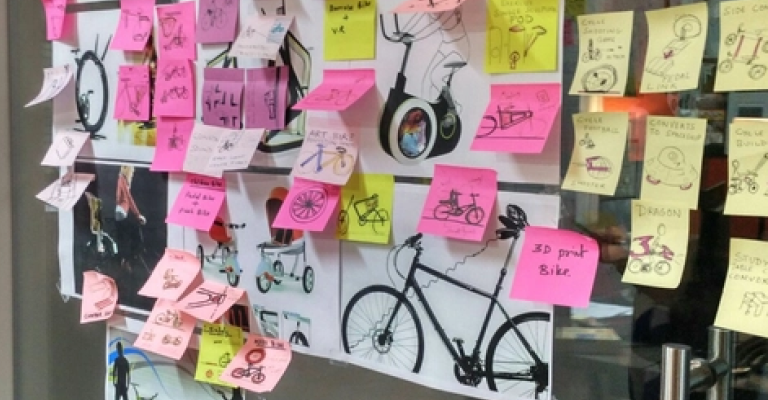
Generating ideas is the first step in hardware product development. This involves brainstorming and creative thinking to come up with potential product ideas. Encouraging a free flow of thoughts can lead to innovative solutions. Idea generation sounds straightforward until you realize that most great hardware ideas arrive disguised as everyday frustrations. The founders who build extraordinary hardware products train themselves to observe how people struggle, with tools, with experiences, with systems designed for someone else. Every observation is a potential product brief. When you approach ideation with that kind of discipline, the quality of your initial ideas multiplies fast. This habit of structured noticing is what separates hardware product creators from hardware product consumers.
Idea Screening
Not every idea is worth pursuing. Screening helps in filtering out the viable ideas from the impractical ones. This stage involves evaluating the potential of each idea based on criteria such as feasibility, market potential, and alignment with business goals. Check out our Cellairis Wireless Car Charger case study, to understand a real life example of successful idea screening. Idea screening is where instinct meets evidence. A compelling concept that fails basic feasibility, cost, or market size tests will drain your resources before you ever reach a prototype. Strong screening criteria save you from falling in love with the wrong idea and protect your runway for the right one. Evaluating each concept against your team's core capabilities and your target customer's real pain points keeps the process honest. The ideas that survive rigorous screening arrive at concept development with energy and momentum behind them.
Concept Development
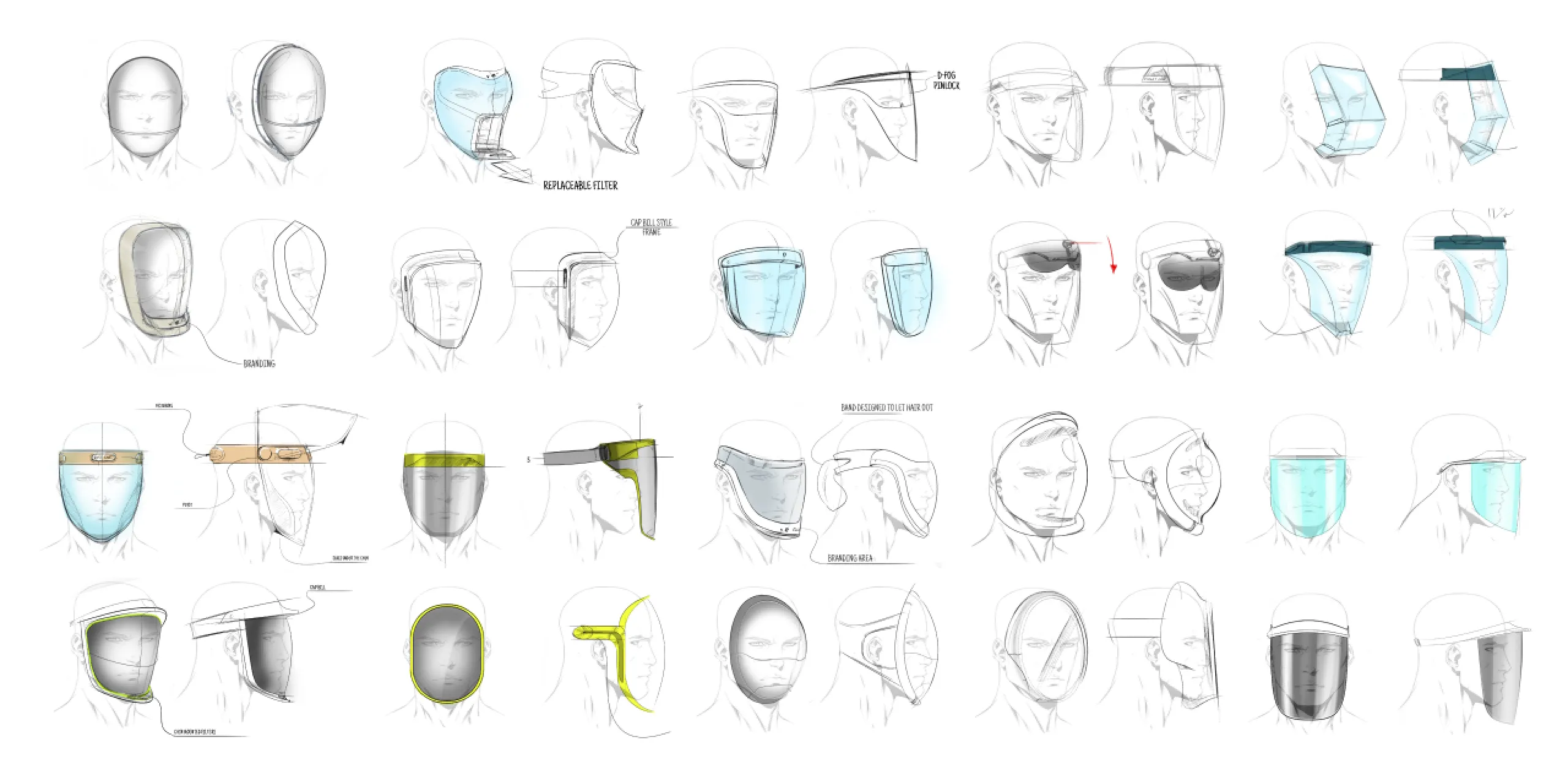
Once an idea is selected, it needs to be developed into a concept. This stage involves detailing the hardware product's features, benefits, and target market. A well-defined concept acts as a blueprint for the subsequent development stages. A concept that is engineered well from the start saves weeks of painful rework later in the process. Think of concept development as the foundation everything rests on: your manufacturing process, your investor pitch, and your customer's first impression. Teams that invest deeply here arrive at prototyping with velocity instead of uncertainty. Discover our Concept Development Services.
Research and Market Analysis
Market research is where founders discover how much of their initial assumption was projection rather than truth. Speaking directly with potential customers, watching them use existing solutions, hearing their language, and understanding their workarounds, reveals insights that surveys rarely capture cleanly. This primary research shapes every downstream decision, from product features to price point to the channels where you will eventually sell. It also becomes one of the most compelling assets in your investor pitch, showing that you built for a real market rather than an imagined one. Founders who skip this stage build products for customers they invented inside their own heads.
Identifying Market Needs
Understanding the needs and preferences of the target market is crucial. Market research involves gathering data about customer requirements and trends to ensure the product meets market demands. This kind of primary research shapes every downstream decision, from product features to price point to the channels where you will eventually sell. It also becomes a key asset in your pitch deck, showing investors you built for a real market. Founders who skip this stage build products for customers they invented in their own heads.
Competitor Analysis
Competitor analysis is valuable far beyond spotting what already exists. It shows you the gaps in the current market, the features customers are underserved on, and the price anchors your product will be judged against. Study your competitors the way a designer studies a brief: with curiosity, precision, and a search for the insight others have overlooked. The strongest market positions often come from a single clear advantage that competitors left unaddressed for years. Your competitor's weakness is your product's opening. Analyzing competitors helps in identifying gaps in the market and areas where your product can offer a unique value proposition. It involves studying competitors' strengths and weaknesses to position your product effectively.
Design and Prototyping
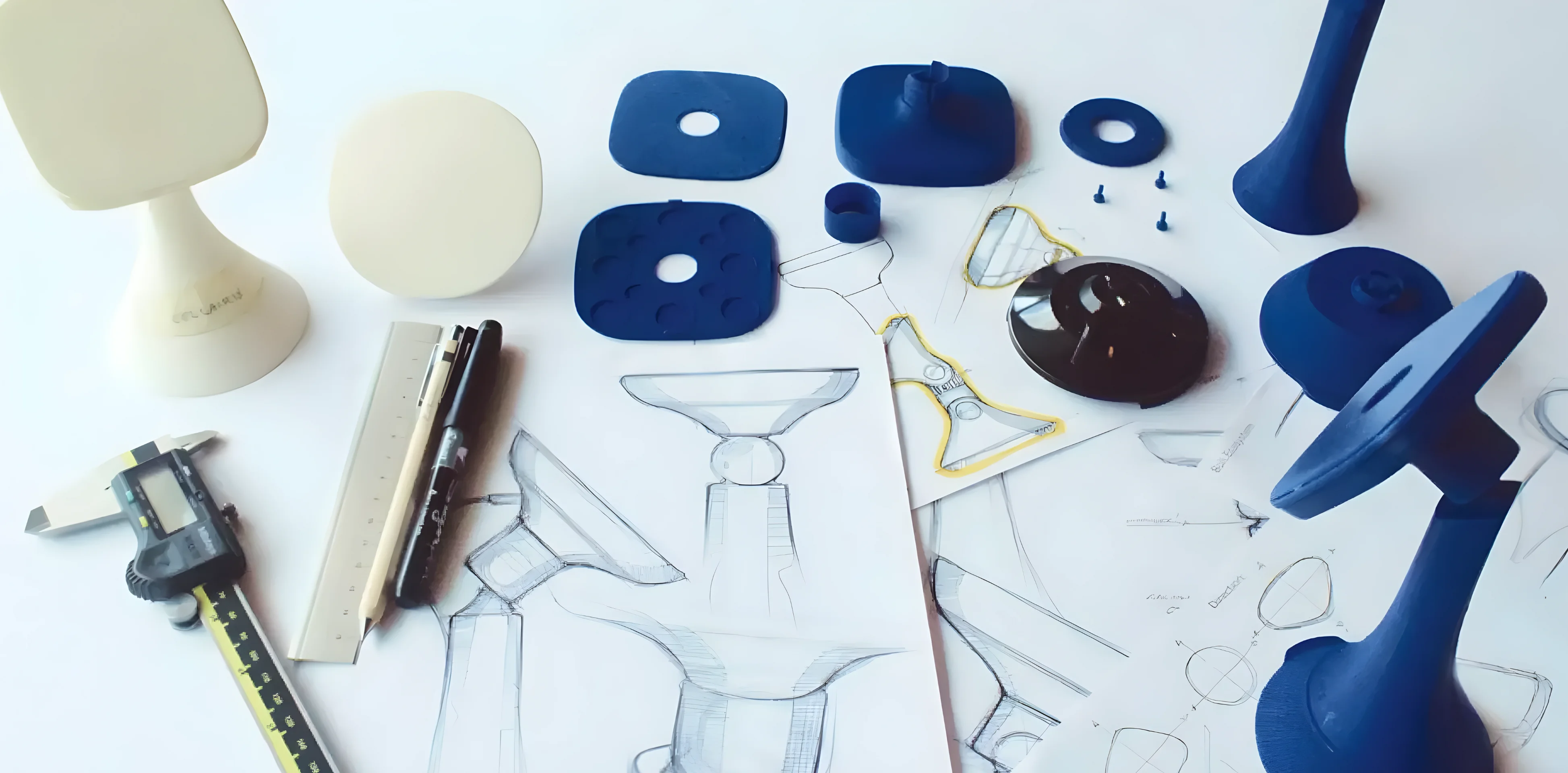
Great hardware products are built twice: once in the design phase, and once on the factory floor. The design and prototyping stage is where your idea stops being abstract and starts carrying real consequences. Every decision your team makes here, on materials, geometry, assembly logic, and tolerances, shapes the final cost, quality, and launch speed of your product. This is where concept meets commitment.
Hardware Product Design
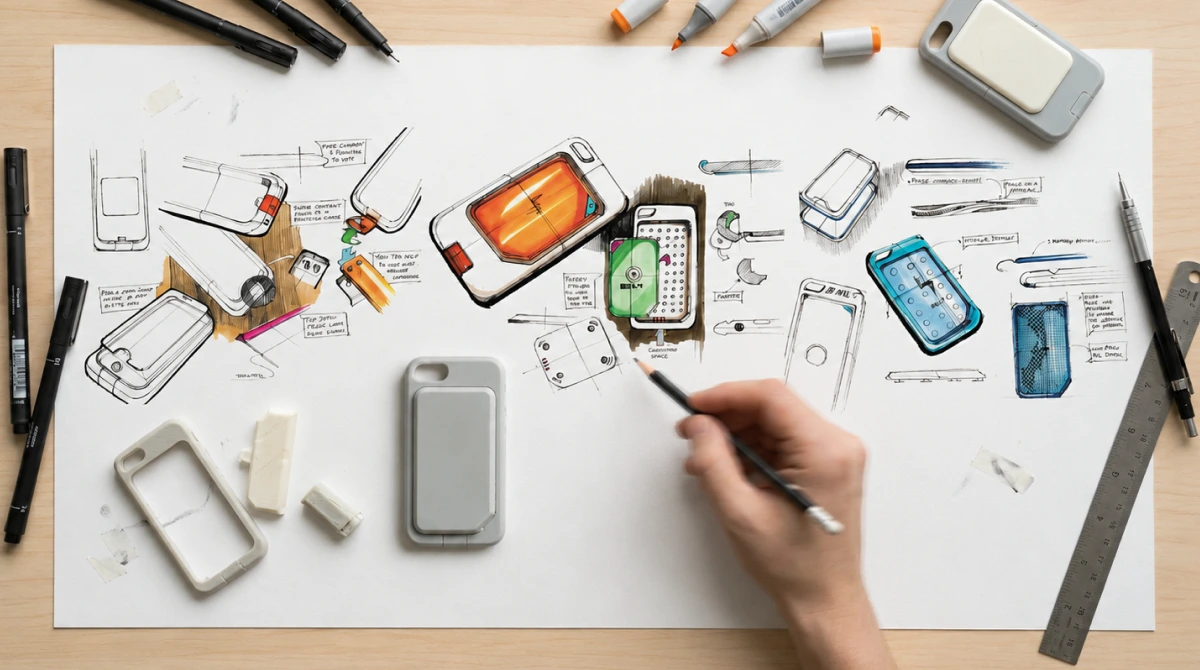
Hardware product design translates the concept into a tangible hardware product. This stage involves creating detailed designs and specifications, considering both aesthetics and functionality. Explore our industrial design services. Hardware product design is where abstract potential becomes a physical decision. Every line, joint, material choice, and button placement carries consequence, for the user's experience, for your manufacturer's process, and for your eventual unit cost. Industrial design and engineering design must work in unison from the earliest sketches, or the cost of misalignment compounds at every stage. A concept that looks brilliant on screen can reveal deep mechanical or ergonomic problems the moment it takes physical form. The earlier your design team engages engineering constraints, the smoother your path to a manufacturable product.
Prototyping
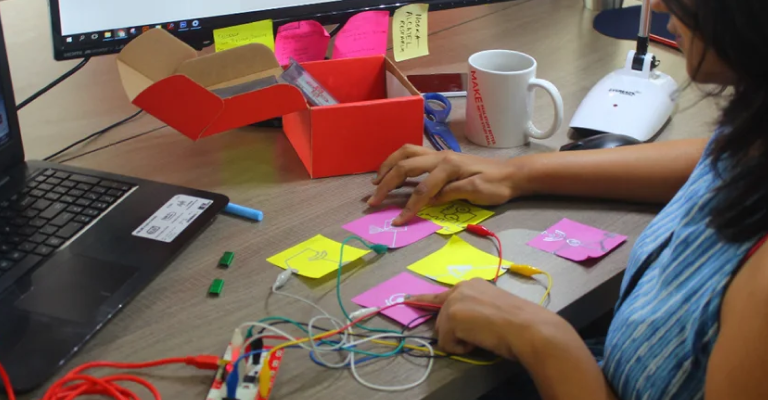
Creating prototypes is essential to visualize the hardware product and test its feasibility. Prototyping helps in identifying design flaws and making necessary adjustments before mass production. Learn about Everything you need to know about prototyping your idea. Prototyping is the single most honest conversation you will have with your product idea. A physical prototype surfaces assumptions held for months in seconds, showing you exactly where the concept holds and where it fractures. Each iteration of prototype testing is an investment in your product's eventual quality: every flaw you find before tooling saves a multiple of that cost after it. Smart founding teams treat prototyping as a rhythm rather than a milestone, something they return to repeatedly throughout the development cycle. Your prototype is your product's first teacher.
User Testing
Testing ensures the hardware product meets quality standards and performs as expected. It involves rigorous testing of prototypes to identify and fix any issues. Real users interact with your product in ways your team will rarely anticipate, finding friction points, misreading interfaces, and using features in sequences nobody planned for. That gap between intended use and actual use is the most valuable data your product will ever generate. Products shaped by honest user testing consistently outperform products launched purely on internal conviction.
Business Planning
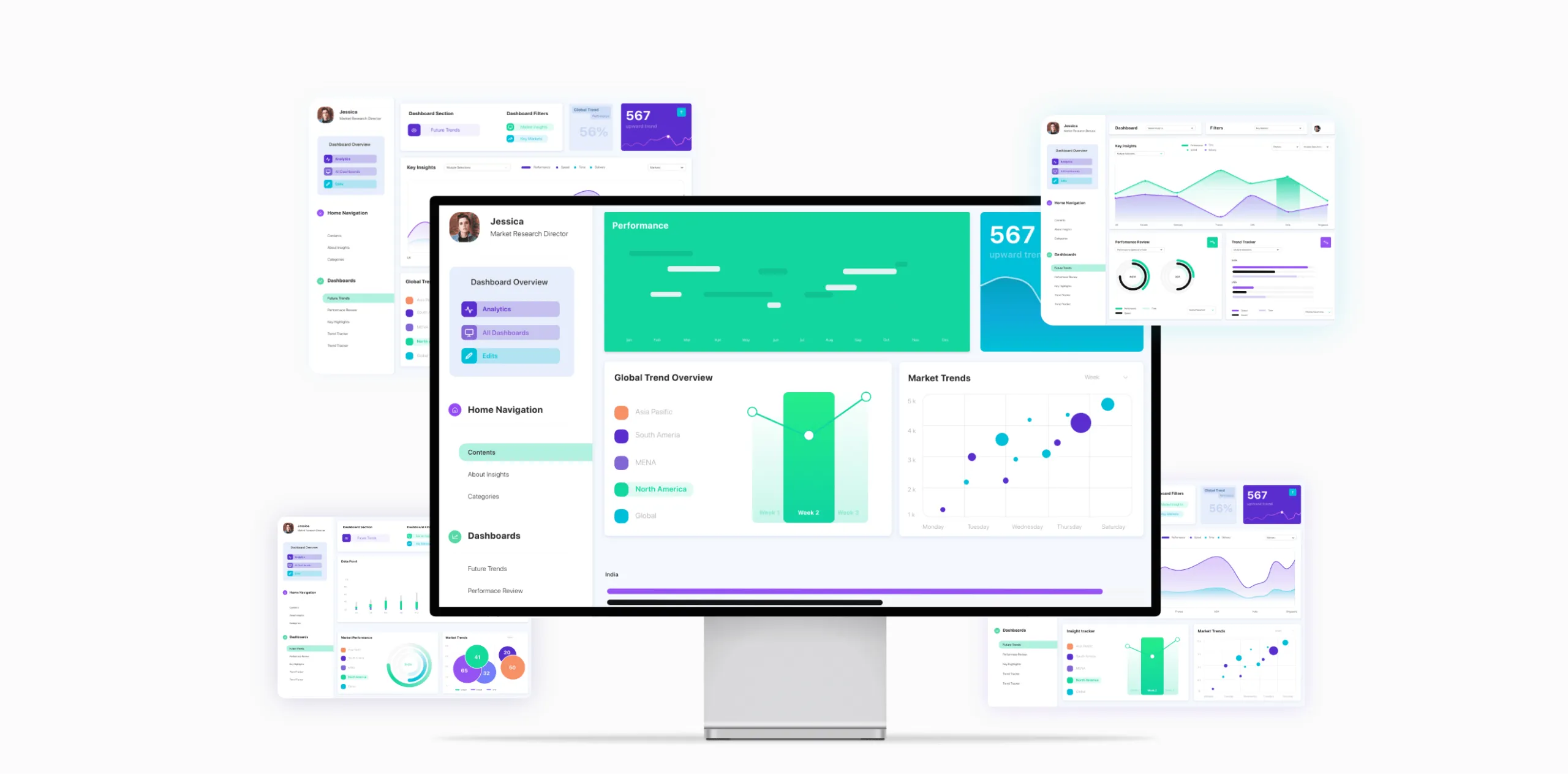
A hardware product without a business model is a prototype without a future. Business planning is the stage where the hardware product team and the commercial team align on the same set of constraints: what the product must cost to build, what the customer must be willing to pay, and what margin survives between them. These conversations are often uncomfortable, and they are always essential. The founders who do this work early launch products that are commercially viable, and technically impressive.
Business Model
Developing a business model involves outlining how the hardware product will generate revenue. This includes pricing strategies, distribution channels, and value propositions. A hardware product without a business model is a prototype without a future. Your revenue structure, pricing architecture, and distribution strategy determine whether your manufacturing cost becomes a margin advantage or a market death sentence. Business planning forces the product team and the commercial team into the same room, creating shared clarity about what the hardware product must cost to build and what the customer must be willing to pay. These conversations are uncomfortable, and they are essential. A business model built before development locks in constraints that protect your viability all the way to launch.
Financial Planning
Financial planning is critical to ensure the hardware product development process stays within budget. It involves forecasting costs, setting budgets, and planning for financial contingencies. Financial planning in hardware product development carries higher stakes than most founders expect. Between tooling, testing, certifications, minimum order quantities, and logistics, the cost of bringing a physical product to market is routinely underestimated. Building a detailed financial model, with conservative scenarios and contingency buffers, is the discipline that keeps hardware projects alive through the expensive middle stages. Most hardware teams underestimate the full financial picture: this breakdown of what hardware product development actually costs across every stage brings the real numbers into focus. It also makes you a far more credible partner for investors, contract manufacturers, and distribution partners. Founders who plan their finances with precision move faster because they spend less energy managing surprises.
Founders who want to understand the exact decisions that separate fundable hardware concepts from ones that stall will find the full breakdown worth reading before their next pitch.

Hardware Product Development Team
The quality of your product development team shapes every output your process produces. Designers, mechanical engineers, industrial engineers, project managers, and product strategists each bring a distinct lens to the problem, and the friction between those lenses is often where the best solutions emerge. Building a team that debates well and decides fast is a structural advantage your competitors will struggle to replicate. Role clarity matters enormously in hardware: ambiguity about who owns a decision creates delays that cascade across the entire project timeline. Invest in team structure early, because the team you build determines the hardware product you ship.
Roles and Responsibilities
A successful hardware product development process requires a dedicated team with clear roles and responsibilities. This includes product managers, designers, engineers, and marketers working collaboratively. Meet our expert team.
Team Structure
An effective team structure ensures smooth communication and efficient workflow. Defining the hierarchy and interaction between team members is crucial for seamless hardware product development.
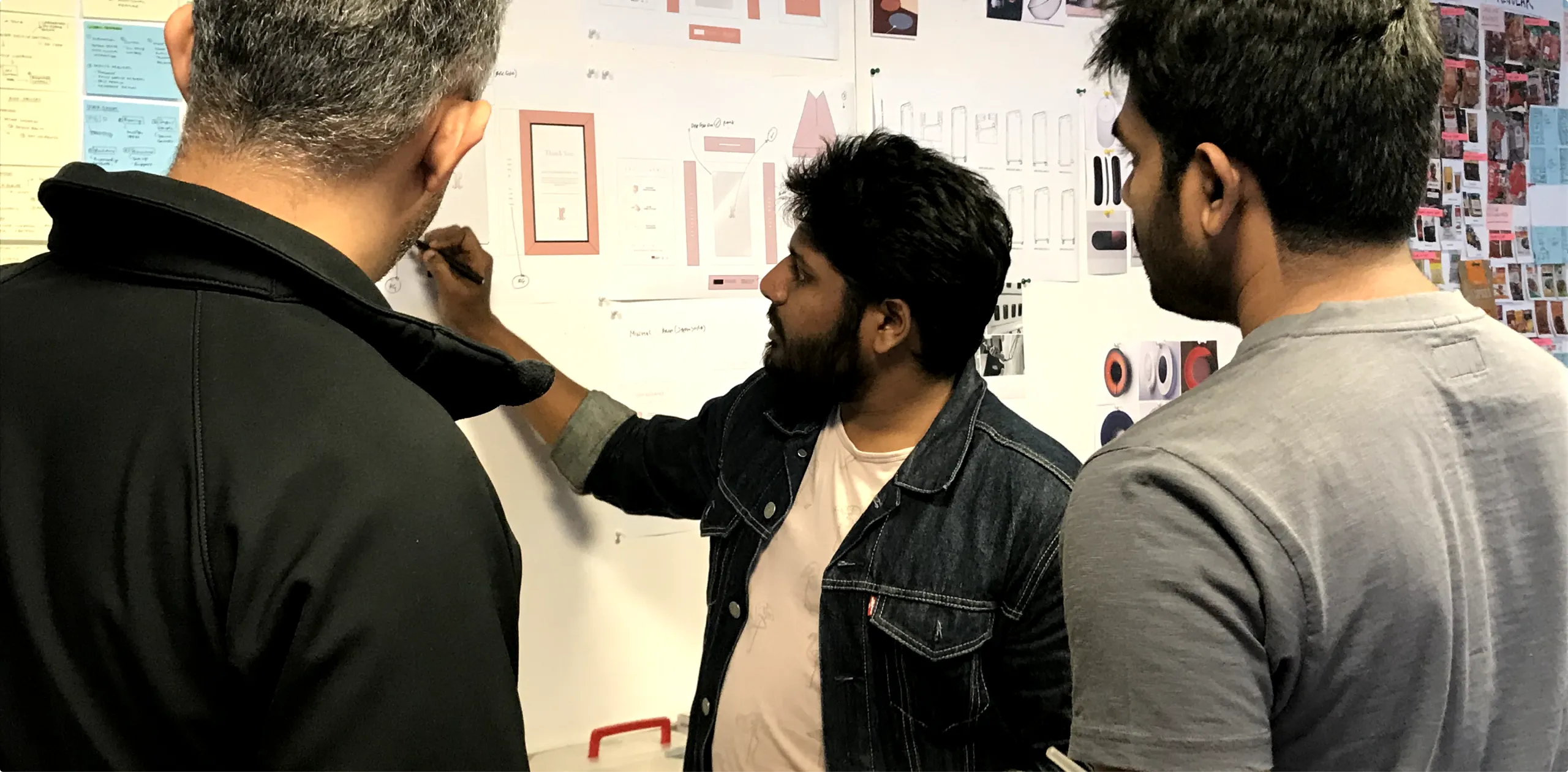
Cross-functional collaboration is the accelerator that most hardware teams underuse. When your design engineers share early-stage concepts with manufacturing partners, and your product managers sit in on user testing, the quality of decisions at every level improves sharply. Structured weekly syncs, shared documentation practices, and clearly defined design review gates keep projects moving and everyone accountable. The founders who build great products are almost always the ones who built great teams first. Your team's alignment is your product's greatest asset.
Testing and Validation
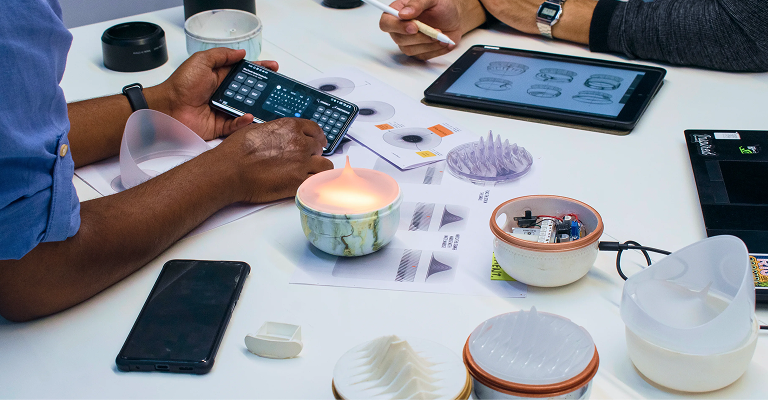
Testing is the stage where confidence gets earned rather than assumed. Every hardware product carries hidden failure modes that only reveal themselves under real-world conditions: thermal stress, physical impact, extended use cycles, and the unpredictability of actual human behavior. A structured testing and validation process surfaces these failure modes before they reach your customer. The cost of finding a problem in testing is always a fraction of the cost of finding it in the field.
Alpha Testing
Alpha testing involves internal testing of the physical product to identify bugs and issues. It is usually conducted by the development team. Alpha testing catches the deep mechanical and software issues that are invisible during design review, problems that reveal themselves only under actual load, heat, or sustained user interaction. Teams that treat alpha testing as a formality rather than a diagnostic tool pay for it downstream with expensive production fixes and customer complaints. A rigorous internal testing protocol, documented and repeatable, gives your team the data it needs to improve with each iteration. The physical product that survives thorough alpha testing arrives at beta in a fundamentally stronger condition.
Beta Testing
Beta testing involves releasing the physical product to a select group of users for real-world testing. Feedback from beta testers helps in refining the product. Beta testing with real users is one of the highest-leverage activities in the entire hardware product development process. External users interact with your product in ways your team will rarely anticipate: they find friction points, misread interfaces, and use features in sequences nobody planned for. That gap between intended use and actual use is invaluable. It tells you precisely where to focus your final refinement effort before market launch. Products shaped by real beta feedback consistently outperform products launched purely on internal conviction.
Market Testing
Market testing involves launching the product in a limited market to gauge customer response. It helps in understanding market dynamics and making necessary adjustments. A limited market launch is one of the most concentrated learning opportunities in the entire product development process. Real purchase behavior, real usage patterns, and real customer reactions give you data that lab testing and beta programs are unable to replicate. Use this window to pressure-test your pricing, your messaging, and your channel assumptions before committing to full production volumes. The insights from a well-run market test have saved more products from expensive pivots than any amount of internal strategy work.
Hardware Product and Manufacturing
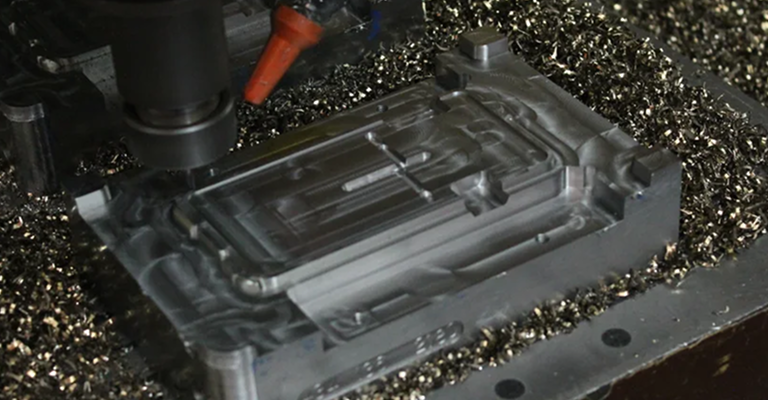
Choosing the right manufacturing partner is a strategic decision with consequences that extend for years. A manufacturer with the right capabilities, communication standards, and quality systems becomes a development partner, helping you optimize your design for their processes and catching issues before they become production problems. A poor manufacturing partner can unwind months of development work in a single production run. Evaluating manufacturers on their track record with products at your complexity level, their quality certifications, and their communication responsiveness gives you a far more accurate picture than price alone. Your manufacturer is the final mile of your product development journey.
Design for manufacturing principles should enter your process long before you select a production partner. Every geometry decision, tolerance specification, and material choice either simplifies or complicates the production process, and that directly impacts your unit cost and production speed. Hardware teams that embed design for manufacturing thinking early in the design phase consistently achieve lower BOM costs and faster production ramp. DFM reviews at concept stage, prototype stage, and pre-production stage create a layered defence against expensive manufacturing surprises. The product that arrives at the factory floor DFM-ready ships faster and scales cleaner.
If your team is encountering DFM for the first time, this deep dive into what design for manufacturing actually means at the component level is the clearest place to start.
Choosing Manufacturers
Selecting the right manufacturer is crucial for product quality and cost-efficiency. It involves evaluating manufacturers based on their capabilities, reliability, and pricing. Learn about our manufacturing partnerships.
Hardware Production Process
The production process involves setting up the manufacturing line and ensuring the product is produced to specifications. Quality control is critical at this stage to maintain product standards. If you are approaching your first production milestone, this guide to the full MVP launch strategy from concept validation to market fit walks through every critical decision.
Before your next design review, run through a practical DFM checklist your engineering team can use at every stage to catch cost and manufacturing issues early.

Marketing Strategy
Your marketing strategy is as much a product decision as any engineering choice you make. The positioning you choose determines which customers find you, how they perceive your product's value, and whether your launch creates momentum or fades quietly into a crowded market. Hardware products carry a unique marketing challenge: customers often need to understand what the product does, why it exists, and why it outperforms existing alternatives, sometimes all at once. Clarity of message, built around a single compelling insight about your target customer's problem, is the foundation of every successful hardware launch. Brand before budget, always.
Branding
Branding involves creating a unique identity for the physical product. It includes developing a brand name, logo, and positioning strategy to differentiate the product in the market. The strongest hardware brands are built around a single, unmistakable truth about what the product stands for. Your brand name, visual identity, and positioning strategy should all express that truth consistently, from the packaging to the product page to the first impression a customer forms at retail. Hardware products that earn emotional loyalty do it because their brand and their product tell exactly the same story. Invest in getting that story right before your product launches, because reshaping brand perception after launch costs exponentially more than building it correctly from the start.
Marketing Channels
Channel selection determines whether your marketing spend reaches the right audience or disappears into noise. For hardware products, the most effective channels vary dramatically by customer segment: direct-to-consumer brands build on social proof and community, while B2B hardware companies invest in trade publications, industry events, and reference customer relationships. Mapping your customer's discovery journey before you choose your channels prevents spending in places your buyers rarely visit. A focused channel strategy with consistent creative execution outperforms a scattered multi-channel approach every time. The brands that build loyal hardware audiences do it by showing up consistently in the right places. Choosing the right marketing channels is essential to reach the target audience effectively. This includes digital marketing, social media, traditional advertising, and more.
Launch Plan
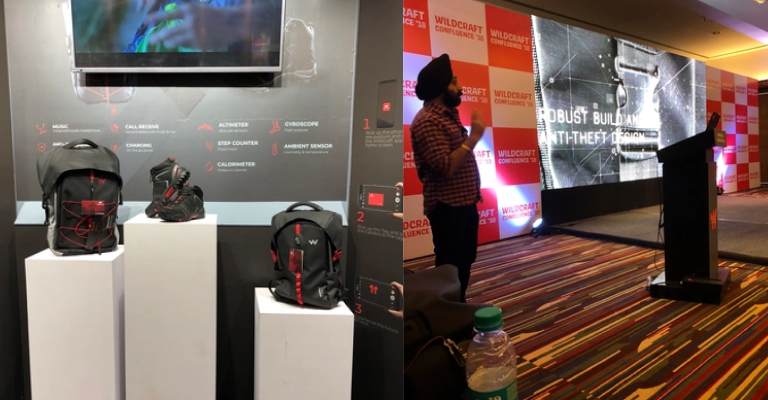
A well-planned product launch creates buzz and attracts initial customers. It involves coordinating marketing efforts, setting launch dates, and planning promotional activities. Your launch plan is the bridge between months of product development and your first real revenue. A strong plan coordinates product readiness, channel activation, PR timing, and customer support preparation into a single orchestrated sequence. The brands that launch well treat the launch plan as a living document, updated weekly in the lead-up to launch day rather than assembled in a final rush. Give your launch plan the same rigor you gave your engineering spec, and it will perform accordingly.
Hardware Product Launch
Launch Preparation
Launch preparation is where the entire hardware product development process crystallizes into a single moment of market debut. Every piece of marketing collateral, every sales enablement asset, and every piece of customer-facing documentation reflects the quality of the product behind it. Teams that treat launch preparation as a final sprint rather than a sustained build often arrive at launch day with gaps that undermine months of development work. A strong launch checklist, covering product readiness, channel readiness, customer support readiness, and PR readiness, is the operational backbone of a successful debut. The launch is the public face of everything that came before.
Preparation involves finalizing the product, creating marketing materials, and training the sales team. It ensures everything is in place for a successful launch.
Execution
Executing the launch involves rolling out the physical product to the market and implementing the launch plan. It includes launch events, promotional campaigns, and media coverage. The gap between a good launch plan and a great launch lives entirely in the execution. Every stakeholder, channel partner, media contact, and team member needs to be briefed, aligned, and ready to move at the same moment. Hardware launches that land with real impact are rehearsed, with every scenario planned and every team member clear on their role when the day arrives. Execute with the same discipline you brought to your engineering process, and your market entry becomes a statement rather than a soft start.
Post-Launch Review
Post-launch review is frequently treated as a wrap-up activity rather than the powerful learning tool it truly is. In the 30 to 90 days following launch, you receive the most concentrated feedback signal your product will ever generate: customer reactions, return rates, support tickets, social responses, and sales velocity all tell the story of how well your development process served your market. Treating this data with the same rigor you brought to beta testing unlocks the improvement roadmap for your next product cycle. The founders who review launches honestly, with clear eyes and open minds, build products that get dramatically better over time. Your first launch is your first lesson.
Reviewing the launch helps in understanding its success and areas of improvement. It involves analyzing sales data, customer feedback, and overall performance.
Post-Launch Management
Customer Feedback
Customer feedback after launch is the data stream that keeps your product alive and competitive. The customers who take time to share their experience, particularly those who articulate specific frustrations or unmet needs, are handing you the brief for your next product iteration. Building a structured feedback collection system, rather than relying on ad hoc reviews, ensures you capture the full picture rather than just the loudest voices. Feedback from your highest-frequency users is especially valuable, as these are the people who have explored your product most thoroughly. Listen to them the way a designer listens to a brief.
Collecting and analyzing customer feedback is crucial for continuous improvement. It helps in understanding customer satisfaction and identifying areas for enhancement.
Product Improvement
Based on feedback, making necessary product improvements ensures it remains competitive. This involves iterative development and updates to enhance product features. The product that earns the most loyal customers is almost always the second version: the one built on real-world learning rather than pre-launch assumptions. Iterative development driven by structured user feedback turns a good product into a great one, systematically closing the gap between what customers experience and what they wish they had. Build a clear process for triaging, prioritizing, and shipping improvements on a regular cadence. The hardware brands that hold their market position over time treat product improvement as a continuous discipline, and their customers feel every iteration.
Scaling
Scaling a hardware product is a challenge of a completely different dimension than developing one. What worked for your first 500 units often fractures at 5,000, in supply chain, quality control, logistics, and customer support. Production scaling requires proactive planning. Founders who model their scale-up requirements before they need to execute them give themselves the time to optimize supplier relationships, refine quality processes, and build the operational infrastructure that sustains growth. Every great hardware brand you admire built a scaling engine before they needed to race one.
Scaling involves expanding the product’s reach and increasing production capacity. It requires strategic planning to manage growth without compromising quality. Explore our scaling strategies.
Common Challenges In Hardware Product Development
Risk in hardware product development comes in layers. Technical risk lives in the design: will the mechanism perform, will the electronics integrate, will the materials hold under real-world conditions? Market risk lives in the assumptions: is the problem real, is the price point viable, is the customer reachable? Execution risk lives in the team and the timeline: does the team have the experience to navigate complexity, and does the schedule reflect reality rather than optimism? Founders who map all three risk categories at the start of a project make smarter decisions throughout its entirety.
Risk Management
Managing risks is essential to avoid potential pitfalls. This involves identifying risks early and developing mitigation strategies. These are essential while looking at developing complex devices and never before done exercises like changing form, adding or removing new technology and also creating complex mechanical parts. These are all fraught with risk and will need mutliple iterations before getting it right. As a founder, its best to budget time and money for these exploratory exercises.
Time Management
Effective time management ensures the hardware product development process stays on schedule. It involves setting realistic timelines and managing deadlines. Time is always a luxury in hardware product development, but that's exactly why its called hardware product development, emphasis on the word development. Developing or crafting a product takes time and without looking into various iterations, activities or prototypes, you are risking discovering these mistakes later after you get into production or launch in the market.
Budget Constraints
Staying within budget is critical to the success of the hardware product development process. This involves careful financial planning and monitoring expenditures. However this can be averted by following a proven hardware product development process and techniques. This helps first time innovators, startup founders and entrepreneurs navigate the complex world of hardware product development without making too many mistakes. Working with a proven partner that can help guide you in this endeavor is an essential step.
Budget constraints are where many promising hardware products quietly stop moving. The costs that challenge hardware projects are rarely the ones that appear in the original plan: they arrive as tooling revisions, additional prototype rounds, certification delays, and minimum order quantity commitments that land simultaneously. Building a realistic hardware budget means adding a meaningful contingency buffer above your best estimate, because in physical product development, the unexpected is the expected. Working with a partner who has navigated these financial terrain features before dramatically reduces your exposure. Experience is the most cost-efficient input you can buy.
Innovative Hardware Product Development Techniques
Agile Methodology
Agile methodology changed software development first, and its core principles transfer powerfully to hardware when applied with intelligence. Short development sprints with defined deliverables, regular cross-functional reviews, and a bias toward shipping testable iterations keep hardware teams honest and adaptive. The constraint in hardware is that physical iterations carry cost: so agile in hardware means designing your development cycles to validate the highest-risk assumptions first, and the cheapest ones first. Teams that operate with agile discipline consistently discover product-defining insights earlier in the process than teams using linear development models. The product development process rewards teams that move fast and learn faster.
Agile methodology involves iterative development with continuous feedback. It allows for flexibility and quick adjustments to meet changing market needs.
Lean Hardware Product Development
Lean hardware product development focuses on minimizing waste and maximizing value. It involves efficient resource utilization and streamlined processes. We have always believed in taking a lean approach as it reduces risk and also creates a much better outcome for brands and companies looking to create unique and fresh ideas.
Design Thinking
Design thinking is a user-centric approach to hardware product development. It involves empathizing with users, defining problems, ideating solutions, and prototyping. Design thinking brings a discipline that technical teams often find counterintuitive: start with the human, before the hardware. Deep empathy research, observation of behavior, and immersion in the user's environment produce insights that transform the brief entirely. The design thinking approach insists that the problem statement itself must be earned through discovery, and that assumption-based product briefs are among the most dangerous documents in product development.
Hardware teams that embed design thinking methodology from day one build products that feel inevitable to the people who use them. That feeling of inevitability is engineered, one insight at a time.
Why Hardware Development Fails at Scale
Scaling a hardware product exposes every compromise made during development. The tolerance stacking that was acceptable in your third prototype becomes a quality control challenge at 10,000 units. The supplier who delivered reliably during your pilot run can become a bottleneck when order volumes jump significantly. The packaging that looked pristine in a sample run warps under the conditions of real logistics and handling. Founders who plan for scale from day one build products that survive it with their margins intact.
The most dangerous phase of hardware product development is the gap between product-market fit and operational scale. During this window, demand grows faster than your production infrastructure can support, and every quality failure you ship becomes a brand credibility problem that is far harder to fix than any engineering flaw. Building your operational backbone, including quality management systems, supplier qualification standards, and logistics frameworks, before you need them is the move that separates hardware businesses that endure. Hardware brands that flame out at their first moment of real growth almost always skipped this build phase entirely. Your infrastructure is your insurance policy for success.
Production scaling also demands a fundamentally different mindset from the founder. During development, speed of learning is the priority. During scale, consistency of output takes over. Founders who remain in development mode, tweaking features, experimenting with materials, and adjusting specifications during active scale-up create chaos in the manufacturing process and cost overruns that erode the margins they worked hard to build. The discipline to freeze the design and optimize the process is one of the most important transitions a hardware founder makes. Embrace it early, and scaling becomes a system rather than a scramble.
Before you commit your next round of budget to development, study the hardware startup mistakes that cost founders the most time and money at every stage of the process.
What DFM Does That Prototyping Alone Cannot
Prototyping answers the question: does this concept work? Design for manufacturing answers the question: can this concept be built profitably, consistently, and at scale? Both questions are essential, but hardware founders frequently answer only the first and assume the second will resolve itself in production. The manufacturing design review process examines every feature of your product through the lens of the production line. It routinely finds that the most beloved design details are the ones driving the highest manufacturing cost. DFM is the discipline that makes your product commercially viable, and technically functional. Design for manufacturability analysis typically examines part count, assembly sequence, tolerance specifications, material selection, and surface treatment requirements. Each of these factors has a direct relationship to cycle time, labour cost, and defect rate on the production floor. A product that requires 40 assembly steps can often be redesigned through part consolidation, design for assembly principles, and smarter material selection to achieve the same function in 22 steps. That reduction translates directly into a lower unit cost, a faster production ramp, and a more resilient supply chain. DFM is a commercial investment, and it returns in measurable margins.
The optimal moment to apply DFM thinking is during concept design and early prototyping stages, before tooling commitments lock your design in place. Post-tooling DFM improvements are expensive and time-consuming because every change requires retooling, revalidation, and often a fresh round of certifications. Founders who treat DFM as a late-stage manufacturing checklist rather than an early-stage design discipline consistently overspend on tooling corrections and underperform on gross margin. Embedding design for manufacturing into your concept review gates changes the economics of your entire development program. The earlier the DFM conversation, the lower the production cost. The production economics behind great hardware products become clearer when you study real DFM examples and manufacturing scenarios behind cost-optimized hardware across different product categories.
See how we structure the prototype and MVP development path for hardware founders who are moving from concept to a testable physical product.
When Your Product Needs A Specialist Studio
Most hardware founders begin product development with a clear sense of what they want to build and a much hazier sense of how. The gap between vision and execution in hardware is where specialist design engineering studios add their most irreplaceable value. A product design agency with deep hardware experience brings design capability alongside an accumulated library of manufacturing knowledge, supplier relationships, and development process intelligence. That depth is impossible for a first-time founding team to build from scratch in a single product cycle. Choosing to engage a specialist studio is one of the highest-leverage decisions a hardware founder makes.
The concept design phase is where specialist studio involvement creates the most outsized impact. Concept design services translate your product vision into engineered, manufacturable, and testable concepts, bridging the gap between industrial design aesthetics and mechanical design engineering constraints. Studios that work across both disciplines produce concept designs that arrive at prototyping with far fewer structural surprises. For a hardware startup, every prototyping surprise that could have been caught at concept stage represents both time and cash burned unnecessarily. Concept design done well is the investment that pays back across every subsequent stage.
8 Reasons Why You Need A Specialist Hardware Studio
- You have an idea but zero hardware background
- Your prototype keeps failing at the same point
- Manufacturing quotes are coming back far too high
- Your concept design needs engineering behind it
- You are preparing for investor or retail conversations
- Your product requires certifications you have never navigated
- The design looks right but unit costs are painful
- You want to launch faster with far less waste
A specialist studio accelerates the critical decisions that founders find most paralyzing: material selection, manufacturing process choice, supplier geography, and certification strategy. These decisions carry long-term implications for cost, quality, and brand perception, and they benefit enormously from precedent knowledge. A studio that has navigated similar decisions across dozens of products brings a calibrated instinct that raw research alone is unable to replicate. The founders who move fastest in hardware development are almost always working with partners who have traveled the road before. Experience, borrowed strategically, is the fastest path forward.
The decision to engage a product design agency is worth examining honestly at multiple points in the development lifecycle, and the right time is often earlier than you expect. At pre-concept stage, a studio can help you define the right product to build. At DFM stage, they can restructure your design for manufacturing economy before tooling commitments are made. At prototype validation, their testing frameworks catch the issues that internal teams are too close to the product to see clearly. Across all these stages, the studio's contribution is perspective that keeps the product honest and the process disciplined. The most important investment you can make before writing a single engineering spec is learning how to validate a hardware product idea before committing your first development budget.
Protecting Your Idea Through Development
Intellectual property protection in hardware product development is a strategic asset, and building it into your development timeline from day one is the habit that professional product teams maintain. A provisional patent application filed at the concept design stage creates a priority date that protects your claim while development continues. Working with NDAs, IP assignment agreements, and clearly documented invention disclosures with every development partner, contractor, and manufacturer you engage keeps your ownership position clean. Founders who treat IP as a legal formality rather than a business asset routinely discover the cost of that decision when they seek investment or licensing. Your IP portfolio is the part of your product that investors examine just as closely as your prototype.
Design protection extends beyond utility patents. Trade dress, industrial design registrations, and copyright over design documentation all contribute to a layered IP position that makes your product harder and more expensive for competitors to copy directly. Hardware products that carry strong design aesthetics alongside functional innovation benefit from both utility and design protection working together. A product design agency with IP-aware design documentation practices helps you build the evidence base your IP applications require. Your design process, documented correctly, is the foundation of your intellectual property portfolio.
Manufacturing partner relationships require particular IP attention. Sharing detailed CAD files, BOM specifications, and manufacturing drawings with production partners without appropriate IP safeguards in place creates exposure that is difficult to remedy after the fact. Manufacturer NDAs, split manufacturing strategies for sensitive components, and jurisdiction-appropriate IP filings each contribute to a manufacturing IP protection framework. Founders who approach supplier and manufacturer relationships with structured IP discipline protect both their product and their business model. Strong IP is the moat that makes your hardware business defensible.
Everything your founding team needs to know about the concept design process from first brief to finished CAD is covered in detail on our services page.
The Real Timeline Hardware Founders Ignore
Every hardware founder builds a launch timeline. Almost all of them are optimistic. The realistic timeline for taking a hardware product from validated concept to first production run is consistently longer than founders plan, and the gap between plan and reality is widest in three specific phases: regulatory certification, tooling production, and first article inspection. These three stages introduce external dependencies and fixed minimum cycle times that investment and urgency are unable to meaningfully compress. Understanding where time compression is possible and where it is structurally fixed is the calendar intelligence that separates experienced hardware teams from first-time founders.
Regulatory certification timelines for hardware products depend heavily on product category, target market, and the certification bodies involved. Consumer electronics requiring FCC, CE, BIS, or product-specific safety certifications typically require 8 to 16 weeks of testing and documentation review after a stable, production-representative sample is available. Medical devices, IoT hardware, and wearable products carry additional certification layers that extend this timeline further. Building certification timelines into your development schedule before engineering begins, rather than after, prevents the most common and painful category of hardware launch delay. Certifications are the longest lead-time items in your development plan: schedule them first.
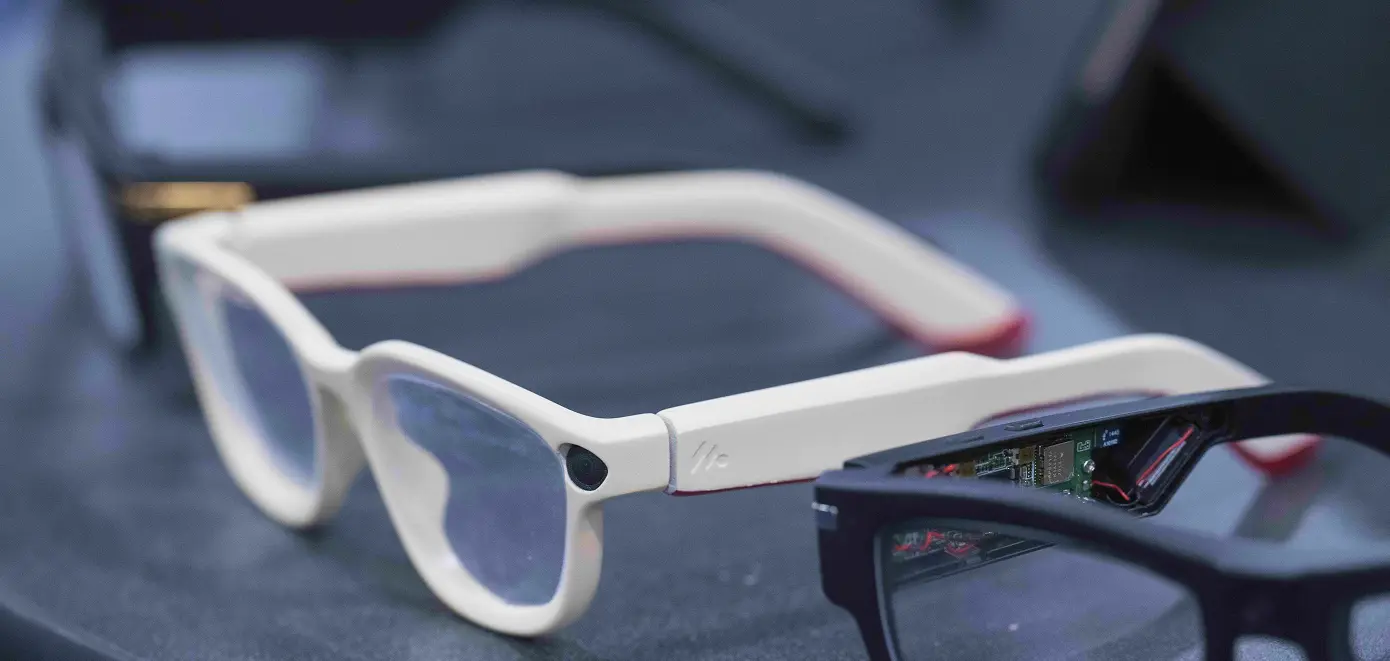
The Mustard AI Glasses project is a direct example of what a realistic, well-managed hardware development timeline looks like in practice. From concept through engineering, prototyping, and a launch-ready product, the team completed the full journey in 10 months and reached an acquisition, in a timeframe most founders assume is reserved for software. Study the disciplines behind that outcome at the AI Glasses for Mustard case study.
The tooling phase is where optimism most often collides with manufacturing reality. Hard tooling for injection-molded components typically requires 6 to 12 weeks per tool, and complex multi-cavity or family molds can extend that window further. First article inspection and tool approval add additional cycles before you reach confirmed production readiness. The discipline of design freeze, committing fully to a specification before tooling begins, is one of the most important and difficult decisions in the hardware development process. Embrace it deliberately, and your tooling timeline becomes predictable rather than chaotic.
The real product development timeline for a mid-complexity hardware product, from validated concept to market launch, is typically 12 to 24 months. Founders who plan for 6 to 9 months consistently arrive at the 12-month mark with a product closer to production-ready but still carrying months of work. The financial implication of timeline miscalculation is severe: extended runways consume cash, push revenue milestones, and test investor patience. Building your timeline from the manufacturing endpoint backward, with realistic durations for every stage including contingency, gives you a schedule that is survivable rather than aspirational.
Plan for the hardware reality, and it rewards you with a launch date you can actually hit.
Case Studies
Successful Hardware Product Development Examples
Studying successful hardware product development cases provides valuable insights. Examples include Apple’s iPhone, Tesla’s electric cars, and Dyson’s vacuum cleaners. If you are interested to see some of the case studies that have been market success, you can view our work on
Bolt - How we created a new car mount to reduce cost & repetitive tasks
Eume - How EUME took a game changer idea from a vision to a mass-produced solution
Panasonic - How Panasonic launched a successful app to increase user retention & learning curve
Amazon - How we helped transform an industry with a human-centered approach to packaging
Each of these case studies showcases how an idea can be taken from just a vision to all the way to a market ready product success.
Fast Company's annual Innovation by Design program recognizes the hardware products that execute development and launch with the most precision: browsing the winners is one of the fastest ways to understand what market-ready hardware excellence actually looks like.
For teams managing complex multi-stage development programs, MIT Sloan Management Review's coverage of product development timelines and team structure offers research-backed frameworks that hold up in real hardware environments.
The Stage-Gate process, documented extensively by Harvard Business Review, is one of the most proven structured approaches to managing complex product development programs from idea through to commercial launch.
Conclusion
The hardware product development process is a multifaceted journey that requires careful planning, execution, and management. By understanding each stage and its importance, businesses can create successful products that meet market demands and drive growth. Every product that has ever made it from a founder's notebook to a customer's hands followed a process, even when that process was imperfect and improvised along the way. The founders who build hardware businesses that last are the ones who respect that process, invest in it early, and treat every stage as an opportunity to strengthen what comes next. The hardware product development journey is demanding, costly, and deeply rewarding for the teams willing to do it right. Your next step, whether that is validating a concept, preparing for your first prototype, or restructuring a product for manufacturing, starts with a single decision to move forward with a structured plan.
The team at Analogy has guided founders and brands through every stage described in this guide, from the earliest concept sketches to production-ready products that have reached global markets. If you are ready to take your hardware idea seriously, start a conversation with our team and bring your product development process to life with people who have done it before.