Every hardware product starts with a problem nobody has solved well enough yet. The hard part is the gap between "I have an idea" and "I have a concept worth building". Concepting methods are how designers and founders close that gap: structured ways to move from a loose problem to a defined, testable product direction before money goes into CAD, prototypes or tooling.
The eight methods in this guide do three jobs. Problem reframing, extreme user analysis and competitive deconstruction make sure you are solving the right problem. Analogical thinking and SCAMPER generate directions you would not reach by looking only at your own category. Constraint-led concepting, use-journey storyboarding and diverge-converge sketching shape and filter those directions into a concept engineering can build. In a professional concept phase, that work takes four to six weeks, not months.
This guide explains each method, when to use it and how to run it on your own product. Most of them need analytical thinking more than drawing skill, so you can start before you have a designer on the team.
Key takeaways:
- Concepting is the cheapest stage at which to be wrong: a change here costs a conversation, not a new mould.
- Frame the problem before generating ideas: reframe it, study extreme users and take competitors apart.
- Use analogies and SCAMPER to get past the obvious first idea.
- Set manufacturing constraints early so concepts survive design for manufacturing review.
- Generate many rough ideas, then narrow to three to five distinct directions before choosing one.
What Are Concepting Methods?
Concepting methods are the structured techniques used at the very start of product development, between "we have a problem worth solving" and "we have a direction worth engineering". They are not open brainstorming with sticky notes. Each method applies a specific lens or limit, which produces ideas faster, exposes assumptions earlier and gives your development team something concrete to work with.
They sit inside concept design, the first phase of hardware development. Concept design is the whole phase, from research to a validated direction in CAD. Concepting methods are the tools used inside it to generate ideas and choose between them.
Two modes run through all of them. Divergent methods widen the field of options; convergent methods narrow it. The UK Design Council's Double Diamond describes the same rhythm: open up to explore, then close down to decide, first for the problem and then for the solution. Good concepting moves between the two on purpose instead of trying to do both at once.
Why Concepting Matters More in Hardware Than Software
In software, a bad idea costs you a sprint. In hardware, it can cost months and a large share of your budget.
Physical products carry constraints that digital ones don't: material costs, manufacturing tolerances, supply chains, certifications and tooling lead times. A concept that looks right on a napkin can fall apart at the design for manufacturing (DFM) review, where engineers check whether it can be made at scale without excess cost or defects.
That is why the concept stage is your cheapest opportunity to be wrong. A change at concept costs a conversation. After CAD it costs a week of rework. After tooling it can mean a new mould and weeks of delay. The more rigorously you explore ideas before committing to engineering, the fewer expensive pivots you face later. It is one of the core principles in our guide to how to build a hardware product from scratch.
Methods That Frame the Right Problem
The first three methods come before any idea generation. They make sure the problem you are designing for is the real one, and they show you where the market leaves room.
1. Problem Reframing
Most founders start with a solution in mind, not a problem. Problem reframing strips away the assumed answer and looks at the underlying need from several angles. Often it shows that the original idea was solving the wrong version of the problem.
How to apply it: Write down your current problem statement, then rewrite it five ways, each starting from a different assumption. "Users need a better way to charge their phone in the car" could become "users need to stop thinking about battery life while they drive". That shift opens different solution spaces, such as passive charging surfaces, predictive alerts or ambient indicators, rather than a better cable or mount. Go wider before you go deeper.
2. Extreme User Analysis
Designing for the average user produces average products. Extreme user analysis studies the people at the edges of your market: the power users who push a product hardest, and the reluctant users who struggle with it most. Both groups reveal requirements that the middle of the market hides. IDEO's design toolkit recommends the same pairing: talk to extreme users as well as mainstream ones, so the result works for everyone.
How to apply it: Define two extreme profiles: one who would use the product in the toughest conditions you can imagine, and one who would find it hardest to use. Map their friction points, workarounds and unmet needs. Then ask which of those insights would also help your core user.
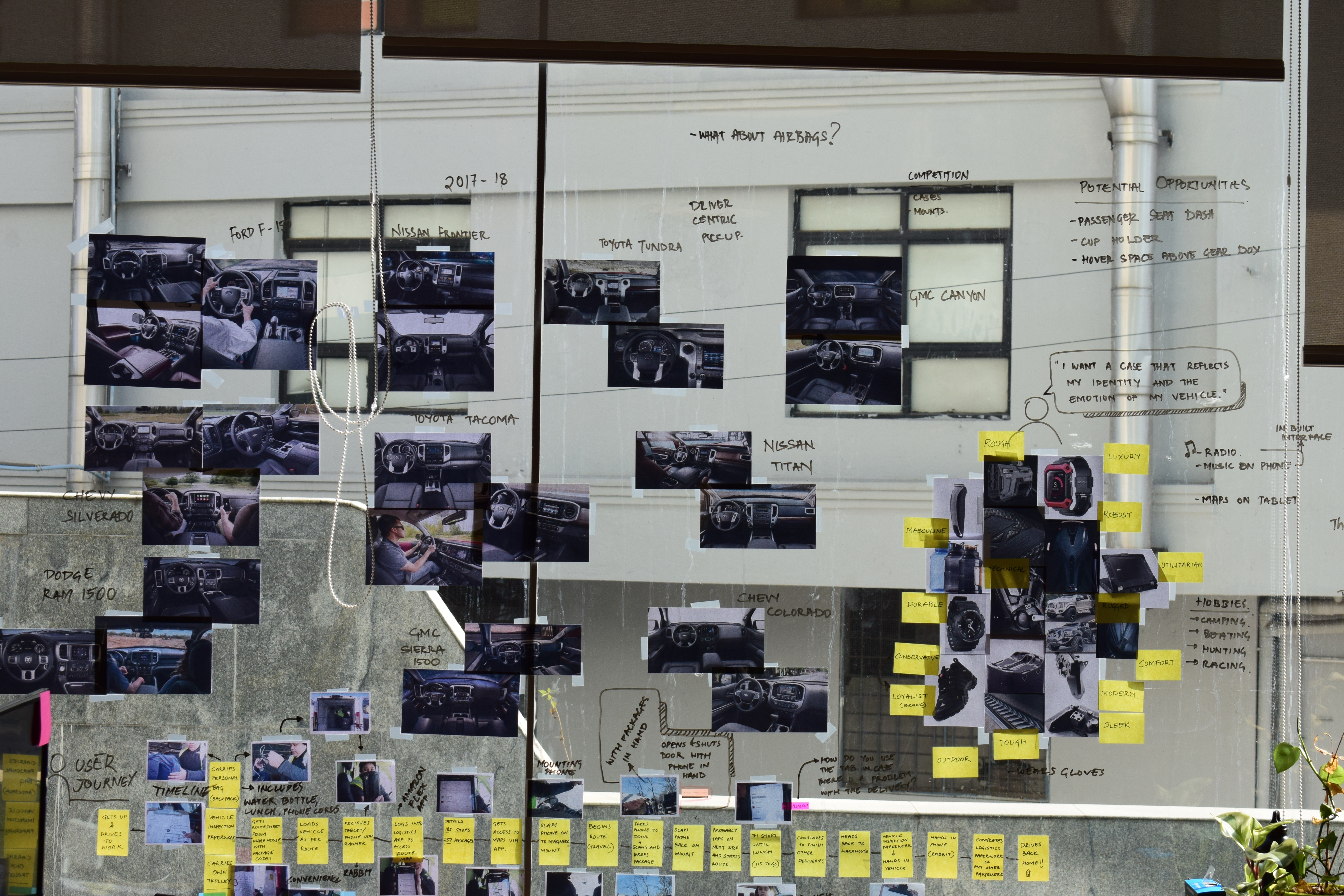
When we designed the Bolt wireless car charger for Cellairis, the users were delivery drivers making hundreds of stops a day with heavy devices, and ordinary mounts failed under that vibration, weight and constant use. Designing for those conditions led to a mount that holds the device securely and lets a driver mount, view and charge it in one motion.
3. Competitive Deconstruction
You can't differentiate from what you haven't studied. Competitive deconstruction takes apart the existing products in your category, physically where possible, to understand their design decisions, manufacturing choices and user-experience trade-offs. The aim is not to copy them. It is to understand the design logic of your market so you can depart from it deliberately.
How to apply it: Buy or borrow the three to five most relevant competing products. Score each on the same criteria: form and ergonomics, material and finish quality, assembly complexity, packaging, first-use experience and price-to-value. Note where each one compromises and why, whether cost, a manufacturing limit or timeline pressure. Then map where your concept can make different trade-offs. You don't need to beat every competitor on every dimension, only to be clearly better on the two or three that matter most to your user.
Methods That Generate New Directions
With the problem framed, these two methods push past the first idea that comes to mind.
4. Analogical Thinking
Analogical thinking borrows a solution structure from a different field and applies it to your product challenge. It works because it breaks the tunnel vision that comes from looking only at your own category. Nature, architecture, aerospace and medical devices are all rich sources of structural ideas that consumer hardware founders rarely study.
How to apply it: Pick one functional challenge, such as heat dissipation in a compact wearable, and ask how another system solves it: passive cooling in buildings, thermoregulation in insects, heat exchange in industrial refrigeration. You're not copying the solution; you're borrowing its logic and translating it into your context. For a studio example of cross-domain thinking, read how we approached designing a kids' bike that grows with its rider.
5. SCAMPER
SCAMPER is a structured ideation checklist: Substitute, Combine, Adapt, Modify, Put to other uses, Eliminate and Reverse. Educator Bob Eberle created it in the early 1970s, drawing on the idea-spurring questions in Alex Osborn's book Applied Imagination. It is most useful when you already have a concept and want to stress-test it systematically. Unlike open brainstorming, it gives you a fixed set of lenses, so fewer ideas get missed.
How to apply it: Run your current concept through each lens in order. Substitute: which materials, components or mechanisms could be replaced? Combine: what if it merged with a device the user already owns? Eliminate: which features could go without reducing core value? Reverse: what if it worked in the opposite direction or sequence? One strong insight can change a concept's direction. Run SCAMPER early, before you're attached to a particular form.
Methods That Shape and Filter Concepts
The last three methods turn a wide field of ideas into a concept that can be built, used and made at your target cost.
6. Constraint-Led Concepting
Constraints feel like obstacles, but they are design tools. Tight limits on cost, size, material, assembly time or part count force creative solutions that open briefs rarely produce.
How to apply it: Set three non-negotiable constraints before you generate ideas, and make them measurable: under $8 to manufacture, fits in a shirt pocket, assembled in under 90 seconds. Then generate concepts that satisfy all three. You'll discard ideas faster, which is the point; the ones that survive tend to be worth building. Concepts born under manufacturing constraints also need far fewer major redesigns when they reach DFM and manufacturing. The modular commercial stove we designed for Agnisumukh is an example: the concept was built around reducing SKU complexity, and that goal shaped its modular architecture.
7. Storyboarding the Use Journey
Hardware products live inside moments: morning routines, commutes, workouts, kitchens, offices. Storyboarding maps the full sequence of interactions someone has with your product, from first noticing the problem through daily use to replacement or disposal. It surfaces interaction requirements that form-focused concepting misses.
How to apply it: Draw or describe six to ten frames: a specific user meeting the problem, discovering the product, using it for the first time, fitting it into a routine, and eventually replacing or disposing of it. At each frame, ask what the product needs to do, look like or communicate for that moment to work. The storyboard will produce form, CMF (colour, material and finish) and packaging requirements that a feature list never would. Our guide to concept sketching in product design shows how quick sketches carry this thinking from idea to validation.
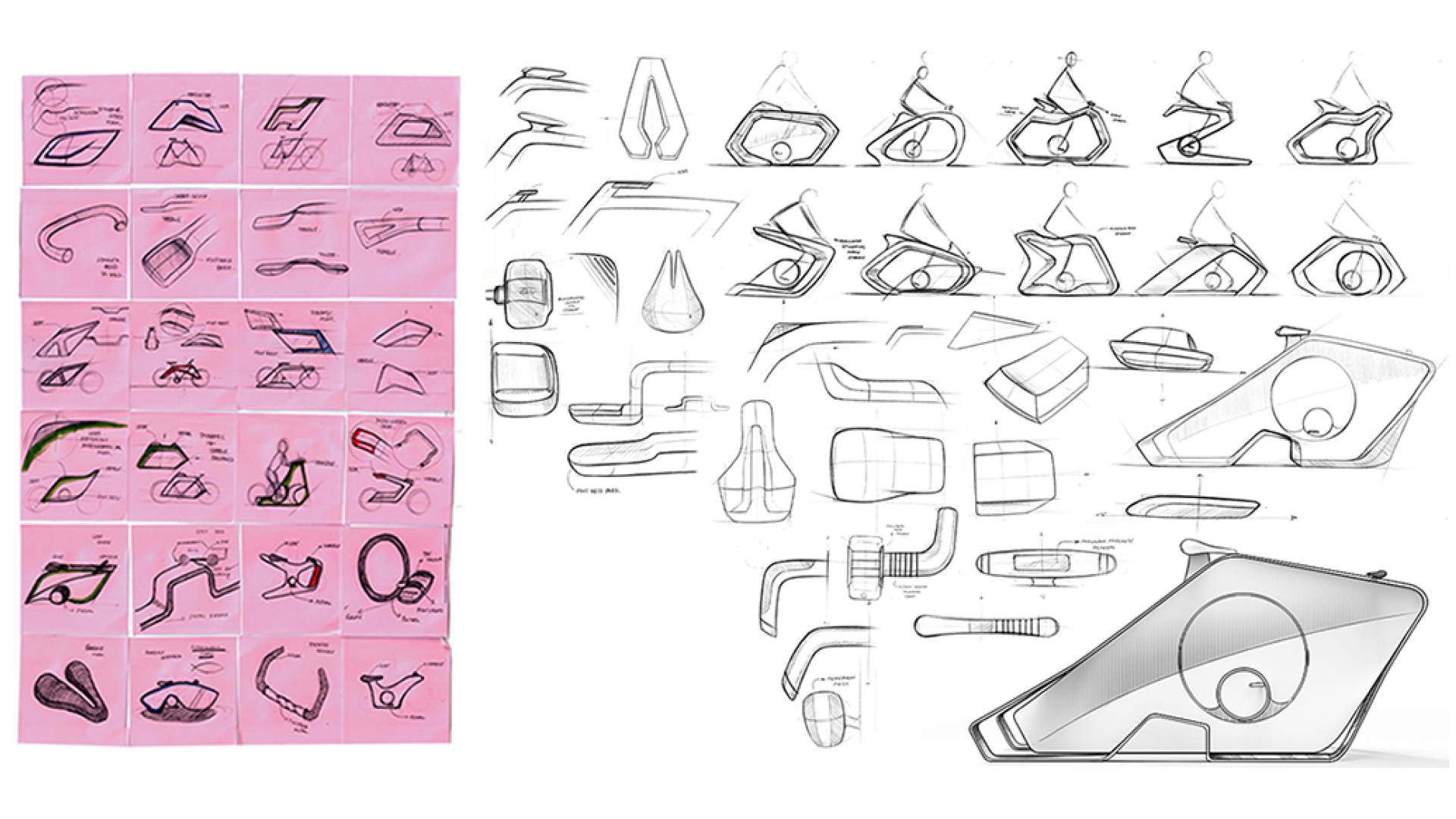
8. Diverge-Converge Concept Sketching
The best concept is rarely the first one. Rapid sketching in deliberate diverge-converge cycles is how professional designers generate volume and then filter hard. Diverge means producing as many distinct directions as possible without judging them; converge means applying criteria to pick the strongest. Repeating the cycle two or three times produces concepts that are both inventive and grounded. Google's Design Sprint uses a short version of the diverge step called Crazy 8s: eight distinct sketches in eight minutes.
How to apply it: Set a 20-minute timer and sketch as many distinct concepts as you can without stopping to evaluate them. Quantity beats quality at this stage. Then score them on user desirability, technical feasibility, manufacturing viability and strategic differentiation, and keep the top three. Take those into a second round, exploring variations and combinations, then converge again on one or two directions.
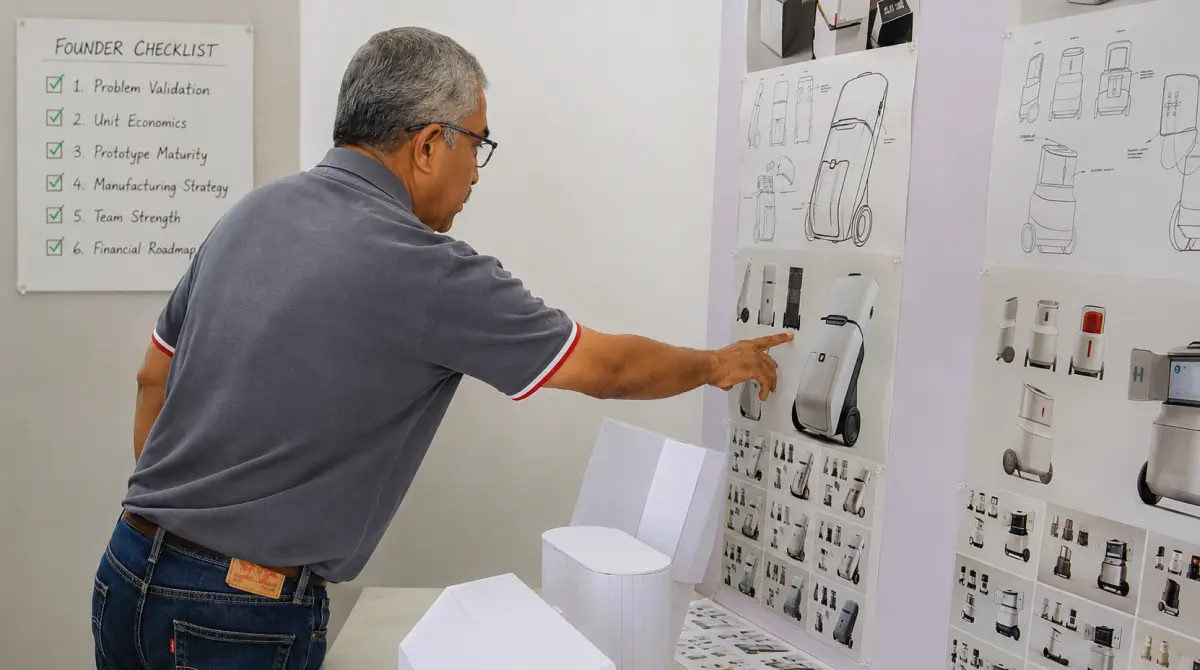
This is how our concept phase works before anything moves into CAD. The light-based motivation idea behind the Shard exercise bike, for example, came out of sketch rounds. For the creative thinking behind ideas with real market potential, read How to Invent an Idea That Can Truly Wow.
How to Combine the 8 Concepting Methods
No single method produces a great product. Teams that consistently generate strong concepts combine them, moving between divergent and convergent modes on purpose.
A typical sequence starts with problem reframing to check you're solving the right challenge. Extreme user analysis and competitive deconstruction then set the edges of the design space. SCAMPER and analogical thinking open up unexpected directions, constraint-led concepting filters them for manufacturability, and storyboarding finds the interaction requirements. Diverge-converge sketching closes the phase by producing and refining the strongest visual directions.
The output isn't just a concept. It's a concept with a clear rationale, a defined user, a manufacturing-aware form and a distinct position in the market, which is what survives engineering.
Stuck between two or three directions? Tell us what you're building and we'll tell you where the real risks sit before you commit to CAD.
Common Concepting Mistakes
- Falling for the first idea. Generate many rough options before judging any of them. The favourite going in is often not the one chosen coming out.
- Treating brainstorming as concepting. Sessions without lenses or limits produce volume, not direction. Give every session a method and a decision to make.
- Designing for the average user. Study the edges of your market; they reveal what the middle hides.
- Leaving manufacturing until CAD. Concepts with no cost or process limits come back from DFM review needing major redesigns. Set constraints early.
- Skipping validation. An idea your friends love is not a tested concept. Put directions in front of real buyers before engineering; our guide to validating your hardware product idea shows how.
- Rushing to CAD. Skipping or compressing concepting is one of the most common and expensive mistakes hardware founders make, because every later change costs more.
When to Bring In a Design Partner
These methods work best with the time, experience and team to run them well. Many founders bring deep domain knowledge and sharp market insight, but not the design-process fluency to get the most from a concept phase on their own.
Our concept design service runs these techniques in four steps: discover, explore, refine and validate. It usually takes four to six weeks, puts three to five distinct directions on the table before one is chosen, and ends with one validated direction in CAD, technical drawings and an indicative unit cost. About 60% of founders change course during this phase, which is the phase doing its job. Concept design is phase 1 of Product-Path™, so the same team can take the chosen concept into engineering and prototyping.
Analogy has shaped 250+ products across consumer electronics, kitchen appliances, wearables and accessories, and has earned 24 international design awards, including Red Dot and iF. Founders we've worked with have raised $65M+, and we've designed for enterprise teams at Google, Panasonic, Unilever and Maersk.
Frequently Asked Questions About Concepting Methods
Sources
- The Double Diamond, Design Council
- Extremes and Mainstreams, Design Kit by IDEO.org, IDEO
- Developing Imagination Through SCAMPER, Bob Eberle, The Journal of Creative Behavior, 1972
- Crazy 8s, Google Design Sprint Kit