You spent months building the prototype. You rehearsed the pitch until every slide felt second nature. You walked into the meeting full of conviction, and the investor said come back when you have more traction. That sentence has ended more hardware startup funding journeys than any bad product or bad market ever has. The most painful part is that most founders leave that room with absolutely no clarity on what more traction means or where to build it first.
Raising capital for a hardware company operates by a set of rules that most first-time founders discover only after their first rejection, which is precisely the problem this guide is designed to solve. Software founders close rounds quickly, speak fluently in investor language, and often raise on thin evidence and a compelling demo. Hardware founders arrive with physical products, real engineering, and genuine innovation, yet face a higher bar, more cautious questions, and a longer path to capital. Understanding why that asymmetry exists is the foundation for working with it rather than against it.
The distance between hardware founders who raise and those who spend months chasing hardware investment almost always comes down to six specific signals. Investors check these signals, consciously or subconsciously, in every hardware startup funding conversation they participate in. They scan for proof that the problem is real, that the hardware business can generate real margin, that the product can be manufactured at scale, and that the team can execute under the genuine pressure that hardware businesses create.
Discover the 6 things investors check before funding a hardware product. A complete hardware startup funding guide for first-time founders.
Why Hardware Startup Funding Feels Impossible
Hardware startup funding feels genuinely harder than almost any other category of early-stage investing because the capital requirements are higher from day one. Software companies iterate to product-market fit on modest capital. Hardware companies face tooling costs, component sourcing challenges, manufacturing minimums, and regulatory certification requirements that consume capital well before a single unit reaches a customer's hands. Investors understand this dynamic intimately, which is why they ask far more questions before writing a cheque into a hardware startup than they do for a software company at a comparable development stage.
The hidden challenge in raising hardware investment is that first-time founders often confuse enthusiasm for evidence. Investors who have spent real time in hardware have developed a sharp ability to distinguish between founders who believe in their product and founders who can prove the market wants it. Belief is powerful but it is not fundable on its own. Evidence is what converts a belief into a term sheet, and building that evidence in hardware requires more rigor, more time, and more direct market contact than in almost any other startup category competing for the same early-stage capital. Every hardware funding conversation is really an evaluation of two things simultaneously.
First, whether the hardware product can be reliably manufactured and sold at a margin that justifies the investment size and timeline. Second, whether this specific founder and team have the experience, the network, and the resilience to execute a hardware business from early-stage prototype through production, commercial launch, and repeatable scale.
Most first-time founders focus entirely on the first question and leave the second completely unaddressed, which is one of the most costly gaps in the entire hardware fundraising process.
The founders who consistently win hardware startup funding have found a way to answer both questions before they are asked. They build their preparation around the investor's actual decision framework rather than around their own conviction about the product. They arrive in meetings ready to discuss margins, manufacturing strategy, supply chains, and financial runways with the same fluency they bring to discussing the product itself. That dual fluency is what the six sections below are designed to build in every first-time hardware founder who reads them.
If you are still at the idea stage before hardware development begins, our guide on how to validate your hardware product idea will help you build the evidence layer that makes hardware startup funding possible in the first place.
1. Prove The Problem Is Real And Painful
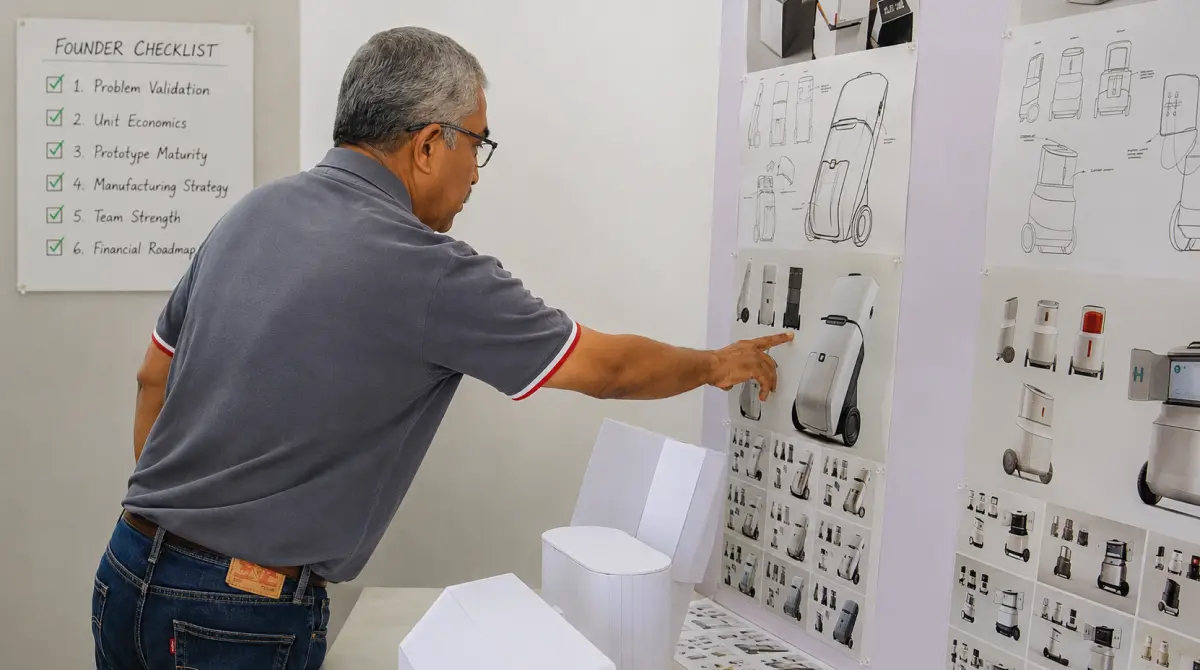
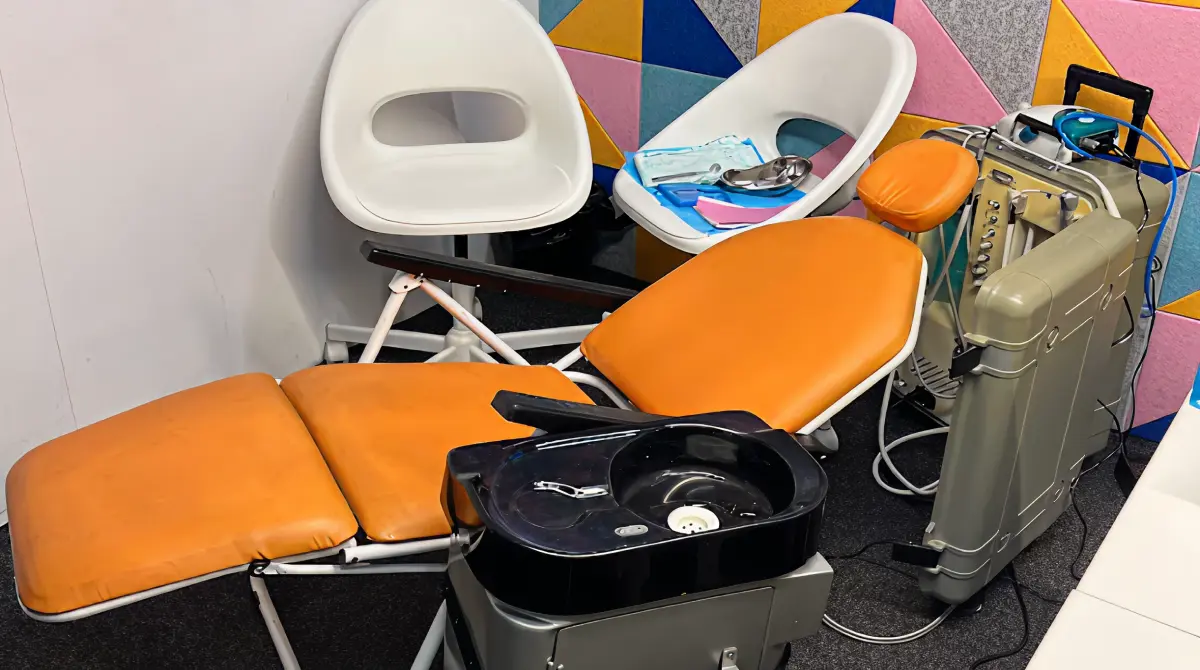
The first signal investors check in every hardware startup funding conversation is the strength of the problem evidence. They are asking whether you can prove that a large enough group of people experiences this problem frequently and painfully enough to pay real money for a solution today. That distinction between problem existence and problem evidence is the exact gap between an interesting pitch and a fundable hardware startup. Most founders understand their problem well. Far fewer have the depth of evidence to prove it at the level investors require before committing capital.
Customer development as a structured methodology exists precisely to help founders build that evidence before committing to a product direction. The practice of conducting thirty to fifty deep, open-ended interviews with real potential customers generates something that secondary market research cannot replicate: direct, first-hand knowledge of how real people experience the problem today, what they currently use to manage it, and exactly how much pain it creates. Investors recognize this type of evidence immediately in a pitch because so few hardware founders bring it to the table prepared and documented.
Hardware market validation at this stage requires founders to move beyond conversations and into measurable demand signals. A landing page that describes the product concept and converts visitors at ten percent or above tells investors the market is warm and receptive. A verified waitlist of five hundred emails from your target segment tells investors that real demand exists at scale. A letter of intent from a corporate buyer or distributor tells investors the market is commercially serious about purchasing the product. Any one of these signals transforms a pitch from theoretical to tangible and improves hardware fundraising readiness significantly.
The final dimension of problem validation that investors probe is the founder's depth of understanding of the competitive landscape. Who does your target customer use today to manage this problem? What are the specific gaps in those alternatives that your hardware product addresses more effectively? How does your hardware innovation create a genuine switching incentive strong enough to change established buyer behavior?
Founders who answer these questions with precision demonstrate a level of market immersion that builds investor confidence from the very first slide, signaling that the founder has been in the market rather than theorizing about it. If you want to learn how to build a hardware product from scratch, watch this video by the Analogy Design team featuring Divya Rao, Co-founder, Analogy Design. The video teaches you the step by step approach to building your dream hardware product.
What Strong Problem Validation Looks Like
Investors consider the following as genuine validation evidence before committing to a hardware startup:
- Thirty to fifty in-depth customer interviews with documented recurring pain points across all conversations
- A landing page for the product concept with measurable conversion data from real, tracked traffic sources
- A verified email waitlist of five hundred or more people from the confirmed target customer segment
- At least one letter of intent from a corporate buyer, distributor, or enterprise client with a real name attached
- Documented competitive alternatives and specific evidence of why users prefer your approach over current solutions
- Willingness-to-pay data collected from at least twenty confirmed potential buyers at your intended price point
- A pilot program with paying customers using the product in real conditions over a sustained period of thirty days
- Month-over-month growth in a measurable demand metric such as waitlist expansion or pilot customer referrals
- User testing documentation showing how product feedback led to specific, traceable design changes in the current version
- A bottom-up market size calculation built from real buyer conversations and verified willingness-to-pay data
2. Show Unit Economics Investors Can Trust
The second signal in every hardware investment evaluation is the unit economics of the hardware business model. Unit economics for a hardware company means the full cost of producing and delivering one unit, the price at which it sells through your chosen channel, and the gross margin that results. These three numbers tell an investor more about the long-term viability of your hardware business than any market size projection, customer testimonial, or feature demonstration can in a pitch meeting.
Hardware business unit economics are uniquely exposed to real-world friction that spreadsheet models built in early stages consistently underestimate. Manufacturing costs run higher at early production volumes because factories give better pricing at scale. Logistics costs for physical goods are higher and more variable than for digital products. Returns, warranty claims, and customer support for hardware products carry real replacement and labor cost that compounds as shipping volume increases. A hardware business that models itself on clean theoretical margins is almost always in for a painful correction the first time real-world friction enters the picture.
The founders who make investors confident in hardware startup funding conversations have done the full cost journey in real conversations rather than on a desktop spreadsheet. They have walked their bill of materials with a manufacturer and received actual component quotes. They have mapped their logistics cost per unit across each sales channel. They have built their gross margin model with real data behind every single line item. They can show an investor the path from their current per-unit cost at small production volume to their target cost at scale, along with a clear manufacturing strategy for achieving that cost reduction.
Investors also pay close attention to recurring revenue potential in any hardware business they evaluate. A hardware product that generates ongoing revenue through a software subscription layer, a consumable component that repurchases, or a data service built into the device is dramatically more attractive than a one-time hardware transaction.
Building a recurring revenue component into your hardware business model is one of the most powerful ways to improve startup valuation, extend the financial durability of the hardware business, and create the kind of long-term return that makes hardware startup investors willing to accept the category-level risk.
3. Build A Prototype That Commands Respect
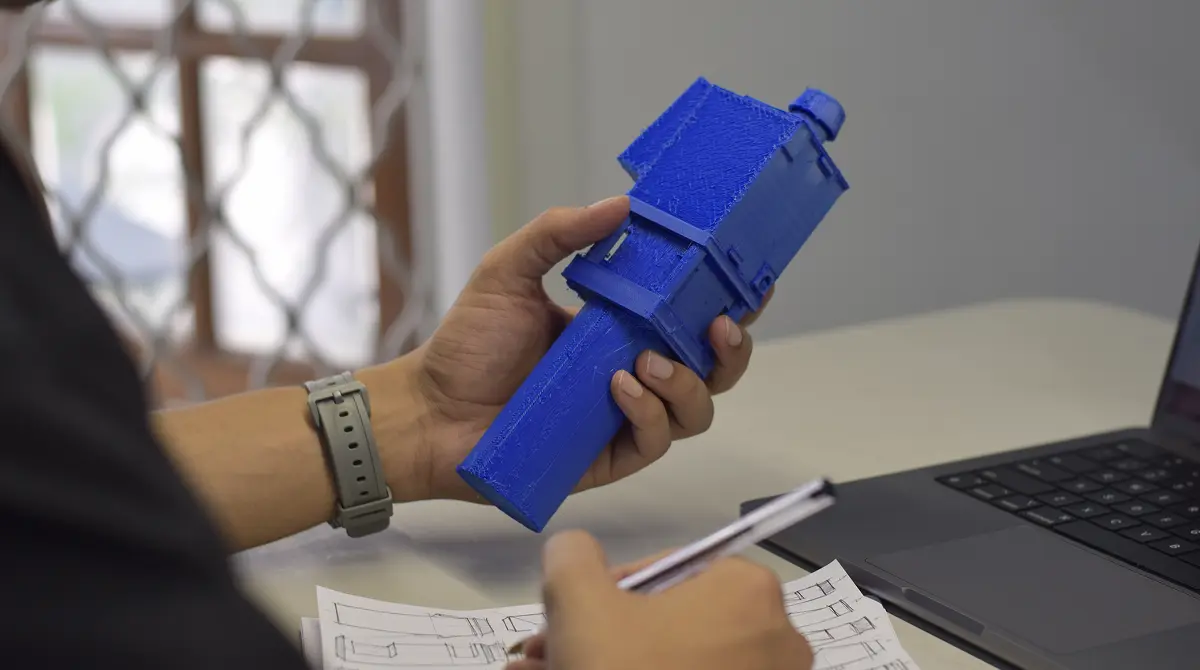
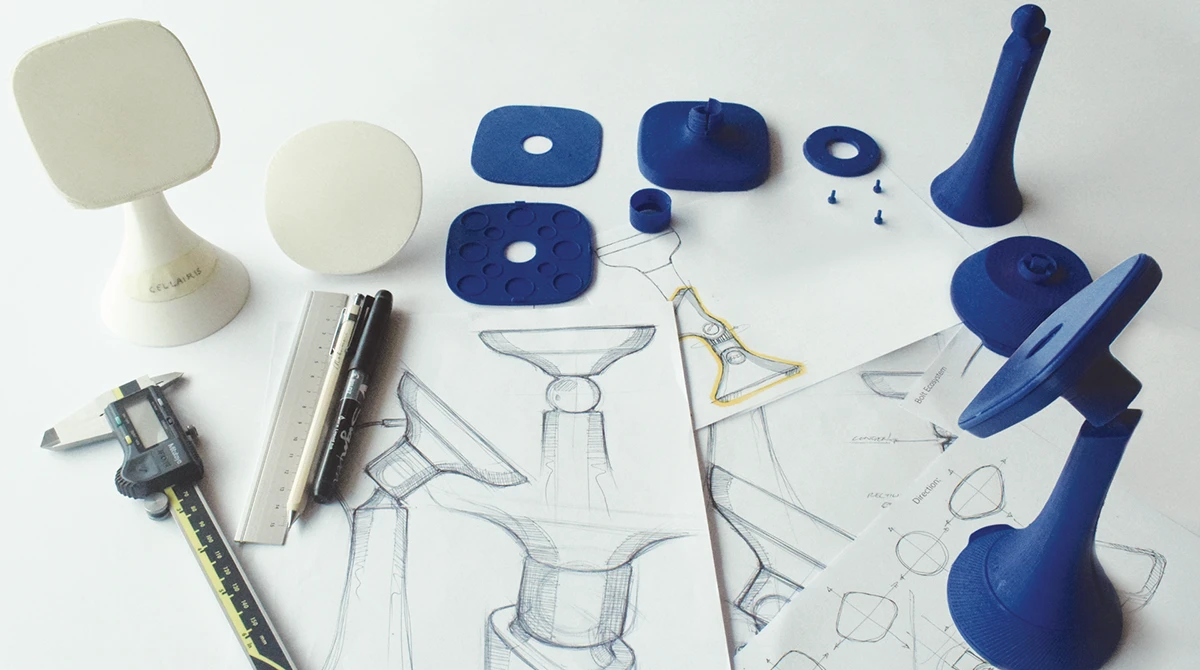
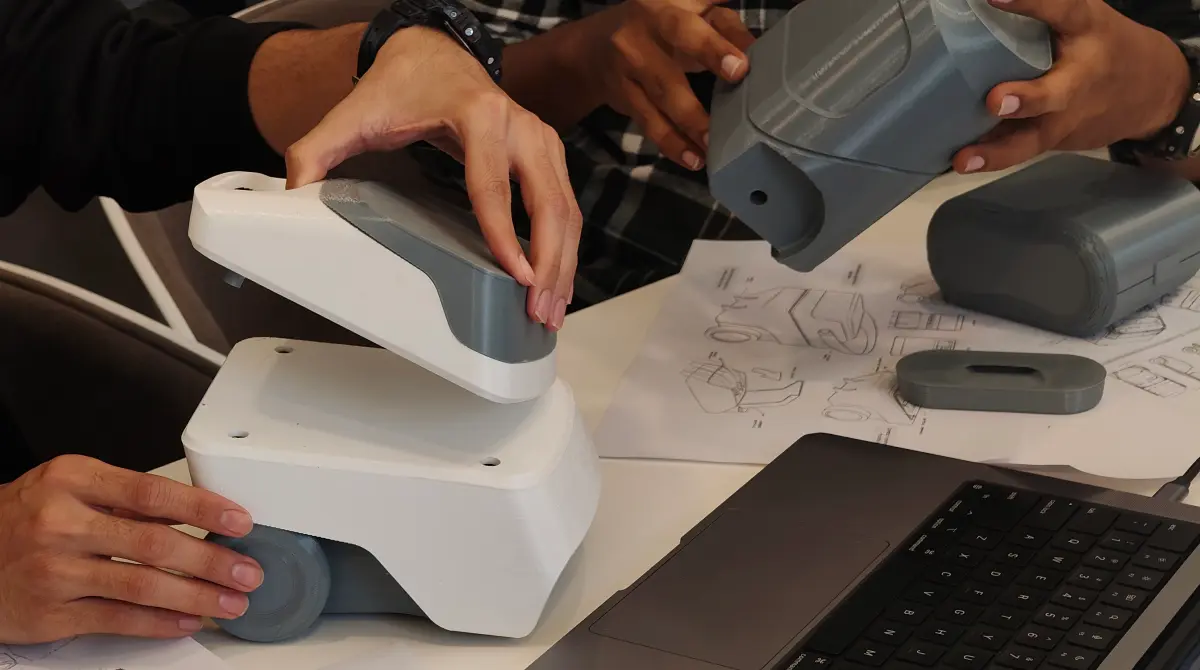
Hardware prototyping is the third signal investors look for, and it carries more weight than most first-time founders anticipate. A physical prototype that works reliably, feels well-engineered, and has clearly been through multiple design iterations communicates more than ten slides of market research. Hardware prototyping that has advanced to the point where the product can be held, tested, and evaluated during the meeting transforms an abstract investment proposition into a tangible reality that investors can form a direct opinion about. There are distinct stages of hardware prototyping that investors with experience in the category immediately identify and weigh differently. A proof-of-concept prototype demonstrates that the core technology works in principle. An engineering prototype demonstrates that the technology works in the correct form factor with the right components assembled.
A design validation prototype demonstrates that the engineering performs consistently across multiple units under real-world conditions.Each stage of hardware prototyping removes a specific layer of investor uncertainty, and knowing which stage you are at and what evidence it produces is essential preparation for every hardware startup funding conversation.
The detail that separates impressive hardware prototyping from fundable prototype development is evidence of real-world user testing with documented outcomes. A prototype that has been through thirty days in the hands of real users generates something invaluable: a feedback record that shows the product living in the real world. User feedback that led to specific design changes demonstrates the founder's ability to learn, iterate, and improve based on real evidence rather than assumptions. That iterative learning process signals to hardware investors that the team can respond to reality rather than to their own convictions.
Prototype development for investor-ready hardware also means taking the product beyond function and into considered, polished form. A prototype that looks like a well-designed, manufacturable product rather than a lab experiment builds both emotional and rational confidence simultaneously.
Checkout the AI Glasses for Mustard as an example of hardware prototyping taken through rigorous design validation to a level that commands immediate credibility in any investor room. That level of execution in prototype development changes the tone of every hardware fundraising conversation it enters.
Hardware Prototype Stages That Investors Recognize
Investors with hardware experience assess which of these stages your prototype has reached and weight their confidence accordingly:
1. Proof of Concept: Core technology works in a basic form without concern for final form factor or manufacturing constraints
2. Engineering Prototype: Technology works in the intended form factor with the right components, demonstrating the full functional experience
3. Design Validation Prototype: Engineering performs consistently across multiple units under real-world conditions with documented test outcomes
4. Pre-Production Prototype: Product meets all manufacturing specifications and passes initial quality testing at the target manufacturing partner
5. Pilot Production Unit: First units produced by the target contract manufacturer at small batch volume with formal acceptance criteria applied
6. Production-Ready Unit: Final product meets all certifications, retail specifications, and target cost at confirmed production volume
4. Have a Manufacturing Strategy Investors Trust
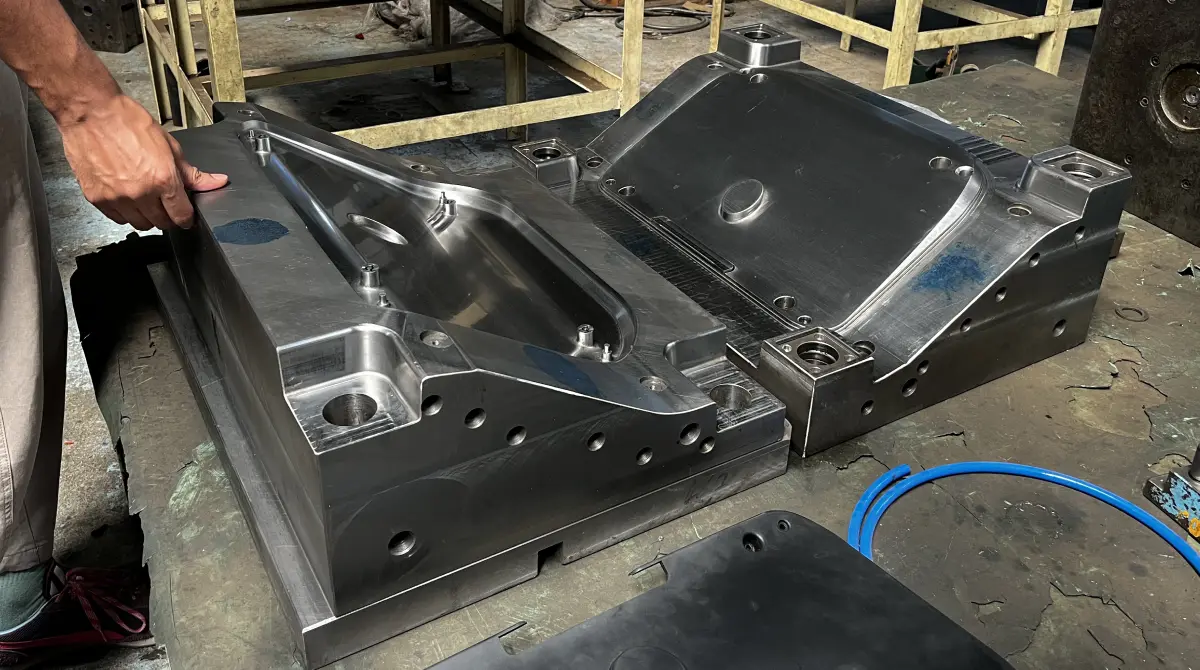
The fourth signal, and one of the most decisive in any hardware startup funding evaluation, is a clear and credible manufacturing strategy. First-time hardware founders almost universally arrive in pitch meetings with strong prototypes and weak production plans. Investors who have backed hardware companies through the full development cycle know that the gap between a validated prototype and a reliably manufactured product is filled with expensive surprises that most founders discover only after capital has been deployed rather than before it is requested.
A credible manufacturing strategy for hardware funding purposes needs to cover several specific areas. Your contract manufacturing partner by name, or a shortlist of three qualified factories you are actively evaluating. Your bill of materials with a sourcing strategy for each critical component and backup sources confirmed for single-source items. Your prototype to production timeline with realistic milestones and buffer time for tooling iterations. Your tooling cost estimate and the amortization plan across your target production volume. Your startup strategy for managing supply chain disruptions before they threaten production continuity.
Design for manufacturing is one of the most important and most frequently overlooked disciplines in early hardware product development. A hardware product designed with assembly, tolerance, and material constraints in mind from the beginning moves from prototype to production far more smoothly than one designed purely for function. Read our DFM guide for the principles that should be built into your hardware product development from the earliest design stage. Hardware investors probe DFM awareness specifically in pitch meetings because it is one of the most reliable signals of the team's manufacturing maturity.
The prototype to production journey is the stage where hardware supply chain risk becomes most visible and most costly if it has been ignored during the design process. A hardware business that depends on a single-source critical component from a concentrated geography carries a concentration risk that investors identify and flag immediately. Building supply chain resilience into your sourcing strategy, component selection, and manufacturing partner selection tells investors your startup strategy is grounded in manufacturing reality.
Founders who can speak fluently about dual sourcing, lead time management, and inventory planning show investors a depth of manufacturing knowledge that dramatically improves hardware fundraising readiness. Manufacturing readiness describes how close a product is to beginning a real factory production run with full confidence. A product with strong manufacturing readiness has had DFM principles applied throughout its design, has a finalized bill of materials with confirmed component lead times, has completed a preliminary manufacturing review with the target factory, and has a hardware quality assurance plan documented.
Presenting this level of manufacturing readiness in a hardware startup funding conversation separates founders who have done the real preparatory work from those treating manufacturing as something to figure out after the capital arrives.
Manufacturing Strategy Checklist
Every hardware founder heading into a hardware startup funding conversation should be able to confirm the following are already in place:
- A named contract manufacturing partner or a qualified shortlist of three evaluated factories with conversations initiated.
- A complete bill of materials with a component-level sourcing strategy and confirmed lead times from real supplier conversations.
- Backup sourcing identified for every single-source or critical-path component in the bill of materials.
- A prototype-to-production timeline with specific milestones and realistic buffer periods for tooling iterations.
- A tooling cost estimate with an amortization plan mapped across your target production volume ramp.
- A design-for-manufacturing review completed or scheduled with the manufacturing partner or a qualified DFM specialist.
- A hardware quality assurance plan covering incoming inspection, in-process assembly checks, and final product acceptance testing.
- A startup strategy for managing component shortages, supplier delays, and logistics disruptions without halting production.
- A cost-reduction roadmap showing how bill-of-materials costs decrease as production volume scales across the first three years.
- A pilot production plan specifying batch size, timeline, and acceptance criteria for the first real factory run.
5. Walk In With a Team Built to Win
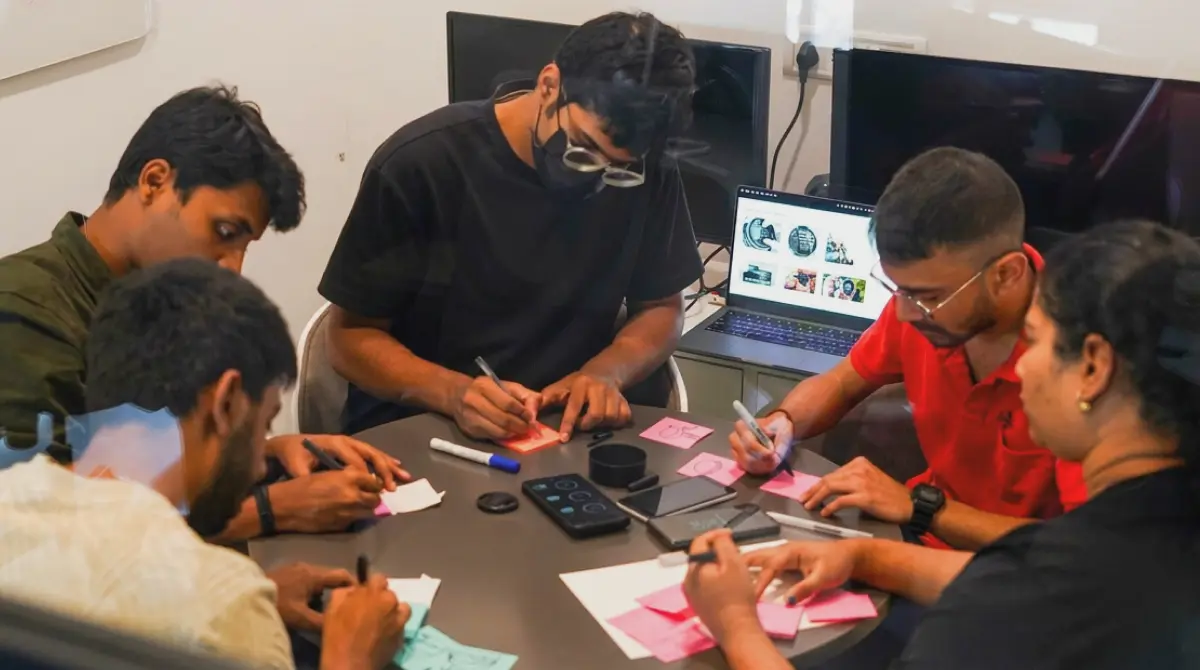
The fifth signal in every hardware investment evaluation is the team, and in hardware this signal carries disproportionate weight. Investors who fund hardware businesses have watched technically excellent teams fail because they lacked the manufacturing experience to bring products to market at a sustainable margin. They have also watched commercially capable teams fail because they lacked the engineering depth to solve production problems that arise during the prototype to production transition.
Both failures are expensive, and both trace directly back to the same root cause: critical competency gaps that were visible before the hardware seed funding was deployed and left unaddressed.
The hardware startup team that investors fund most confidently covers three distinct areas simultaneously. First, deep technical hardware expertise spanning product design, mechanical engineering, electronics, and firmware development, backed by a track record of shipping working hardware rather than only designing it. Second, manufacturing and operations capability from someone who has spent real time on factory floors, navigated a genuine prototype to production journey in a commercial context, and understands design for manufacturing and hardware quality assurance as practiced disciplines.
Third, commercial execution ability from a founder who has built customer relationships, signed distribution agreements, and grown revenue in the specific markets the product targets.
Hardware fundraising rounds are far harder to close for single-founder teams unless that founder carries a rare combination of all three competency areas and a strong execution track record to prove each of them. Investors understand that hardware is a team sport because the failure modes are so diverse and domain-specific. A hardware product can fail at the design stage, the manufacturing stage, the hardware quality control stage, or the market launch stage. A well-rounded team has navigated at least some of those failure modes in real commercial contexts, and knows how to apply that experience under genuine production pressure.
Building your team before the hardware startup funding process begins is one of the most powerful ways to improve your fundability before you ever enter a pitch room. Bringing in a fractional manufacturing advisor, a supply chain specialist, or an experienced hardware design studio as a committed partner signals to investors that you have already addressed the gaps they would otherwise identify as risk.
See how cross-functional hardware team execution translates into market-ready products through our iDiya Smart Wellness Device case study, and browse the Analogy Design blog for more resources built for hardware founders at every stage of development.
Team Competencies Hardware Investors Score You On
- Hardware investors evaluate founding teams against these competency signals during every pitch conversation:
- Hardware engineering depth spanning product design, mechanical engineering, electrical engineering, and firmware development, supported by proof of prior shipped products.
- Prior experience taking physical products from concept through production and commercial launch, with documented outcomes and measurable results.
- Manufacturing and supply chain expertise gained through real factory-floor experience in a commercial production environment.
- Hardware quality assurance knowledge covering incoming inspection, in-process testing, final validation, and defect management.
- Commercial execution capability demonstrated through prior sales performance, channel partnerships, or distribution agreements.
- Domain expertise in the target market, including customer needs, buying behavior, competitive landscape, and purchasing patterns.
- Regulatory and certification awareness relevant to the product category and intended geographic markets.
- Financial discipline demonstrated through capital-efficient hardware development and effective resource allocation in previous roles or ventures.
- A strong manufacturing network across contract manufacturers, component suppliers, logistics providers, and distribution channels.
- Resilience and adaptability demonstrated through successful responses to technical challenges, production issues, or market setbacks.
6. Build a Financial Roadmap They Believe
The sixth signal in every hardware startup funding evaluation is the financial roadmap. This document tells investors whether you understand how capital moves through a hardware business and whether the money they are about to commit will actually reach the milestones that reduce risk and create the foundation for the next round. A credible financial roadmap is the difference between a hardware funding ask that sounds precise and confident and one that sounds like an optimistic guess with a number attached.
Hardware startup valuation at the seed stage is heavily driven by the clarity and capital efficiency of the financial roadmap. Investors calculate whether the cheque they are writing will produce the proof points needed to justify a higher startup valuation at the next round.
A roadmap that shows the hardware business reaching design freeze, manufacturing partner selection, pilot production, and initial commercial sales within the funded runway is far more compelling than one that exhausts capital before any of those milestones are achieved.
Financial projections for a hardware business need to be built from the bottom up and grounded in real-world cost data rather than market-share assumptions. Revenue projections should come from specific customer conversations, identified distribution channels, and realistic conversion assumptions from your actual early pipeline. Cost projections should come from real supplier quotes, manufacturing partner conversations, and confirmed tooling estimates.
Investors identify hardware financial models built on real conversations within the first few minutes, and they treat those models with proportionally more confidence in every hardware venture capital decision they make.
The hardware startup funding ask itself needs to be structured with precision rather than a range. Determine exactly what milestones the capital needs to reach, build a line-by-line cost model for each development stage, and add a thirty percent contingency buffer across every line. Present the ask as a total tied to a specific milestone map rather than as an annual operating budget. This level of specificity tells investors that the capital will be deployed efficiently toward risk-reduction milestones rather than exploratively toward possibilities.
That signal alone can be the deciding factor when two comparable hardware companies are evaluated simultaneously for the same hardware investment allocation.
Financial Milestone Map: 12 Months Post-Funding
Structure your hardware startup funding deployment around these milestones to give investors a clear capital efficiency story:
Month 1 to 2: Design freeze and final product specification locked for manufacturing handoff.
Month 2 to 3: Manufacturing partner selected, contracted, and tooling initiation scheduled with confirmed dates.
Month 3 to 4: Tooling initiated with first article inspection timeline confirmed by the factory in writing.
Month 4 to 5: First article inspection completed and design-for-manufacturing corrections finalized.
Month 5 to 6: Pilot production run of 50 to 200 units completed with full hardware quality assurance testing applied.
Month 6 to 7: Regulatory certification submission completed and compliance testing in progress.
Month 7 to 8: Certification approval received and commercial production batch planned and scheduled.
Month 8 to 9: Commercial launch executed with initial customer orders fulfilled and shipped on time.
Month 9 to 10: First revenue milestone reached and initial customer feedback collection underway.
Month 10 to 12: Gross margin target achieved at current volume, with a scale roadmap confirmed for the next funding round.
The Hardware Funding Readiness Checklist
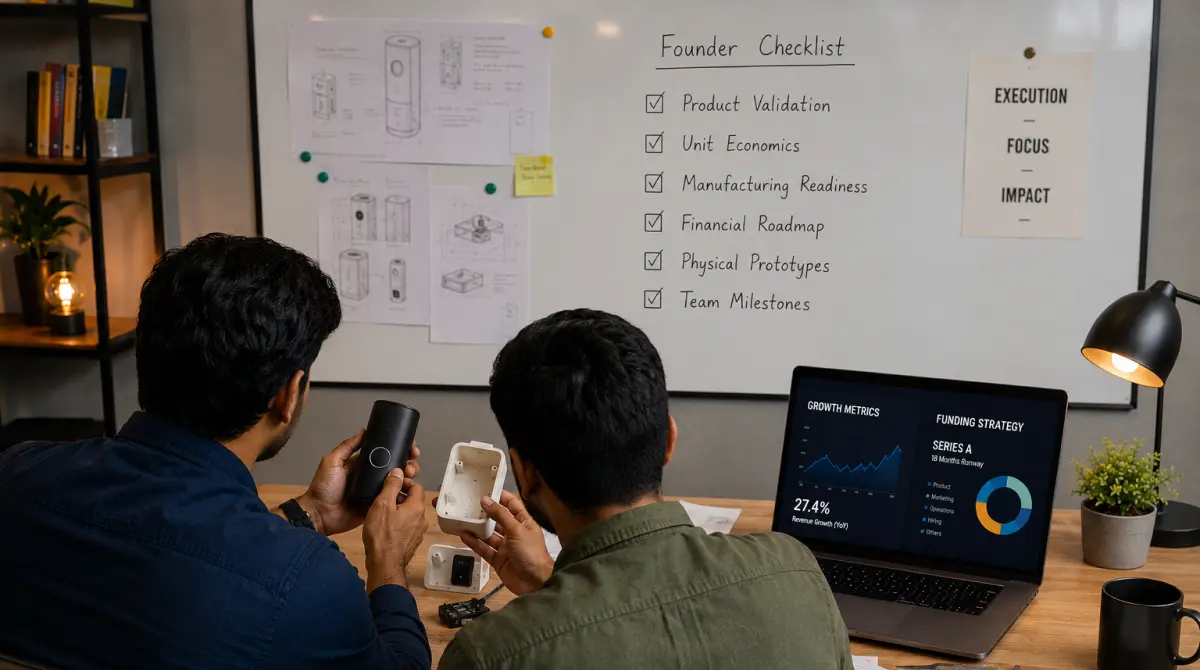
Before entering any hardware startup funding conversation, run through this checklist honestly and completely. Each item maps directly to the evaluation framework experienced hardware investors apply when they decide whether to move forward or pass. Every item represents a question you will face in every serious investor meeting, and every gap you address beforehand is a doubt you eliminate from the investor's decision process before the conversation begins.
Hardware founders who close rounds fastest are consistently the ones who have addressed every item on this list before scheduling their first investor meeting. Preparation at this level builds your actual hardware fundraising readiness and the quiet confidence that investors register immediately when a prepared founder walks through the door.
- Problem validation: Documented conversations with thirty or more potential customers showing three to five specific recurring pain points.
- Demand signals: A verified waitlist, confirmed pre-orders, or a signed letter of intent from a credible buyer in your target segment.
- Unit economics: A gross margin model built from real supplier quotes and manufacturing conversations at your target production volume.
- Prototype stage: A working prototype at the engineering validation stage or beyond, with real user-testing documentation on file.
- Manufacturing partner: A named contract manufacturing partner or an evaluated shortlist of three qualified factories with conversations underway.
- Hardware startup roadmap: An 18-month roadmap with specific milestones, deliverables, and capital allocation mapped to each stage.
- Financial projections: A bottom-up cost model with real data behind every line item and a thirty percent contingency buffer included throughout.
- Team coverage: A team covering technical hardware engineering, manufacturing operations, and commercial execution competencies.
- Supply chain map: Critical components identified with primary and backup sources confirmed, and component lead times documented.
- Quality plan: A hardware quality assurance plan covering incoming inspection, in-process checks, and final product acceptance testing.
Do This Before Your First Hardware Investor Meeting
Hardware founders who close hardware startup funding rounds fastest consistently do the following before the first meeting rather than learning from the first rejection. Each action below eliminates a specific doubt from the investor's mind before you say a single word in the room.
- Arrive with a working prototype investors can hold and interact with physically during the meeting itself.
- Know your unit economics at your target production volume and walk through them from memory with full confidence and specificity.
- Have your manufacturing strategy prepared at a level of detail that shows real factory-floor familiarity and genuine supplier conversations.
- Present your startup valuation anchor with a clear justification built on traction, team credentials, and comparable transactions in your category.
- Bring user-testing documentation that shows how real feedback shaped the current product iteration in specific, traceable ways.
- Research your investor's hardware portfolio and connect your pitch explicitly to their current investment thesis and existing hardware companies.
- Have a customer reference available who can speak to real product experience if the investor wants to verify your traction claims.
- Present your financial roadmap as a milestone map tied to capital deployment rather than as an annual operating budget by department.
Avoid These Patterns in Every Hardware Pitch
These patterns appear consistently in hardware pitches that lose the room. Awareness of them before you walk in gives you a meaningful preparation advantage over founders who discover them only after the meeting ends.
- Leading with feature lists before establishing the market problem and the evidence of customer demand in the target segment.
- Using top-down financial projections with no bottom-up grounding in real supplier quotes, manufacturing cost data, or customer pipeline assumptions.
- Glossing over supply chain strategy or presenting single-source component dependencies as temporary and easily resolved after funding.
- Operating with visible team competency gaps in manufacturing or commercial execution that no founding team member currently addresses.
- Asking for capital with a departmental budget rather than a milestone map showing what each dollar is expected to achieve.
- Responding to risk questions with optimism instead of presenting a documented mitigation strategy and a clear contingency plan.
- Presenting a prototype that looks finished on slides but has never been tested with real users in real-world conditions.
- Treating startup valuation as a negotiation tactic rather than a conclusion grounded in market data and comparable transactions.
How a Design Partner Boosts Your Fundability
One of the most powerful preparation strategies for hardware startup funding is working with a specialist design and engineering studio before entering the fundraising process. The gap between a founder-built prototype and an investor-ready hardware product is significant, visible, and immediately apparent to every hardware investor who has evaluated dozens of pitches. A well-chosen design partner closes that gap by elevating the prototype quality, building manufacturing readiness into the product from the ground up, and contributing the engineering credibility that hardware investors look for before they commit.
A great design partner contributes three specific things that directly improve hardware startup funding outcomes. First, they bring the prototype to a level of engineering polish and visual credibility that builds both rational and emotional confidence in the pitch room.
Second, they deliver the design for manufacturing assessment that signals to investors that the product is ready for a real factory production run. Third, they bring manufacturing network depth, supplier relationships, and process expertise that fills the team competency gaps hardware investors would otherwise flag as risk.
At Analogy Design, we have worked alongside hardware founders across India and globally to take hardware products from initial concept through rigorous design validation and into production-ready development. Our ergonomic toothbrush for Pepsodent and our backpack for Wildcraft both demonstrate the manufacturing-ready product development level that tells investors the team understands the complete journey from first sketch to retail shelf. That execution depth in a design partner builds investor confidence before a single financial number is presented.
Working with a specialist hardware design studio also gives you access to a manufacturing network, supplier relationships, and process expertise that most first-time hardware founders spend years building independently. That network compresses your hardware development timeline, reduces the execution risk investors are most concerned about, and gives your startup strategy a credibility layer that is very difficult to build from scratch.
Explore our services to discover how Analogy Design builds the investor-ready foundation for hardware startups across India and globally.
Hardware Startup Funding For First-Time Founders
Start Your Hardware Startup Funding Journey Today
Hardware startup funding rewards the founders who prepare with the same rigor they bring to their engineering. Every signal on this list, the problem evidence, the unit economics, the prototype quality, the manufacturing strategy, the team composition, and the financial roadmap, comes from decisions made and work done weeks and months before the first investor meeting. The founders who raise capital are the ones who arrive having already answered every question that most founders only discover after the meeting has ended.
Start building those six signals today with intention and a clear hardware fundraising timeline in mind. Map your customer validation evidence with documented conversations. Build your manufacturing strategy with real supplier quotes and factory conversations behind every line. Define your financial roadmap with specific milestones and capital allocation at each development stage. Address the competency gaps in your team before an investor finds them in the pitch room. Take your hardware prototyping to the level of engineering polish and credibility that commands genuine respect from any experienced investor who picks it up.
The founders who raise are the ones who show up most prepared, most transparent, and most credible in every room they enter. Preparation is the real competitive advantage in every hardware startup funding conversation, and it is entirely within your control.
Explore product market fit principles that apply directly to hardware. When you are ready to build the investor-ready hardware product that gets you funded, explore our services and start a conversation with the Analogy Design team today.For India-based hardware founders, the DPIIT startup resources provide access to government-backed funding programs, incubators, and policy frameworks that hardware startups across Bangalore, Mumbai, and Delhi can leverage as part of a broader hardware startup funding strategy.
About The Author

Vyasateja Rao - Founder, Analogy
Vyasateja Rao is a multi-award-winning product designer with over two decades of experience, and the visionary founder of Analogy, a Bangalore-based industrial and interaction design studio. He specializes in crafting memorable and innovative experiences for both physical and digital products. After earning a Masters in Industrial Design from North Carolina State University in 2007, Vyasateja worked across the United States, Hong Kong, China, Korea, Taiwan, Singapore, and India, collaborating with Fortune 500 companies and leading design studios. His studio has received international recognition, including the Red Dot, IBDC, Singapore Design Award, and multiple patents for product innovation. Vyasateja has designed for global clients such as Panasonic, Unilever, Amazon, Marvel, and Cellairis, blending creativity with manufacturability to create breakthrough products. Beyond design, he mentors aspiring designers, teaching the importance of contrast, surprise, and hidden artifacts in creating compelling experiences.