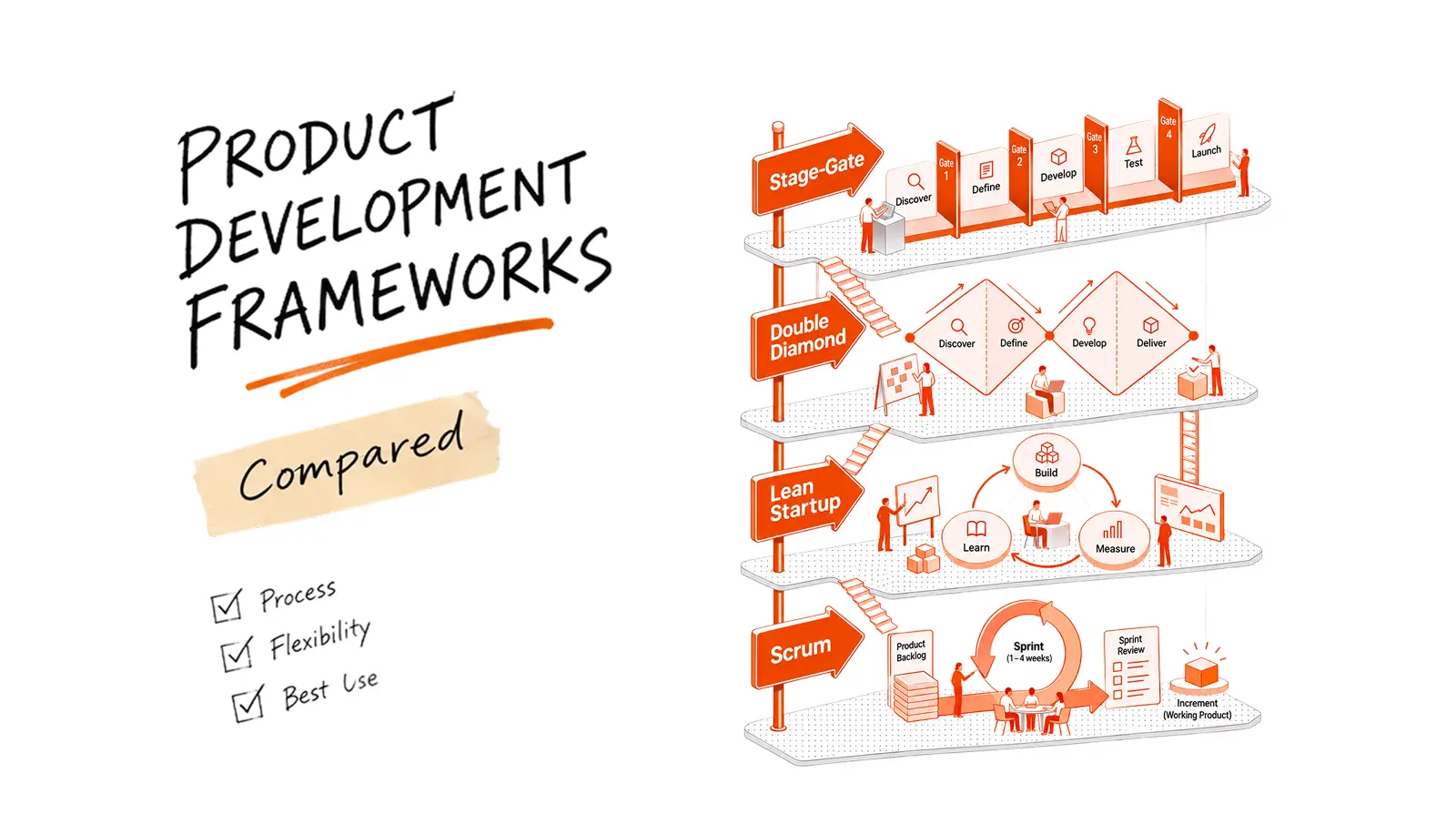
Product development frameworks are structured ways of deciding what to build and when to spend money on it. Four dominate: Stage-Gate, the Double Diamond, Lean Startup and Scrum. Each was designed to guard against a different, expensive mistake, and the strongest teams run one as their spine and borrow from the other three.
Ask four people which framework to use and you will get four answers. A manufacturing engineer draws a row of boxes with gates between them. A designer draws two diamonds. A startup coach draws a loop and says "pivot" at least twice. A software lead talks about sprints. All four are right about something, and none of them tells you which one fits your product.
That is the problem with treating them as rival methodologies. They answer different questions at different moments, and the skill is knowing which question you are facing now.
This guide compares the four side by side: where each came from, how it works, where it breaks and when to use it. Then it shows how to combine them, with a worked example for a physical product.
What a Product Development Framework Actually Does
Strip away the diagrams and every framework does the same job: it buys information before you commit money.
Robert Cooper, who created Stage-Gate, traces the idea to an interview early in his career. A senior venturing executive at GE told him that the whole new product process is a series of information-gathering activities: fill the knowledge gaps, reduce the uncertainty, and so manage the risk (Cooper, 2025). A customer interview, a sketch, a prototype and a beta launch are the same thing in different clothes.
That also tells you what a framework is really for. It exists to stop things. A framework that never kills a project, changes a brief or delays a spend is not doing its job.
Timing matters because cost is locked in early. A figure often quoted in design for manufacture, popularised by Geoffrey Boothroyd and Peter Dewhurst, is that 70–80% of a product's cost is fixed during design. Researchers have questioned how precise that number is (Barton, Love and Taylor, 2001; Ulrich and Pearson, 1993), so treat it as a rule of thumb. The direction holds: by the time you pay for tooling, the expensive decisions are already made. It is the same logic behind design for manufacturing.
Frameworks govern how you make decisions, not which steps you take. For the steps themselves, see our guide to the steps of product development.
The Four Product Development Frameworks at a Glance
Read the second column again. Each framework was built by people who had been burned in a particular way, and you can see the scar tissue in the design.
Stage-Gate: When Mistakes Are Expensive to Reverse
How it works
Work is split into stages. Between them sits a gate, where a cross-functional group decides to go, kill, hold or recycle before releasing the next tranche of money. Cooper compares a gate to the TV show Shark Tank, and insists Stage-Gate is an investment model rather than a project-management tool.
It grew out of his research into why new products succeed or fail. In a study of 203 products with Elko Kleinschmidt, the winners had a genuinely superior product, a sharp project definition backed by thorough up-front work, and real cooperation between marketing and technical teams (Cooper and Kleinschmidt, 1987). In a 2025 talk, Cooper says more than half of companies worldwide use Stage-Gate for physical products, citing PDMA's best-practice survey (Knudsen et al., 2023). That is the creator describing his own model's uptake, so read it as indicative.
Where it breaks
Gates drift into rubber stamps, which is why Cooper later argued for "gates with teeth" (Cooper, 2008). Run heavily, Stage-Gate also breeds paperwork; Cooper acknowledges that project teams rightly complain about make-work, and modern versions include a lighter variant for small projects. And its early stages can feel too linear when you do not yet know what the problem is.
Use it when
Spending is hard to reverse: tooling, certification, inventory, regulated products. Also when money arrives in tranches, from investors or a board, and each release needs a clear decision behind it.
Double Diamond: When You Might Be Solving the Wrong Problem
How it works
The UK Design Council launched the Double Diamond in 2004. Its 2007 study of design practice at 11 global brands, including Lego and Starbucks, described the same pattern of widening and narrowing twice. The first diamond finds the right problem (Discover, Define). The second finds the right solution (Develop, Deliver).
The Council is explicit that the process is not linear: what you learn often sends you back to the start. Its Framework for Innovation wraps the diamond in four principles: put people first, communicate visually and inclusively, collaborate and co-create, and iterate, iterate, iterate.
Where it breaks
It describes how to think, not when to spend or how often to ship. It has no built-in kill decision and no delivery cadence. In our experience, teams also treat it as a one-off workshop sequence that ends in a slide deck, rather than a loop they return to when evidence changes.
Use it when
The problem is unclear, the product is a service, or you are redesigning something that already exists. It is the natural partner for concept design, where the brief is still being written.
Lean Startup: When Nobody Knows Whether Anyone Wants It
How it works
Eric Ries published The Lean Startup in 2011 and gave product teams a vocabulary they still use: build–measure–learn, pivot, MVP. The loop is the point, and the aim is to go round it as fast as possible, then decide whether to pivot or persevere.
Ries defines a minimum viable product as the version that lets a team complete one full turn of that loop with the least effort and development time. It is an experiment wearing a product's clothes, not a rough release you will apologise for later. Our MVP validation framework covers this in depth.
Where it breaks
Lean was shaped by software, where an experiment can cost an afternoon. In hardware, every build costs real money and weeks of lead time. The MVP has to become a looks-like model, a works-like rig, a landing page or a pre-order campaign, not a shipped device. The other failure is using "MVP" to excuse a half-finished product with no hypothesis behind it.
Use it when
Demand, price or the customer is unknown. Run Lean experiments before you commit to engineering, and again whenever a major assumption changes. It pairs well with work to validate a hardware product idea.
Scrum: When the Team Is Drifting
How it works
The 2020 Scrum Guide defines three accountabilities: a Product Owner, Developers and a Scrum Master. The Product Owner orders work in a Product Backlog. The team pulls a slice into a Sprint of one month or less and delivers a usable Increment, with planning, daily, review and retrospective events built in. The 2020 revision added the Product Goal, because a team can run sprint after sprint and still travel in the wrong direction. Cooper notes that PDMA's research finds Agile is now the predominant way software products are developed.
Where it breaks
Scrum assumes you can produce something usable every Sprint. Physical builds often cannot. Cooper reports that hardware teams at firms such as Honeywell and Corning run sprints of one to three months, which is past the Scrum Guide's one-month limit. Hardware teams adapt Scrum rather than adopt it. And Scrum never asks whether the product should exist at all.
Use it when
The work is software, firmware or a companion app, or you are inside the development stage of a physical product and need visible, regular progress.
How the Four Frameworks Fit Together
Lay the four along a product's life and the overlap disappears. The Double Diamond leads at the start, when the question is "what problem?". Lean Startup takes over when the question becomes "will anyone pay?". Stage-Gate governs every decision to spend more. Scrum runs the build.
Cooper himself now advocates the Agile–Stage-Gate hybrid (Cooper and Sommer, 2016). The gates stay as investment decisions, while sprints run inside each stage. Sprinting is heaviest in the concept and development stages and tapers off near launch, once most questions have been answered.
In practice, that means you rarely choose a framework. You choose a spine, then borrow the rest on purpose.
How to Choose a Product Development Framework
Pick the spine that matches what is most expensive to get wrong. This is our judgement rather than a rule from any of the frameworks' authors.
The food row comes from evidence. A peer-reviewed study of failed beverage launches in Peru, which used Stage-Gate as its reference model, found two recurring errors: companies did not listen to consumers from the start, and they skipped pilot market tests (Alvarado Alarcón et al., 2018).
Underneath every row is one rule: match rigour to the cost of being wrong. A four-person team shipping a new checkout flow does not need five gates. A team about to commit to injection-mould tooling, where one change can mean a new tool and weeks of delay, absolutely does. For physical products, our hardware product development process guide shows where those gates fall.
A Worked Example: Four Frameworks, One Product
Here is a hypothetical, not an Analogy case study. It is the route we would expect a sensible team to take.
Picture a two-person team in Bengaluru with an idea for a countertop composter for apartment kitchens.
Double Diamond: finding the real problem
They start by talking to 20 households, not by sketching. The interviews show that the real problem is not composting at all. It is the smell and the flies that make people give up after a month. That one finding rewrites the brief, and two other ideas on their list are parked.
Lean Startup: testing demand and price
Next come foam mock-ups and a landing page with three price points. The mock-ups show the unit is too tall to fit under a standard wall cabinet. The landing page shows people clicking the middle price and almost nobody clicking the top one.
Stage-Gate: deciding when to spend
Now they write their first real gate. If the bill of materials for the core unit cannot hit a target set in advance, the project stops. Two more gates follow: one before tooling, and one after a field trial, before any production order is placed.
Sprints: building it
Engineering runs in short cycles, and each prototype answers one question. Does the odour filter work? Does the lid seal? Can you empty it with one hand? Thirty units then go into homes for six weeks. The trial catches what the lab missed: people overfill it at weekends. A fill line on the inside wall and a clearer instruction card fix it cheaply. Launch is one city and one online channel, and the support tickets become the brief for version two.
Stage-Gate was the spine because it was a physical product. Everything else was borrowed on purpose.
Common Mistakes With Product Development Frameworks
Most teams do not abandon their framework. They keep it and hollow it out. For traps specific to physical products, see the hardware startup mistakes that cost founders most.
Stage-Gate: gates that never say no
If every project that reaches a gate passes it, you do not have a gate. You have an event invitation. Write the kill criteria before the review, while nobody is emotionally invested.
Double Diamond: stopping at the first diamond
A beautifully defined problem with no tested solution is research, not development. Set a date by which the team must be building and testing ideas, not still discovering.
Lean Startup: calling a half-built product an MVP
Shipping something half-finished with no hypothesis and no measure is not Lean. It is just shipping something half-finished.
Scrum: sprinting without a Product Goal
Busy sprints feel like progress. Without a Product Goal that everyone can state, they can carry a team steadily in the wrong direction.
All four: adopting one wholesale
Every framework here is a loop with gaps its authors never meant it to cover. Teams that run one by the book, and treat a step backwards as failure, start hiding bad news to protect the timeline.
Three Questions That Tell You Which Framework You Need
Ask these before any piece of work, big or small.
- What is our most dangerous assumption? If it is about the problem, reach for the Double Diamond. If it is about demand or price, Lean. If it is about cost or feasibility, a Stage-Gate decision. If it is about delivery, Scrum.
- What is the cheapest way to test it? A conversation before a survey, a landing page before an app, a mock-up before code, one unit before ten.
- What result would make us stop or change course? Write it down before you start. "Four of five users complete an order without help" is a test. "People like it" is not.
Revisit the answers after every test. The riskiest assumption changes the moment you retire the last one, and so does the framework you need.
How Analogy Combines the Frameworks for Hardware Founders
Our process for physical products, Product Path™, uses a Stage-Gate spine with fast iteration inside each stage. It runs in four phases: concept and strategy, engineering and prototyping, manufacturing and scaling, and launch. Each phase removes one kind of risk and ends with a review of what we learned, what changed, and the plan and price for the next phase.
The early phase borrows from the Double Diamond and Lean Startup, and it does real work. In our experience, about 60% of founders change direction or pivot during the concept phase, which is where a change costs a conversation rather than a mould.
The Mustard AI glasses show what that combination does for speed. We took the product from idea to manufacture-ready hardware in 10 months, using concept design and rapid prototyping to validate comfort and form early, with design for manufacture built in from the start. Mustard was later acquired by Kaynes Technology.
If you are budgeting your own product, read our breakdown of hardware product development costs. Or tell us what you're building and we will tell you which gate you are at.
Sources
- Alvarado Alarcón, M., Alegre Valdivia, V., Martínez Utía, T. and Seclen Luna, J.P. (2018) 'Análisis de fracasos en el lanzamiento de nuevos productos en la industria de bebidas en el Perú a partir del modelo stage-gate', 360: Revista de Ciencias de la Gestión, 3, pp. 61–83. doi.org/10.18800/360gestion.201803.003
- Barton, J.A., Love, D.M. and Taylor, G.D. (2001) 'Design determines 70% of cost? A review of implications for design evaluation', Journal of Engineering Design, 12(1), pp. 47–58. doi.org/10.1080/09544820010031553
- Boothroyd, G., Dewhurst, P. and Knight, W.A. (2011) Product Design for Manufacture and Assembly. 3rd edn. Boca Raton, FL: CRC Press.
- Cooper, R.G. (1990) 'Stage-gate systems: a new tool for managing new products', Business Horizons, 33(3), pp. 44–54.
- Cooper, R.G. (2008) 'Perspective: the Stage-Gate idea-to-launch process — update, what's new, and NexGen systems', Journal of Product Innovation Management, 25(3), pp. 213–232.
- Cooper, R.G. (2025) The evolution of StageGate: integrating Agile and Lean for new product development. Snyder Innovation Management Center, Syracuse University. snyder.syracuse.edu
- Cooper, R.G. and Kleinschmidt, E.J. (1987) 'New products: what separates winners from losers?', Journal of Product Innovation Management, 4(3), pp. 169–184.
- Cooper, R.G. and Sommer, A.F. (2016) 'The Agile–Stage-Gate hybrid model: a promising new approach and a new research opportunity', Journal of Product Innovation Management, 33(5), pp. 513–526. doi.org/10.1111/jpim.12314
- Design Council (2007) Eleven Lessons: Managing Design in Eleven Global Brands. London: Design Council.
- Design Council (n.d.) Framework for Innovation. designcouncil.org.uk
- Knudsen, M.P., von Zedtwitz, M., Griffin, A. and Barczak, G. (2023) 'Best practices in new product development and innovation: results from PDMA's 2021 global survey', Journal of Product Innovation Management, 40(3), pp. 257–275.
- Ries, E. (2011) The Lean Startup. New York: Crown Business.
- Schwaber, K. and Sutherland, J. (2020) The Scrum Guide. scrumguides.org/scrum-guide.html
- Ulrich, K.T. and Pearson, S.A. (1993) Does Product Design Really Determine 80% of Manufacturing Cost? Working Paper 3601-93. MIT Sloan School of Management.