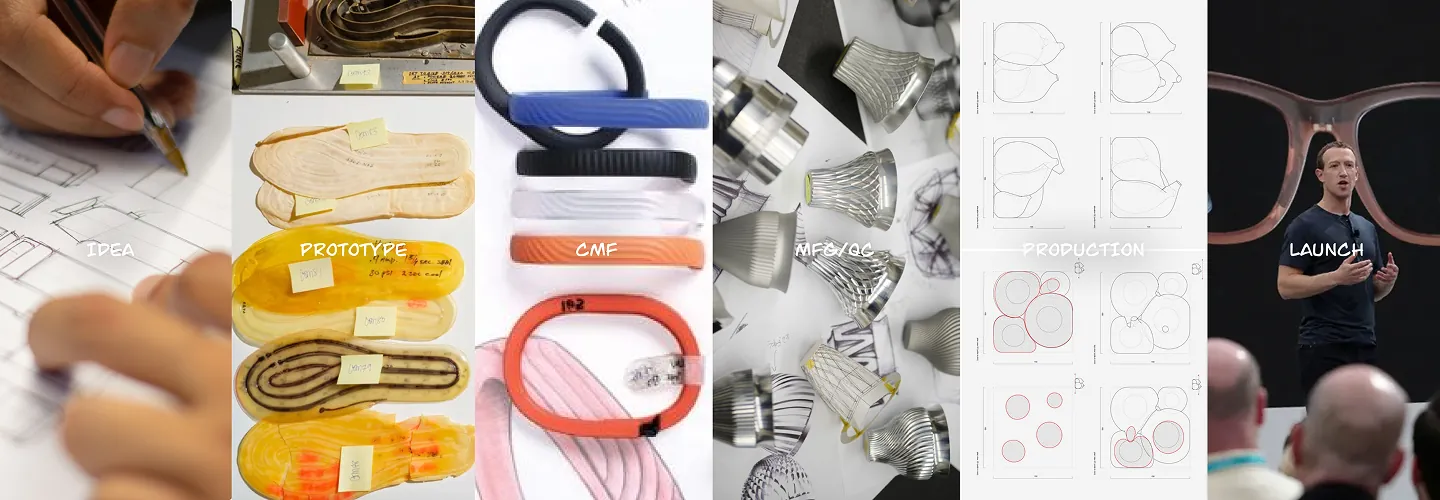
Ever had a brilliant product idea that keeps you up at night? You're not alone. You've taken the first step on an exciting journey of innovation. But that lightbulb moment is just the beginning. The road from idea to market can be daunting, especially when it comes to manufacturing your product idea.
There are a million questions swirling: How do you find the right manufacturer? What are the minimum order quantities (MOQs)? Will overseas production be a nightmare? Can you ensure quality control? Here's the good news: you don't have to become a manufacturing expert overnight. This blog is your one-stop shop for navigating the exciting, but sometimes intimidating, world of product creation. In this article we'll break down the complexities and guide you through the process step-by-step. This might also interest you: Guide on how to sell an idea.
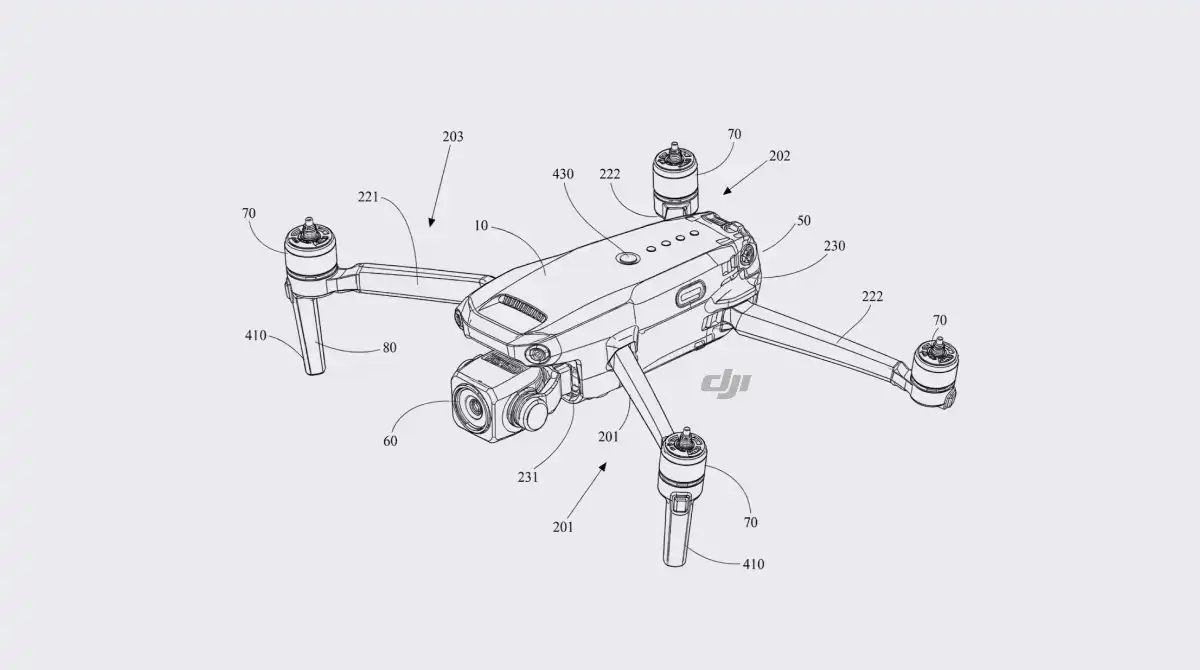
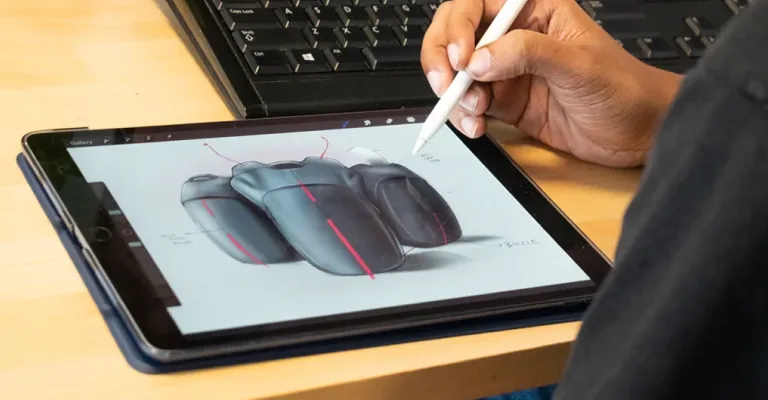
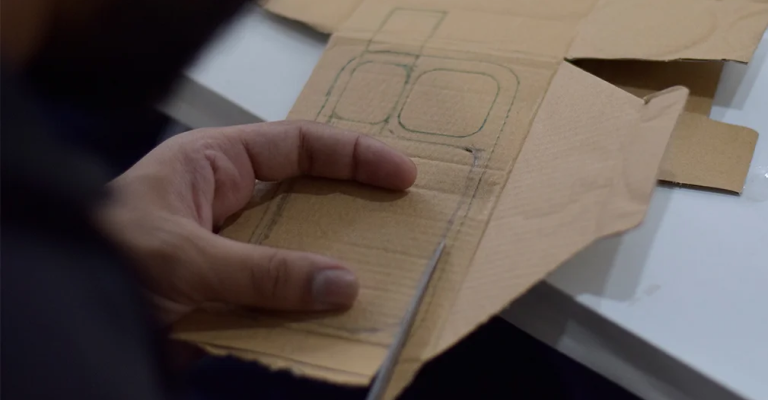
The first step on your exciting journey to getting your original product idea manufactured is bringing your invention to life. Here, you'll need to translate your vision into a tangible form. This can be done through detailed sketches, with clear dimensions and annotations. Consider using multiple views to showcase the functionality and form of your invention. 3D modeling software allows for even greater visualization, enabling you to create digital prototypes and test their feasibility. Don't underestimate the power of a basic cardboard prototype! This quick and inexpensive method can reveal potential design flaws and user interaction issues early on. Once you have a clear design, research potential manufacturers who specialize in your product's materials and complexity. Talking to experienced professionals can provide valuable insights into manufacturability, costing, and potential challenges. Read our comprehensive guide about developing a prototype.
Your prototype is a springboard for developing a new product, not the finished product itself. It's a powerful tool to gather user feedback and conduct thorough testing to refine your design. Analyze how users interact with your prototype – are there any awkward or confusing steps? Is it intuitive and easy to use? This feedback will help you identify areas for improvement. The refinement stage might involve redesigning components to enhance functionality or user experience. Consider optimizing materials to improve durability, weight, or cost-effectiveness. Most importantly, ensure your product meets all relevant safety and quality standards. Remember, a successful product solves a problem in a way that is user-friendly, safe, and well-made. Prioritizing user needs throughout the development process is paramount to achieving this goal. By constantly iterating and refining based on feedback and testing, you can transform your initial vision into a reality that truly benefits your target audience.
Ready to build?
Tell us what you're building.
We'll tell you where the real risks sit in your specific product and what it would take to ship it, concept to production.
1. Define Your Concept and Market Research
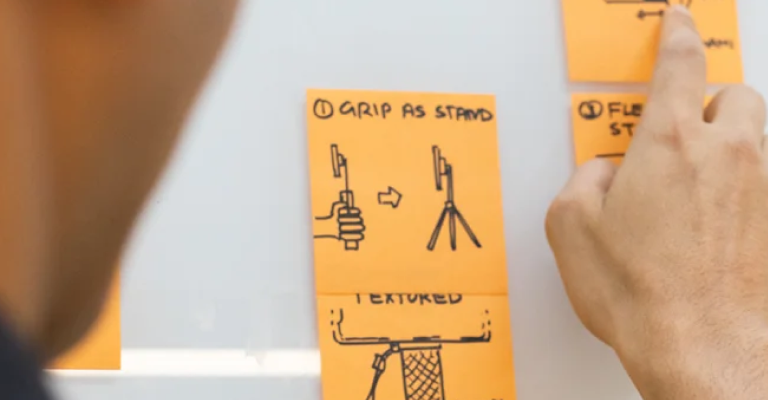
Before diving headfirst, take a step back and solidify your product idea. Read our guide on how to make a new invention idea. Clearly define its features, functionalities, and what unique value it offers to solve a specific problem. Research is key! Understand your target audience – who are you building this product for? Conduct thorough market research to analyze demographics, buying preferences, and current market trends. This knowledge helps refine your product concept and ensures it resonates with the right market segment.
Strong concept design is the foundation every successful product rests on, and it is far more than aesthetics. Founders who rush through the ideation phase often discover far too late that their product targets a market segment too small to sustain a business, or solves a problem the market has already moved past. Detailed concept sketching in product design forces you to confront the real form and function of your idea before committing any engineering budget to it. The discipline of drawing your product, even roughly, surfaces assumptions you were previously unaware of making. Concept validation through quick user interviews, competitor teardowns, and price sensitivity tests at this stage can save months of wasted development downstream. Market research and concept design should feed each other simultaneously and continuously, in both directions.
2. Protect Your Idea
Your innovative idea is your golden ticket. Protect it! Consult with legal professionals to draft non-disclosure agreements (NDAs) with anyone you involve in the development process. This ensures confidentiality and safeguards your intellectual property. Additionally, consider exploring patent, trademark, and copyright protections. These legal measures can prevent others from copying your invention or using your brand name, giving you a competitive edge.
Intellectual property protection is one of the most underrated steps in a hardware founder's journey, and one of the most consequential if skipped. Filing a provisional patent application gives you a 12-month window to test your product in the market while securing your priority date against any competing filings. Trade secrets, design registrations, and trademarks each protect distinct facets of your product's commercial value and they work best deployed together as a layered strategy rather than in isolation. Working with a qualified IP attorney from the beginning ensures the protections you put in place hold up under scrutiny, rather than collapsing the moment a competitor mounts a challenge.
The cost of legal counsel early in your journey is a fraction of what you will spend managing an infringement dispute after your product gains commercial traction. Treat your intellectual property as the genuine commercial asset it is, and protect it with the same seriousness you would apply to any significant financial investment.
Internal protection practices carry as much weight as the formal legal structures surrounding your product. Every vendor conversation, co-founder discussion, and manufacturing partnership should begin with a signed NDA before any substantive design or technical details are shared. Maintain detailed records of your ideation process, including dated sketches, version-controlled CAD files, and design decision logs, because this paper trail becomes critical evidence if your priority date is ever challenged.
Hardware businesses that treat IP as an afterthought typically find themselves negotiating from a weak position precisely when the product begins to gain the commercial momentum they worked so hard to build. Build the habit of documenting and protecting your work at every stage of development, and those habits will repay you enormously when you need them most. Your idea is your most valuable early-stage asset; give it the protection it deserves from day one.
3. Design the idea
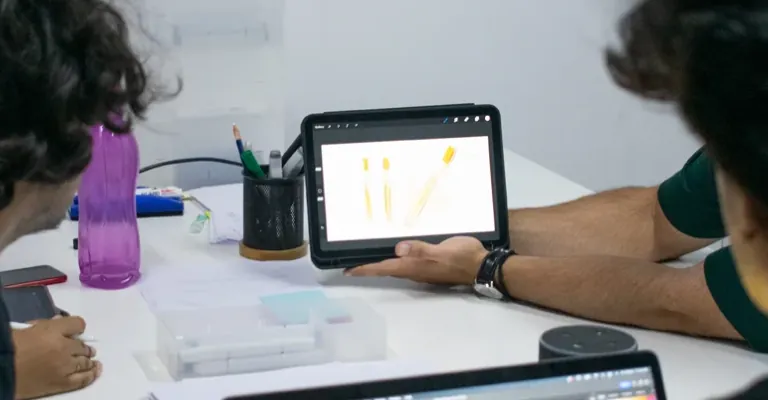
The design phase is where your vision takes shape. Here, consider both the practical and aesthetic aspects of your product. Think functionality – will it work smoothly and fulfill its intended purpose? Material selection is crucial, impacting cost, durability, and user experience. Prioritize features that address customer needs and manage resources to ensure cost-effective development. Don't forget user-friendliness – design a product that's intuitive and enjoyable to use. Remember, aesthetics aren't just about looks; they influence brand perception and marketability.
For a successful design process, consider collaborating with a designer or design team. Their expertise can help translate your vision into a product that excels in both function and aesthetics. They can guide you through material selection, user experience (UX) design, and visual identity to create a product that resonates with your target audience.
The design phase is where most hardware startups quietly lose money before production has even begun. Choices made here, around material grades, wall thicknesses, fastener types, surface finishes, and tolerance requirements, ripple directly into your per-unit manufacturing cost in ways that compound at every production volume. Bringing mechanical design expertise into conversation with industrial design at this stage, rather than sequentially after aesthetic decisions are locked, prevents the expensive conflicts that arise when a beautiful concept turns out to require exotic tooling or complex multi-step assembly.
A product that looks striking in a render but demands a six-slide mold will bleed your margins dry the moment production scales to real volume. The concept design services at Analogy Design integrate engineering thinking from the very first concept phase, so aesthetics and manufacturability develop together rather than in opposition. The most commercially successful product designs are simultaneously beautiful and manufacturable, and that outcome requires both disciplines in the room at the same time.
4. First working copy of an invention
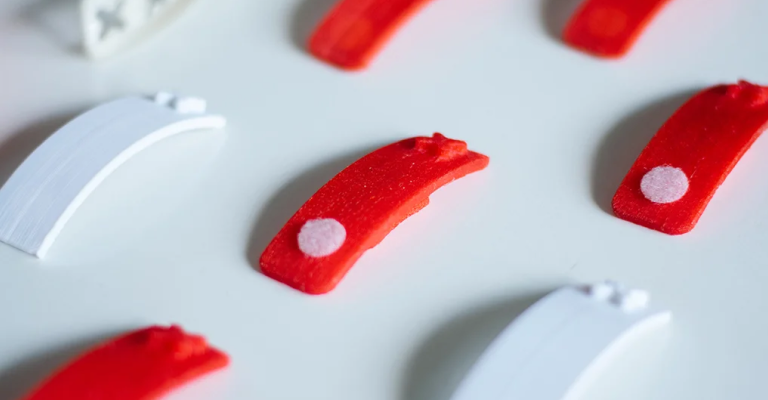
Now, bring your concept to life! The prototype is your first working model, a tangible representation of your idea. Collaborate with professionals like engineers and designers to create a minimum viable product (MVP). An MVP focuses on core functionalities, allowing you to gather user feedback and refine your design before full-scale production. Early packaging design plays a role here too. Packaging influences user experience and can impact pricing decisions. Consider preliminary packaging designs alongside developing a prototype to ensure a cohesive product offering.
Concept validation through your prototype is also your strongest asset in investor conversations and early customer commitment discussions. A working model in someone's hands converts curiosity into genuine conviction far more powerfully than any slide deck or photorealistic render ever will. Many hardware startups use the prototype phase to collect pre-orders or letters of intent that validate real demand before committing to expensive production tooling, which significantly de-risks the capital commitment. Prototype testing should simultaneously begin stress-testing your bill of materials for real-world component availability and supplier lead times across different seasons and geographies.
A component that sources easily in India during one quarter may carry a 12-to-16-week lead time from an overseas supplier during another. Building this supply chain awareness into your prototype phase protects your launch timeline from delays that are entirely avoidable with early foresight.
Ready to build?
Tell us what you're building.
We'll tell you where the real risks sit in your specific product and what it would take to ship it, concept to production.
5. Finding a Manufacturer for your product idea
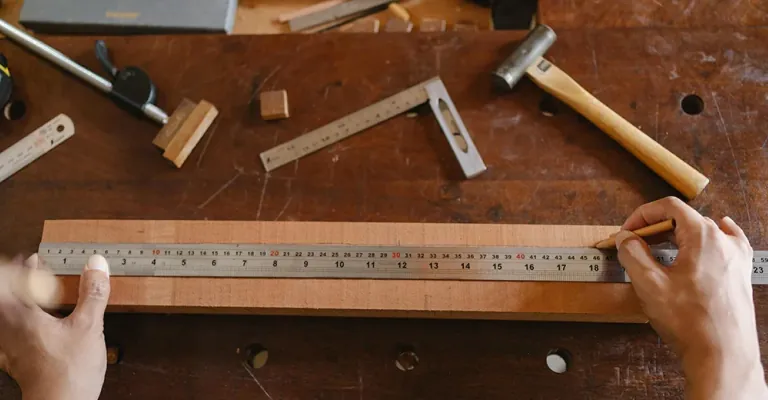
So how do you get your idea manufactured? With a solid prototype, it's time to find the perfect manufacturer to bring it to life. Prepare detailed specifications outlining your product's materials, dimensions, and functionalities. Provide potential manufacturers with samples and clear expectations. Don't limit your search – explore both domestic and overseas options, weighing factors like cost, turnaround time, and quality control standards. Beyond cost, consider the manufacturer's working conditions and environmental practices. Request quotes and samples for comparison before making a final decision.
Finding the right manufacturer is as much about culture and communication as it is about production capability and quoted unit cost. A factory with excellent machinery but poor responsiveness will frustrate you through every engineering change, quality dispute, and timeline negotiation. Visit shortlisted manufacturers in person wherever possible, walk their production floor, and observe how quality control is handled in real time rather than relying on their sales presentation. Ask specifically about their experience with products in your category, request client references from companies at a similar scale, and pay close attention to how they respond to detailed technical questions about your design. The manufacturer you choose becomes an extended member of your product team for years, so cultural compatibility and communication quality matter alongside raw capacity and equipment specs.
Manufacturing partnerships built on transparency and shared expectations consistently outperform those driven purely by the lowest unit price on the initial quote.
Overseas manufacturing in markets like China, Vietnam, and India's own industrial clusters offers competitive unit costs but introduces coordination complexity that demands deliberate planning across every milestone.
6. Finalizing Manufacturer Agreement
A clear and well-defined contract is crucial for a successful manufacturing partnership. Ensure the agreement outlines expectations and timelines for production, delivery, and quality control. Specify minimum order quantities and pricing structures. Don't be afraid to negotiate terms that benefit both parties. Consider involving a legal professional to review the contract, ensuring its enforceability and protecting your interests. Remember, a strong contract safeguards your investment and sets the stage for a smooth manufacturing process.
Pricing structures within your manufacturing agreements deserve thorough scrutiny at the negotiation stage, well before any tooling commitment is made. Understand the full cost breakdown, including materials, labor, overhead allocation, and the factory's operating margin, so you can identify where genuine savings are achievable as your volumes grow. Minor design changes, such as converting a two-part glued assembly into a snap-fit configuration, can produce significant unit cost reductions while leaving user experience entirely intact. The design for manufacturing service at Analogy regularly identifies exactly these opportunities during manufacturing readiness reviews conducted before tooling kickoff.
Build price renegotiation triggers into your agreement, linked to specific volume milestones, so your unit cost improves automatically as your order quantities scale. Approach your manufacturer as a strategic partner and treat pricing as a shared optimization exercise rather than an adversarial negotiation between opposing interests.

7. Logistics Planning and Testing
Don't underestimate the importance of logistics! Finalize how your product will be transported from the manufacturer to your warehouse or distribution centers. Streamline delivery processes to ensure timely and cost-effective fulfillment of customer orders. Invest time in testing and refining your chosen logistics solution. Conduct trial runs to identify and address any potential bottlenecks. A well-oiled logistics system ensures your product reaches customers quickly and efficiently, contributing to a positive brand experience.
Import and export regulations, GST documentation, BIS certification requirements, and e-waste compliance obligations all affect your logistics architecture in India, and they vary significantly by product category and technical specification. Bypassing any of these compliance steps can result in shipments held at customs, regulatory fines, or product recalls that damage your brand reputation and consume your working capital at the worst possible moment. Working with a freight forwarder and customs broker who specialise in consumer electronics or hardware categories eliminates most of this regulatory risk before it materialises. Build landed cost calculations that include duties, freight, insurance, packaging materials, and last-mile delivery directly into your retail pricing model from the very beginning.
The launch support service at Analogy addresses these go-to-market readiness questions as part of every product handoff. A product that reaches its customer on time, in perfect condition, at a healthy margin is the result of logistics planning that started during product design.

8. Preparing for Manufacturing Challenges
The road to manufacturing isn't always smooth. Anticipate potential challenges that can disrupt production or delivery timelines. For example, unexpected demand surges or raw material shortages can occur. Develop contingency plans to mitigate risks. Consider agreements with the manufacturer for emergency stock availability and rush order processes. Open communication and a proactive approach can help you navigate unforeseen obstacles and ensure a steady product flow.
Design for manufacturing (DFM) is the discipline that prevents most manufacturing crises before they ever begin. When your design team systematically analyzes every feature of your product for its impact on tooling complexity, assembly efficiency, and quality consistency, you surface problems on paper rather than on the factory floor at enormous cost. The complete DFM guide walks through this analysis process in depth, covering draft angles and parting lines, tolerance stacking, assembly sequencing, and material selection implications.
DFM analysis typically reduces tooling costs by identifying geometric features that create unnecessary mold complexity, such as sharp internal corners, thin walls adjacent to thick sections, and undercuts that require side actions. It also reduces assembly time by reorganizing component counts and fastener types for line efficiency and reduced operator error at volume. Every hour your team invests in DFM before tooling is cut saves approximately ten hours of corrective action after tooling.
Common manufacturing challenges beyond tooling include surface finish inconsistencies, color matching failures, dimensional variation between production batches, and component substitutions by the factory during material shortages. Each of these has a root cause traceable to the design or specification stage, and each is far easier and cheaper to address in advance than to correct once production has begun. Surface finish inconsistencies typically originate from insufficient parting line control or suboptimal gate placement in injection-molded components. Color matching failures arise when specifications rely on approximate visual references rather than precise Pantone or RAL codes defined against a specific substrate type and process condition.
Running through a thorough DFM checklist before locking your design for tooling catches the vast majority of these root causes while changes remain inexpensive. In manufacturing, preparation is consistently the most reliable and cost-effective form of quality control you can apply.
Ready to build?
Tell us what you're building.
We'll tell you where the real risks sit in your specific product and what it would take to ship it, concept to production.
9. Manufacturing your product idea and Monitoring
It's finally happening! Production is underway, and your vision is becoming a reality. Don't take your foot off the gas pedal just yet. Monitor quality control procedures during the initial production ramp-up phase. This ensures your product meets the high standards you've set. While manufacturing is underway, it's prime time to launch your marketing campaigns. Generate excitement and build anticipation for your product's arrival. Consider offering pre-order opportunities to incentivize early customer engagement. By effectively managing production and building pre-launch buzz, you'll be well-positioned for a successful product launch.
While the factory runs, your marketing engine should already be building momentum toward launch day. Pre-launch campaigns, product waitlists, and content that documents your product journey generate organic interest and build an audience primed to purchase the moment inventory is available and cleared. Social proof from beta users or prototype testers, even brief informal testimonials, dramatically improves conversion rates for hardware products where tactile experience drives purchase confidence.
Many successful hardware startups have leveraged their manufacturing journey as a content series, sharing behind-the-scenes glimpses of factory setup, quality testing, and packaging design that build authentic brand credibility. Aligning your mvp launch strategy with your production timeline ensures your entire go-to-market motion is ready the moment your inventory clears final inspection. A product sitting in a warehouse with zero audience is just capital tied up in cardboard boxes.
When Your Design Ignores Manufacturing Reality
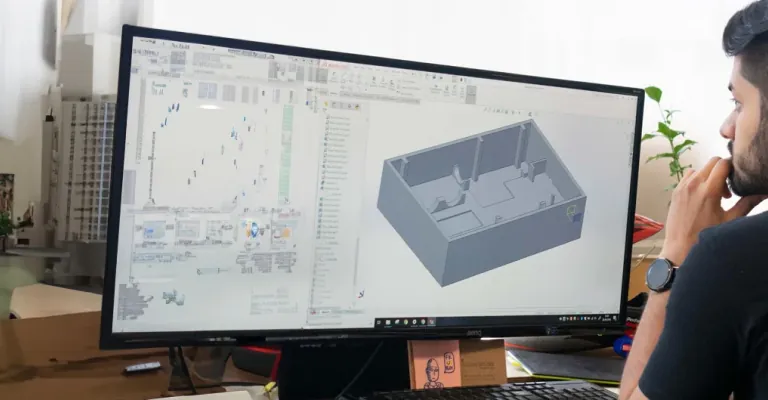
The gap between a beautiful CAD render and a product that a factory can produce consistently and profitably is where hardware startups lose the most money across the entire development cycle. A design that prioritizes aesthetics in isolation, without accounting for tooling constraints, material behavior, and assembly sequence, generates engineering change orders that can delay your launch by months and consume budget earmarked for marketing or initial inventory. Every ECO after tooling has been cut carries a direct cost: the mold must be modified, new samples must be approved, and your production timeline shifts accordingly. Harvard Business Review's research on product development cycles reinforces exactly this finding, showing that manufacturing changes made after tooling commitment carry disproportionate costs compared to design-phase modifications.
Founders who have lived through this describe it as paying twice, because you effectively redesign portions of the product after already investing in the manufacturing tools. Understanding common hardware startup mistakes reveals that design-to-manufacturing misalignment is consistently among the top causes of budget overruns and launch delays in the hardware world.
Specific design features that create manufacturing complications include:
- Sharp internal corners in injection-molded parts, which create stress concentrations leading to cracking and require additional mold machining time
- Thin wall sections adjacent to thick ones, causing differential shrinkage that produces cosmetic sink marks on exterior surfaces
- Geometric undercuts requiring side actions in the mold, significantly increasing tooling cost and mold maintenance complexity
- Excessively deep ribs or bosses, which extend cycle time and create fill and warp issues in the molded part
- Uniform wall thickness violations, where thick-to-thin transitions create knit lines and dimensional instability at volume
Surface finish and color consistency are two areas where design decisions carry major manufacturing implications that founders frequently overlook until samples arrive. Specifying a high-gloss class-A surface finish on a part with a complex parting line requires exceptional mold polishing, tight temperature control at the injection press, and rigorous handling protocols throughout assembly to prevent surface damage. Gloss surfaces reveal every imperfection that matte or textured surfaces hide, making quality control far more labor-intensive and every production batch subject to a higher rejection rate. Color consistency across a production run requires precise material formulation, controlled resin drying procedures, and tightly managed process parameters at the molding press.
These requirements must be written into your product specification and your manufacturing agreement explicitly, or the factory will default to its own standard practices, which may fall short of your expectations.
Scale Production Without Losing Quality
Production scaling is the phase that separates hardware companies from hardware startups in a way that most founders only fully understand after experiencing it. Delivering 200 units from a pilot run is a fundamentally different engineering and operations challenge from delivering 20,000 units across multiple production batches with consistent quality on every piece. The quality systems, supplier relationships, and process controls that perform well at small scale frequently require significant reinforcement to hold at volume, and the gaps tend to appear in exactly the places you least expect them. Founders who plan for this transition from the design stage build products that scale gracefully; those who defer the thinking until the third or fourth production batch often discover quality issues their first run never surfaced.
The Lean Enterprise Institute offers extensive frameworks for building the production systems that make scaling work without sacrificing the quality standards your brand depends on. The shift from startup to scaling company is as much an operations discipline as a product design one.
Quality culture is perhaps the hardest element to scale in a manufacturing partnership. At low volumes, a small dedicated team catches most defects through manual inspection and personal attention. At high volumes, quality depends on process design, measurement systems, and a factory-floor culture where defect prevention is every person's responsibility. Investing in your manufacturing partner's quality capability, through shared training resources, calibrated inspection equipment, and transparent defect reporting systems, delivers consistent output at every volume level and every production shift.
Many of the real-world DFM examples in consumer products demonstrate how quality systems built into the design stage, rather than added after production problems surface, produce substantially better outcomes when a product scales. Quality at volume is designed in from the start; it is almost impossible to inspect your way there after the fact.
Conclusion
This journey from concept to getting your product idea manufactured is an exciting one, filled with challenges and triumphs. Remember, even the most brilliant product idea needs room to evolve into a true invention. Embrace user feedback, adapt to changing market dynamics, and never stop iterating. By constantly refining your vision based on real-world insights, you'll transform your initial spark into a product that not only solves problems but resonates deeply with your target audience. The road ahead may be winding, but with dedication, perseverance, and a user-centered approach, you'll be well on your way to turning your innovative idea into a resounding success.
Ready to build?
Tell us what you're building.
We'll tell you where the real risks sit in your specific product and what it would take to ship it, concept to production.